Showing posts sorted by relevance for query post-bundling. Sort by date Show all posts

Friday, August 7, 2015

Post-Bundling -- Packaging Better TV/Video Value Propositions with 20-20 Hindsight


[SEE UPDATES AT END 
WSJ report on cost, viewership,
Disney's ESPN moving in this direction?

"Risk-Free" Subscriptions to The Celestial Jukebox?]

The increasing shift from bundles of TV channels to Over the Top (OTT) and "a la carte" -- or at least "skinny bundles" or re-configurable bundles -- has raised cheers and fears -- and now a broad stock market decline -- but I suggest we should be thinking about a different kind of "post-bundling" future.

The answer is for bundles to become dynamic, and on-demand -- not post-bundling as in after bundles go away, but post-bundling as in defining bundles after the viewing. Alfalfa, one of "Our Gang" comedies' "Little Rascals" had the answer in 1936: "Pay As You Exit."

This may seem strange, but think about it. What sense does it make for me to choose ahead of time what channels I want to be able to watch in a given month? Does Spotify ask me to choose what record labels I will want to listen to? How would I know?

This also bears on the broader migration from pay TV networks on cable and satellite, to OTT services like Netflix, as given new immediacy by this week's market sell-off of traditional TV companies. Still more broadly, this idea of post-pricing and post-bundling can be beneficial for almost any kind of content aggregation, as expanded on below.

What I propose is that TV/video distributors let viewers select a special post-bundled plan that offers "run of house" access to all available programming, and then applies bundled package rate discounts to that month's viewing -- after the viewer household has made its choices, program by program. Note that this differs from simple "a la carte" which charges a non-discounted rate for a given channel or program. (It has been suggested that a la carte will actually raise costs to consumers, but that does not reflect the idea that a sensible a la carte plan should include package discounts.*) It also differs from skinny or changeable bundles, which still must be pre-set in advance, even if easily changed from month to month. The idea is to apply quantity discounts, much like in current bundling, but do it in a way that lets viewers choose what to watch with a minimum of constraints.

Such a scheme can give viewers full choice, match that with appropriate levels of billing, and open up a whole world of programming that has been walled off. It may hurt some programmers who have gotten a monopoly benefit by locking in a channel slot, but will help programmers who are able to find a public, without being arbitrarily gated by the distribution system.

This can be done with conventional pricing methods, but can be far more effective with the more flexible, value-based FairPay model described in this blog, as explained further below.

Busting the dam of bundling

Channel bundling is a historical accident, based on the fact the cable and satellite TV distribution systems could only carry a limited number of channels, and had no on-demand capability. The distributor had to allocate those channels well in advance to match demand. Furthermore, it was impractical to charge consumers based on programs watched, so prices were for unlimited viewing of a bundle of channels.  Since different households had different viewing habits and budgets, a range of bundles were offered at different price levels, and with some flexibility as to which channels were in the bundle.

None of that makes sense in our new world of Internet-based TV, where any program can be provided on demand. It remains a knotty problem for the economics of distributors and TV programming networks, but that too shall pass. They have resisted fiercely, but the dam seems to be breaking as a growing list of incumbent players test the waters or consider it.

Similar issues apply in a somewhat different form to OTT SVOD "channels" like Netflix and Hulu -- see my post "Beyond the Deadweight Loss of 'All You Can Eat' Subscriptions." Hints at the turbulence resulting from the busting of the dam, even for these OTT services, is provided in a VideoNuze article, "Why SVOD Services Are At Risk Of Being Downgraded by Consumers to Transactional VOD," showing how our current business models just do not make sense, and concluding:
All of this underscores how uncertain things are for everyone in the TV and video ecosystem. In our Uber-crazed world, consumers are being trained to expect services on-demand and pay only for what is valued and used. Continuously fine-tuning their video services for those actually being watched will become the norm, a huge departure from the traditionally inert world of pay-TV subscriptions. [emphasis added]
Simple Post-bundling

The idea is simple. Let viewers pay for what they use, and do it in a sensible way that corresponds to the value they get. Current bundles (regular or skinny) do not do that, a la carte does not do that (not without discounts), and flat-rate SVOD does not do that. Viewing is irregular and unpredictable -- the only way to determine its value is after it is logged.

Instead of selecting a bundle from a menu beforehand, we need to be able to consume dim sum-syle, and then see what we used, and then price that with an aggressive discount schedule (unlike simple dim sum). A simplistic un-discounted dim sum at a la carte prices would be overpriced, and consumers will fear running up unexpectedly high charges. But it is easy to do better, with discount tiers for various levels of viewing, and for various mixes of premium content.
  • Pricing should factor in not only which channels were viewed, but how many shows (and maybe even which ones). 
  • Tiered plans could give prices similar to current bundles, but with the flexibility to dynamically alter the bundle. 
  • Usage factors could reasonably be set so a bundle of many lightly viewed channels might cost no more than a bundle of a few heavily viewed channels. 
  • A degree of usage related pricing would better track to value.  That could limit the cord-cutting of light viewers, and obtain fair increases in revenue from heavy viewers (with price caps to maintain affordability). 
  • Consumers could be alerted when they approach various budget thresholds, so they need not fear nasty surprises. 
FairPay post-bundling

Even greater tracking to value -- and consumer friendliness -- can be obtained with the FairPay cooperative pricing process (see overview). This provides greater flexibility in matching the value proposition to the consumer, and in protecting the consumer from pricing shocks to their budget.
  • With FairPay, the distributor can propose prices for the past month based on a post-bundling discount schedule, but the consumer has leeway to soften the effect of spikes due to high usage (in terms of number or type of programs viewed). 
  • The distributor balances this consumer power by determining whether the consumer is being fair over the life of the relationship, and the ability to revoke the FairPay privilege of those who are consistently not fair enough, sending them back to conventional set-pricing plans for their future viewing. 
  • Since there is little actual cost to short periods of unfairly low pricing, this serves to grow a larger and more loyal customer base, while weeding out those found not to pay fairly for the value they receive.
Why subscribe to channels?

As the VideoNuze article points out, subscribing to channels makes no sense in an on-demand world. This actually applies to both cable channels and OTT services, since either way, a la carte pricing threatens their survival.
  • Traditionally, channels got viewer revenue by being packaged in cable/satellite systems. Post-bundling can readily apply there, administered by the distributor. Some long tail channels that enjoyed subsidies in excess of their value will have to retarget their production models, but those that had no channel slots could find new life in a more open post-bundling world.
  • For OTT, free-standing long tail services will find it hard to justify $5-10 per month from more than a small cadre of dedicated viewers. But aggregators like Netflix and Hulu can make them accessible to an entire world of viewers. 
  • Even high-end channels will find the going tough. Is CBS really worth $5.99/month? To some maybe, but to most people, probably not -- not once every other channel tries to get a fixed slice of our wallet.
  • And even Netflix should move on from its one-size-fits-all model. Holding its fees to a set $8.99/month means it cannot offer much premium content (nor can it appeal to those on very low budgets) -- sooner or later that inflexibility will become a real problem -- and the spotty availability of prime movies already is a problem. With flexible post-bundling, Netflix could afford to offer all of CBS, HBO, ESPN, etc., and a full catalog of movies. Netflix should be the Spotify of video!  

The very idea of a long tail channel becomes questionable -- their curation model must shift from a channel (24 hours of content) to a brand (a continuing supply of desirable content, maybe less continuous, but well curated).

Content wants to be free  ...as in free speech, not free beer

This is the whole new value proposition of the Internet age -- its an "inter-network," remember! Content providers keep trying to wall-off their content (in "walled gardens"), but the manifest destiny of the Internet keeps breaking those walls down. Post-bundling is the pricing model for the Internet age, the age of the Celestial Jukebox. Why can't we access anything we think we will value, and then pay a fair price for whatever that turned out to be? This obviously applies to music (Spotify) and why not news, magazines, books, etc. An earlier post explained how a similar form of post-bundling could expand the market for travel guides, such as when taking a multi-country cruise to one city (=program) in each of several countries that were each covered in different guidebooks (=channels).

The Celestial TV Jukebox

It is time for TV/video providers to embrace the new consumer-driven on-demand world. I don't care if I watch my programs from CBS or HBO or Showtime or Netflix -- I care about watching specific programs. Channels are no longer "channels." They are simply content brands that I may come to have some interest and trust in. Why should I buy a "channel" and pay for programs I don't watch?

It is time to think about the answer Alfalfa found: "Pay As You Exit" -- bundle in arrears -- post-bundle. Finding the right way to do that will take some experimentation, and be disruptive to the incumbent networks and distributors, but the sooner we get started, the sooner we will find our way out of the wilderness to reach the land of milk and honey. It seems clear that some of the incumbents have begun to take this sea change seriously, and this week's wake-up call in the stock market adds evidence that we are approaching an inflection point.

[More on post-pricing and value-based strategies in this newer post: Finding Value in The Subscription Economy]

====================================
*The analysis of a la carte pricing in the Barro NYTimes article, Irwin's follow-up, and in Wikipedia, seems flawed not only by ignoring the role of volume discounting, but also by assuming that the technology of pay TV distribution will continue unchanged. Barro says that channelized distribution argues for bundles:
Think of it this way: If I put my bag in an overhead luggage bin, you can’t put your bag in the same spot, so it makes sense to charge me personally for my use. But if I watch Bravo, that doesn’t stop anyone else from watching the same show. When a good is “nonrivalrous” like a cable signal, giving it to me doesn’t stop anyone else from using it or add production costs at the margin. In those cases, it can make sense to throw lots of stuff into one package, whether or not I’ll actually use it.
But that is obsolete technology. It may take time to change over, but cable operators already send a mix of TV channels along with a separate Internet stream down the same pipe to our cable modems -- that can carry any channels desired, as it now does for OTT services like Netflix. (Even the "cable TV" channels now use Internet Protocol in their dedicated channel slots.) As I pointed out in a 2006 post, cable operators can shift capacity between these pipes, and they continue to gradually increase the capacity of the Internet pipe. With some simple equipment changes their plant can shift to all IPTV, with no fixed channels. (Doing that system-wide will take some time and money, but not that much.) So the technical reason that made bundling economical is now disappearing.

The skeptics also point to the psychic cost of being nickel-and-dimed, but there are ways to counter that as well. I suggest that post bundling goes a long way toward softening that, and the even softer post-bundling of FairPay makes that even more comfortable.

As to the more fundamental economics, a recent WSJ article puts it plainly: "Selling packets of channels to subscribers once made sense, but not so much anymore." It makes even less sense once you think about post-bundled packaging discounts.

====================================

[UPDATE 4/2/19:  See this generalization and expansion, 
"Risk-Free" Subscriptions to The Celestial Jukebox?

[UPDATE 8/30/18: The Information reports on "AT&T's Plans for Changing TV"]

The Information published a very interesting interview with AT&T Communications CEO John Donovan that shows movement toward the more value-based pricing that I am suggesting. I commented there:
Looks like it takes a telcom guy to realize the TV industry biz model has no clothes!
"The existing television business is hugely lucrative because channel owners get paid regardless of who watches." The telcom industry has long known that flat-rate subscriptions are economically inefficient for everyone, and consumers can be happier with usage based models when done with "the customer value proposition" in mind.
I don't agree that mid-range bundles need to be ad-subsidized if they are smartly usage based (all levels could be, if desired to reduce costs -- or not). What Donovan calls "engagement pricing" I would view as volume-discounted usage pricing, and would design pricing to map to the value of whatever usage level that is. To do that, apply what I call "post-bundling" -- let the user watch whatever they want, and price it based on what they actually watched -- with a discounted price that corresponds to that specific mass-customized bundle -- after the distributor and the customer both know just what it is for that month. Details are in my post, “Post-Bundling – Packaging Better TV/Video Value Propositions with 20-20 Hindsight” [this post]
---
[UPDATE 3/22/17:  WSJ report on cost, viewership]
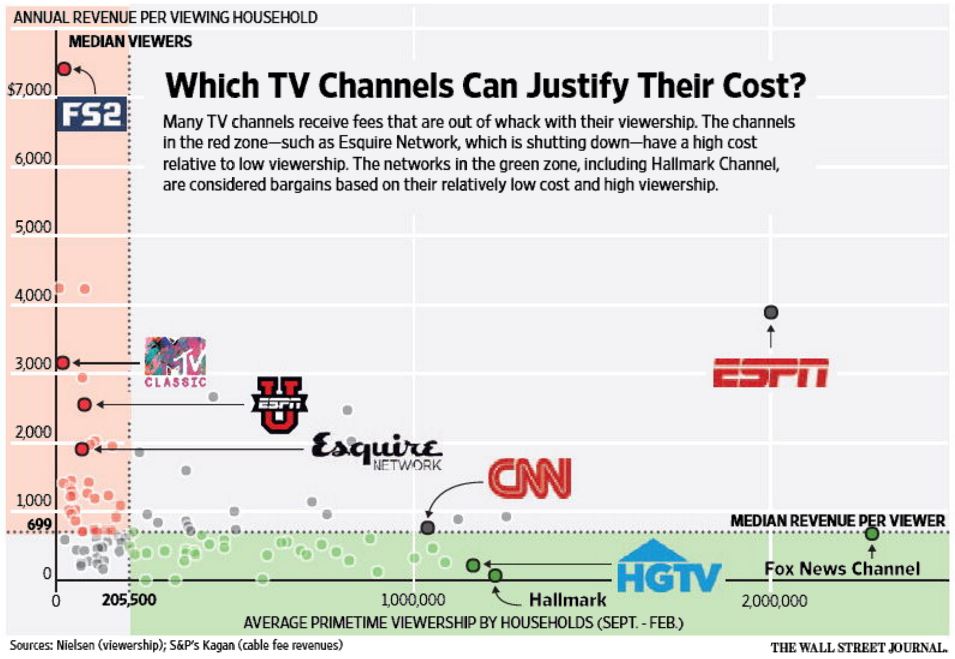
This perverse economics of TV channel-based models for costing and pricing continues to grow as a problem for both legacy cable businesses and upstart OTT providers -- and the content providers who supply them. Today's WSJ article title and subtitle drive this home: "Small Cable Channels You Pay for—but Don’t Watch—Are Dying. But don’t expect your bill to decrease as networks go away."

This report points out how dramatically the cost per viewer varies. with rarely-watched channels like Fox Sports 2 and MTV Classic costing many thousands of dollars per year per viewing household, compared to a median of $699 (and of course the more highly viewed cost outlier, ESPN at $3,885, for its barely over 2 million viewers). Some of the channels are nothing but reruns! What a waste! Some channels have made a killing on this, but it is time the industry got its house in order, and moved on to provide real value at a fair price.

There is a constant drumbeat of news reports on the decline of pay-TV bundles, and of the difficulties faced by the growing number of skinny bundles.

When will the industry move beyond all of these silly bundles? We don't need no stinking bundles! What we need is value-based pricing for what customers actually watch.

[More Updates:

Thursday, October 13, 2016

Continuing Chaos in Cord-Cutting Value Propositions...

"The Definitive Guide to Cord-Cutting in 2016, Based on Your Habits," by Brian X. Chen of the Times, notes that:
Every quarter for the last few years, hundreds of thousands of American households have put an end to their TV subscriptions, fed up with the costs of cable subscriptions, channels they never watch and the annoying commercials. 
But he writes this guide because:
What we found was there is no one-size-fits-all solution because each streaming service carries a different catalog of content, and each gadget has access to different services.
He also notes the fundamental flaws in current TV packages, both from cable and cord-cutting services:
For value, cutting the cord isn’t very cheap if you then subscribe to multiple services to gain access to a diverse set of content. For cable subscribers, paying one bill is less of a hassle than juggling multiple bills. And even after you subscribe to multiple streaming services, there is still some content that you may miss out on because it is available only via cable or satellite, like some TV shows or live sports events. 
But for cable, "all you can eat" gets expensive for those who are not gluttons. The real problem is highlighted in this quote from Kirk Parsons of J.D.Power:
“I would love to have the ability to pick and choose what I want as opposed to having four different services,” Mr. Parsons said. “I think we’ll get there, but right now it’s frustrating for consumers to get what they want.” 
A Post-Bundling future

A ready solution to this chaos is offered in a post I did last year, Post-Bundling -- Packaging Better TV/Video Value Propositions with 20-20 Hindsight. Consider the heart of the problem:
  • Cable packages offer channel bundle discounts for moderate and high numbers of channels, but offer little adaptivity to what you actually watch in a given month.
  • OTT packages are "skinny bundles" of fewer channels.
  • "A la carte" pay per view lets you pay for just the shows you watch, but at one-off prices that are prohibitive if you watch many shows.
  • Why is there no volume discount for just what you watch????
The solution is simple. Post-Bundling lets you have run-of-the-house, and watch whatever you want, then calculates a discounted price for just those shows. The pre-set discount schedule can be comparable to a full or skinny bundle, depending on how much you watch (and how much of that is premium programming). For more, see that post.

A simple step toward the win-win future of FairPay

Readers of this blog know that FairPay takes this idea of post-pricing and marries it to deep customer participation in pricing. It does that in an adaptive process that personalizes pricing to match the individual consumer value received. Doing that takes some sophistication on the part of the seller, since the discount schedule is no longer pre-set, but adapts to additional variables such as how pleased you were with the programs you watched in a given month. But basic post-bundling (with pre-set discount schedules) is a very simple step in the right direction, one that can set the stage for an even more win-win future beyond that. Both steps are good for the customer and good for the TV distributor. It will bring the distributor more profits from more and happier customers -- and give them better understanding of how to please their customers.

-------------

For a full introduction to FairPay see the Overview and the sidebar on How FairPay Works (just to the right, if reading this at FairPayZone.com). There is also a guide to More Details (including links to a video).

Even better, read my highly praised new book: FairPay: Adaptively Win-Win Customer Relationships.

Friday, June 22, 2018

Upending the TV Pricing Model -- Why Pay For What You Don't Watch???

AT&T reportedly will "upend the established model in which cable and satellite-TV companies pay programmers fees based on how many subscribers have a channel accessible in their bundle, regardless of whether they watch it." AT&T's new "'skinny bundle' of channels" will be free to subscribers on unlimited data plans Drew FitzGerald reports in the WSJ, and "...the free version that comes with unlimited-data plans would only count subscribers that spend significant time using the app, according to a person familiar with its plans."

This seemingly simple change represents an important break from tradition -- a necessary step toward more sensible, value-based pricing models for TV/video. It opens the way for a variety of new consumer-value first pricing models.

I have written about why this is urgently needed and where this should go, in “Post-Bundling – Packaging Better TV/Video Value Propositions with 20-20 Hindsight.”  Updates to that post explain why this is increasingly a life or death issue for pay-TV providers.

("Post-bundling," alone, is a fairly straightforward half-step toward the much more advanced customer-value-first models suggested by my FairPay strategy -- as also noted in that prior post.)

Let's hope this crack in the dam of tradition will lead to an increasing range of better offerings.

Wednesday, January 24, 2018

Making "Pay As You Wish" More Equitable -- Sustaining the Met Museum (and Others)

The Metropolitan Museum of Art in NYC stirred up a lot of heat and raised some interesting questions when it announced a partial end to its "pay as you wish" (= pay what you want, PWYW) admission policy earlier this month. Under financial pressure, it is ending PWYW admissions for all but residents of NY state (plus students from NJ and CT).

The underlying issue is how can a museum build relationships with "patrons" that are fair and affordable, while encouraging them to be true patrons, paying what they can afford to sustain the museum. Modern technology enables new ways to solve this knotty problem, but few have begun to exploit that.

An industrial strength variant of PWYW -- for profits -- and for non-profits

While for-profit businesses currently tend to fear giving any pricing power to customers, PWYW works surprisingly well in many situations. PWYW is common in museums, and has become popular for digital content and services (and has other well-established uses such as tipping). What I suggest is that the Met -- and others -- look at how to make it work better.

My work on FairPay points to new technology-enabled strategies to make enriched forms of PWYW "ready for prime time" -- by balancing pricing power more fairly on both sides in an ongoing relationship. FairPay was developed for for-profit businesses, but it is very well-suited to non-profits, such as the Met, as well.

FairPay membership relationships

My post from last year, A Better Revenue Strategy for Non-Profits in the Digital Era, explains how FairPay (short for Fair Pay What You Want) can change the game in ongoing patron relationships.
  • The idea is to seek to personalize a level of payment that is fair and affordable to each patron, and to motivate each patron to pay at that fair level. 
  • The problem is that patrons have very different value propositions -- different levels of usage, of value obtained, and of willingness and ability to pay.
  • Addressing that variability is facilitated by shifting to a relationship view: from one-off admissions, to the total being paid by an individual patron over an ongoing period. 
  • This shifts all sides from a transaction mind-set to a relational mind-set -- and turns price-setting into a repeated game that centers on value instead of price, and encourages cooperation, transparency, and trust
  • That relational mind-set builds mutual dialog and engagement -- which is good for both the museum and the patron. Technology enables this to become far stronger.
FairPay works much like a membership, but with fully personalized pricing that adapts to the value each member gets, as well as their willingness and ability to pay. Because FairPay is highly flexible and adaptable in its pricing, it can work for anyone who is likely to make repeat visits. It can provide for free or low-price admission in cases where that is fair, given the circumstances -- and enable simpler forms of premium patronship for those willing and able to provide greater financial support to a cause they think worthy. (Another post explores FairPay memberships in more depth: The Missing Piece of the Membership Puzzle -- Agreeing on Value for Each Member.)

Even for institutions not ready to move to FairPay, understanding the principles behind it suggests a direction to move toward (as encapsulated by the thought experiment described in another post).

From visitors to members ...to become true patrons

Of course many who visit the museum will be one-time visitors. FairPay is primarily aimed at ongoing "member" relationships, and that was the focus of my prior post on non-profits. However, FairPay can be adapted to address the issue of new and one-shot relationships, and to provide a smoother path from visitor to ongoing patron. That leads to pricing that is both more win-win, and more economically efficient -- raising more funds from more people.

Much of the negative response to the Met's PWYW change is about how it may reduce access to disadvantaged visitors. FairPay's flexibility in customizing relationships adapts to patrons with both low and high ability to pay.

Here, I sketch out some suggestions on how a new visitor might be addressed with FairPay, and highlight some of the underlying principles.
  • The idea is to invite those who want to pay less than full price -- as well anyone who expects to be a repeat visitor -- to join a special "FairPay patronship program." 
  • This can work for any visitor who is willing to build a relationship that is more value-centered, even those of means -- many of whom might pay at premium levels, just as in other membership programs.
  • While this may not be well suited to the out-of-area visitors now being excluded from the PWYW policy (at least those who will not visit regularly), it offers a way to get more, on a more cooperative basis, from those who are still permitted to pay as they wish. (And it should be able to pass muster with NYC as being no more onerous to those who cannot pay than the current PWYW policy mandated by the Met's lease of public parkland.)
  • It also provides a tool for the Met to build a direct relationship with the many visitors who have not joined as members. Membership now costs $100 for unlimited visits (if within 200 miles) versus the suggested $25 per visit.
  • FairPay provides a smoother and more rational range of value propositions -- less that $100 for those who might visit 2-3 times per year, and a basis to suggest those who visit many times per year should pay more, if they can. Instead of pre-set bundles of perks for higher level memberships, FairPay can provide for individually customized on-demand bundling.
FairPay relationships generate personalized prices and value propositions based on the following key principles:
  • Post-pricing: set the price after the experience, when the value of the experience is known. That eliminates the patron's pricing risk (the risk that the experience is disappointing). Note that the Met has little pricing risk at an individual level (since its marginal cost per person is near zero), only the overall risk that the aggregate pricing level (over all people) is too low. [See update at end on "risk-free membership" as a partial step toward FairPay.]
  • Post-bundling: a further aspect of post-pricing -- enable the patron to select the package or bundle of services they desire, one piece at a time, when they know what they want -- not as some pre-set package that is arbitrarily bundled (often with undesired pieces that are not used, as in the Met's current $200 and $600 membership bundles).
  • Participatory pricing: get the patron involved in setting a personalized price that they consider fair and affordable for them. That avoids misunderstanding the value proposition (as they perceive it), and helps build a deeper and more cooperative relationship. Some patrons will push for lower prices, while some can be "nudged" to pay more than now suggested.
  • A repeated game: shift the focus to the continuing relationship, rather than the one-shot transaction, to focus on value rather than price, and to draw on human values of cooperation:  fairness, reciprocity, trust, and altruism (especially powerful for museums and other public services).
Together, these principles lead to prices that are fair for each patron, whatever their level of activity and their ability to pay.

The repeated game of relationship

How does this game work?  Think of it as something like "running a tab," but with a new kind of cooperative price-setting process. See the diagram (fully explained in another post, with some basics here):
  1. Visitors seeking this FairPay admission would join as "FairPay patrons," providing and confirming their email (and maybe presenting a credit card for validation only, with no payment), thus beginning a basic, ongoing relationship with the Met. 
  2. They could immediately be given a membership card (or an app) with a coded tag that allows tracking of their entry and exit times (and which exhibits they visit).
  3. After their visit, the Met would email them to request a payment -- reminding them of how much time they spent, and any special exhibitions visited, with a suggested price for them. The Met would emphasize the importance of the patron's financial support to maintain its offerings, and emphasize the benefits offered to ongoing patrons. 
  4. The patron could then "pay what you think fair" -- and indicate the reasons why they feel it is fair to pay less (or more) than the amount that had been suggested for them to pay. They would be free to be unfair and not pay much (or at all), but that would be tracked. Note the important difference between "pay what you think fair" and "pay what you wish" -- the emphasis is on fairness, not whim. 
  5. On their return for another visit, the card or app could be used again on the same terms -- if the holder is in good standing, based on their prior usage and payment history. Thus repeat visits would be enabled, with all payment requests for that month processed together. 
Note how tracking visits provides a way for the Met to make the value obtained more evident, and more personalized. These repeated visits could be discounted on a sliding scale to work much like an annual membership, but still be priced to reflect individually varying levels of activity. There could also be cap on total payments in a given year, as with conventional memberships.

But unlike conventional memberships, it could be made clear that those who visited often, and for longer times (and visited premium exhibits) might be expected to pay more than those who visited less. Similarly, students, retirees, and other categories with limited means might be empowered to claim discounts (with more flexibility and privacy than at a ticket window). Conversely, visitors who can afford to pay more could be "nudged" to do so. Seniors and students who are affluent could be discouraged from seeking discounts.
Another important benefit these methods would provide to the Met is that new visitors are immediately brought into an email-based relationship with the museum. That has numerous obvious benefits.

There are strong behavioral economic underpinnings to making this strategy fair and sustaining -- this should be primarily "carrots," but there are also some "sticks:"
  • Some might try to abuse FairPay and not return, or could return with another email address. But FairPay's tracking process makes such abuse harder -- and more conspicuously at odds with maintaining one's own positive self-image. 
  • Such abuse might have results similar to the current PWYW policy -- but probably for fewer people, and less aggressively -- and abusers could now be tracked and cut off from repeated abuse. (Enforcement of fairness criteria could be lenient, or as whatever level the Met and the city agree to be appropriate.)
  • Other methods proven by behavioral economics could be applied to nudge patrons to pay fairly, and even generously. 
  • More direct, proactive programs could be applied to encourage participation by the disadvantaged (or others) -- and even to encourage them to volunteer non-cash support that might be credited toward their membership obligations.
Thus total revenue should be higher than with the current PWYW policy -- and relationships should be much stronger.
Naturally the Met would want to test this to learn how to manage the process well, starting with selected segments of visitors who can be expected to be most deserving and appreciative of this increased level of cooperation, transparency, and trust.


From visits to relationships, from price to value

FairPay is all about building value-centered relationships, and being smart about how to motivate and value such relationships. Technology is providing much more powerful ways to do that than ever before.

The institution's challenge is to exploit these new ways to make museum pricing work better for all of us -- whether with full forms of FairPay, or with partial steps in that more win-win direction.

---
[Update 7/11/19]: For an important "80/20" variant on FairPay, see "Risk-Free" Subscriptions to The Celestial Jukebox? This outlines a simpler solution to the Met's membership offer that does not get into the participatory pricing of a full FairPay solution described above, but makes simple $100 memberships "risk-free." Why not offer a plan that starts with a first visit, tracks member visits, and guarantees a refund at the end of the year for any unused visits (less than the break-even level of four)?  Of course there will be some revenue loss from the refunds. But how many added memberships would there be? How many additional members would keep renewing if they did not fear they would lose money by doing so? What is the value of the added connection to all those additional members who would otherwise just be anonymous visitors (and the value of all the activity data you can continue to obtain about them)?]

----

For a full introduction to FairPay see the Overview and the sidebar on How FairPay Works (just to the right, if reading this at FairPayZone.com). There is also a guide to More Details (including links to a video). 

Even better, read my highly praised new book: FairPay: Adaptively Win-Win Customer Relationships.

(FairPay is an open architecture, in the public domain.)

Tuesday, November 13, 2018

"The Case Against Micropayments" versus "Subscription Hell" -- Finding Flexibility

This was initially published as"The Case Against Micropayments" -- From Fear and Surprise to The Comfy Chair
Both subscriptions and micropayments, as currently applied, are far too inflexible to satisfy more than a small fraction of potential paying customers. What is needed is a more flexible strategy that blends elements of both in a way that minimizes risk to the customer -- whether they access, and enjoy more or less than they expect in any given period. This more descriptive title reflects that core message. [2/1/19]

...and, see the update at end on how the beautiful theory of NFT micropayments is being murdered by a brutal gang of customers. [1/18/22]

Part 1: Micropayments  
(Followed by Part 2: Subscriptions and a unifying perspective)

Micropayment hope springs eternal. Clay Shirky and Andrew Odlyzko drove a stake in its heart way back in the dot-com era, but here it is again -- with new, more frictionless payment solutions and new content aggregators, some counting on the magic of blockchain and cryptocurrencies. Some micropayment content services have gained limited traction, primarily in Europe. But as Shirky said, "their weakness is systemic." Decades later, these systemic problems remain unsolved.

But that is true of micropayments as currently conceived: small payments at pre-defined rates. When the rates at which micropayments are charged become more reflective of the dynamics and behavioral economics of actual value -- as received and perceived by the customer -- that systemic problem can be solved. How can that be?

The problem as we now conceive it

Shirky summarizes the systemic problem:
The Short Answer for Why Micropayments Fail
Users hate them.
The Long Answer for Why Micropayments Fail
Why does it matter that users hate micropayments? Because users are the ones with the money, and micropayments do not take user preferences into account.
In particular, users want predictable and simple pricing. Micropayments, meanwhile, waste the users' mental effort in order to conserve cheap resources, by creating many tiny, unpredictable transactions. Micropayments thus create in the mind of the user both anxiety and confusion, characteristics that users have not heretofore been known to actively seek out
Odlyzko pinpoints the behavioral problem, drawing on the century old history of micropayments, and quoting Kara Swisher:
What was the biggest complaint of AOL users? ...Their overwhelming gripe: the ticking clock. Users didn’t want to pay by the hour anymore. ... Case had heard from one AOL member who insisted that she was being cheated by AOL’s hourly rate pricing. When he checked her average monthly usage, he found that she would be paying AOL more under the flat-rate price of $19.95. When Case informed the user of that fact, her reaction was immediate. ‘I don’t care, I am being cheated by you.’
Odlyzko's conclusion: "The lesson of behavioral economics is thus that small payments are to be avoided, since consumers are likely to pay more for flat-rate plans/"

Now it is not so much the "ticking clock," as "the ticking meter," but the problem remains. Much like Monty Python's Spanish Inquisition: "surprise and fear." Fear that we may be surprised to have run up a large bill without realizing it. It may be only a little regrettable, or it may be very seriously regrettable.  We will be stuck with that (or try to plead with the Inquisition's customer service department for forgiveness).

Even if you make the micropayment process totally frictionless, surprise and fear remain.

The pricing theory of relativity -- removing surprise and fear

We think of micropayments as immutable quanta of price. So many cents or micro-tokens for so many units of service. But why are we stuck with such Newtonian pricing, when Einstein showed us that clocks and meters can expand or contract relativistically?

We forget that prices need not be pre-set, but can be dynamic, and that they should adapt to whatever the customer and the business agree is fair. Prices should be relative to value, as I said above: reflective of the dynamics and behavioral economics of actual value -- as received and perceived by the customer.

The most systemic solution to the problem with micropayments is to apply post-pricing, in the form of post-bundling. We are talking about micropayments for digital "experience goods," which are unlike traditional "goods:"
  • They have little marginal cost.
  • Their value is not really known until after the experience. 
  • They are typically bundled such that the mix of items and amount to be metered is not known until the entire bundle is chosen by the customer, on demand, during the course of a billing period.
Why should such services be metered and priced at a pre-set rate? That is antiquated thinking:
  • The vendor can afford to take on most of the pricing risk (since the marginal cost of service is negligible).
  • The unit price should be discounted to provide quantity discounts (and to adjust for items sampled but not finished).
  • Price caps can be applied to ensure reduce surprise and fear. Such a cap might be higher than the corresponding rate for a simple flat-rate subscription, to compensate for the expectation that the customer will often pay less than the cap or even the usual flat-rate, but still low enough to eliminate the customer's fear.
I have written about simple forms of doing this:
The need for a relationship perspective

The core idea is that micropayments are most relevant to recurring business relationships, whether with a single content/service provider, or with an aggregator of such content/services. In either case we need to look beyond individual transactions to the aggregate value transfer over a period, in the context of the ongoing relationship. Subscription businesses already recognize that Customer Lifetime Value (CLV) is their primary success factor.

Advanced forms of FairPay take this farther, eliminating fear by allowing the customer to pay no more than they think fair for any given billing period -- as long as they do not abuse that privilege. That is just another level at which to leverage the "free" replication of digital content/services to eliminate the customer's pricing risk.

Whatever degree we take it to, when we shift to this relationship view, we realize that the vendor can absorb most of the short-term pricing risk, as long as the overall relationship is profitable over the lifetime of the customer. They can use the meter as just a guide, applying it to get a price that is adaptive to the nature of the relationship. The business can track each customer's fairness reputation over time, and use that to decide how much pricing power to grant and when. That enables prices to be set in a way that eliminates the customer's fear of nasty surprise. If we can remove that "anxiety and confusion," users' hatred of micropayments will turn to love. Good relationships build and thrive on comfort -- give customers the comfy chair!

Part 2: Subscriptions and a unifying perspective 

"Subscription hell" -- the case against flat-rate subscriptions

Interestingly enough, the critics of micropayments argue that the success of flat-rate subscriptions dooms micropayments, but now it is becoming apparent that the success of subscriptions is self-limiting. So many services are turning to flat-rate subscriptions that consumers are facing what Danny Crichton called "Subscription Hell."
Another week, another paywall. ...I’m an emphatic champion of subscription models, particularly in media. Subscriptions align incentives in a way that advertising can never do, while also avoiding the morass of privacy and ethics that plague ad targeting. ...Incentive alignment is one thing, and my wallet is another. All of these subscriptions are starting to add up. ...Worse, subscriptions aren’t getting any cheaper. ...I’m frustrated with this hell. ...And I’m frustrated that subscription pricing rarely seems to account for other subscriptions I have, even when content libraries are similar.
...For product marketers, the default mentality is to extract a lot of value from the 1% of readers or users that are going to convert to paid. Subscriptions are always positioned as all-or-nothing, with limited metering or tiering, to try to force the conversion. To my mind though, the question is not how to get 1% of readers to pay an exorbitant price, but how to get say 20% of your readers to pay you a cheaper price. It’s not about exclusion, but about participation.
...Subscription hell is real, but that doesn’t mean the business model is flawed. Rather, we need to completely transform our thinking around these models, including the marketing behind them and the features that they offer. We also need to consider consumers and their wallets more holistically, since no one buys a subscription in a vacuum. For too long, paywall playbooks have just been copied rather than innovated upon. It’s time for product leaders to step up and build a better future.
I have made similar points in a number of posts, most pointedly in Beyond the Deadweight Loss of "All You Can Eat" Subscriptions.

Relationships and share of wallet -- a unifying perspective

With a broader relationship view, we see that the apparent dichotomy between flat-rate subscriptions and discrete "pay per view" micropayments is an artifact of our narrow, transaction-level thinking.
  • We think of micropayment transactions as isolated quanta that add up in ways that cause "anxiety and confusion" because we do not think about how the metered units map to actual value.
  • We think of flat-rate subscriptions from the isolated perspective of a single provider, because our vendors do not think about the whole customer, and what other subscriptions make competing demands for "share of wallet." 
But if we look past those blinders, we see that we exchange variable levels of value, and each should draw a fair share from the consumer's painfully finite wallet. To solve the systemic problems of payments that sustain the creation of digital services -- whether micropayments or subscriptions -- we must take a systemic view of value, share of wallet, and pricing risk. That is why my book has the subtitle "Adaptively Win-Win Customer Relationships."

Most of us can have nearly all of the content and services we want, at a fair and affordable price -- if businesses get smarter about sustainably exploiting the nature of digital services in a cooperative relationship context. Total removal of surprise and fear from pricing is inefficient and impractical, and benefits few. Even with flat rate, we have the converse fear that we will not get our money's worth in any given month. But businesses can leverage digital abundance (that costs them nothing) to put limits on the fear. They can seek to put each of their customers into a comfy chair that is cooperatively and adaptively designed to fit them just right. Failing to do that will be a tragic waste, for businesses and consumers alike.

[Update 2/16/19:] Many advanced examples of better flexibility are on this blog, but one of the simplest is this one: Post-Bundling – Packaging Better TV/Video Value Propositions with 20-20 Hindsight.

[Update 7/2/19:] FairMicroPay -- simple, relationship-value-based adjustments to micropayments. Simplified forms of FairPay might be applied to make micropayments more flexibly value-based. Consider how this might be done in a blockchain-based micropayment system. Relationship-value-based adjustments can be overlaid on micropayment models.  The idea is to add a FairPay layer that identifies the user, and that allows the user to modify a standard base price within limits permitted by a smart contract -- downward as a refund/discount for lack of desired value, or upward as a value-based bonus or sustaining contribution. 

[Update 1/18/22:] Crypto Enthusiasts Meet Their Match: Angry Gamers: "Game publishers are offering NFTs, but skeptical gamers smell a moneymaking scheme and are fighting back...Much of their resentment is rooted in the encroachment of micro transactions in video games." It seems the beautiful theory of NFT micropayments is being murdered by a brutal gang of customers.

------------------------
More about FairPay

For a full introduction to FairPay see the Overview and the sidebar on How FairPay Works (just to the right, if reading this at FairPayZone.com). There is also a guide to More Details (including links to a video). 

My article in the Journal of Revenue and Pricing Management, "A Novel Architecture to Monetize Digital Offerings" also provides an overview of FairPay (summarized more briefly in the ESADE Knowledge article "Three building blocks to monetize a digital business," and previously in Harvard Business Review, "When Selling Digital Content, Let the Customer Set the Price.").

Even better, read my highly praised book: FairPay: Adaptively Win-Win Customer Relationships.


(FairPay is an open architecture, in the public domain. My work on FairPay is pro-bono. I offer free consultation to those interested in applying FairPay, and welcome questions.)

Thursday, March 24, 2016

How Blendle Could Do Much Better with FairPay

Blendle has made impressive progress, but still has some serious issues to face with its model. FairPay shows how it can do much better.

This news aggregator that just launched its US beta, after success in the Netherlands and Germany, bills itself as "a Spotify, Netflix, or iTunes" for news, and has major funding and publishers behind it.  I wish them well, and hope they will adapt improvements along the lines suggested here.  I have addressed many aspects of selling news in this blog (see some links below) but let's focus on Blendle.

The heart of the issue is the inherent flaw of a set-price micropayment model (that apparently does not offer volume discounts). According to the Wired report, "Newspaper stories will cost on average between 19 and 39 cents per article, while magazine stories will cost on average between 9 and 49 cents." For light users who want a variety of stories, or even just one or two stories from a publication that is locked behind a paywall, that is a good deal. But for moderate to heavy users, the meter will be clicking away, and the bill will get to be pretty hefty. If one news story in a month costs say 25 cents, should 100 stories in a month cost $25, and 500 in a month (just 17 per day) cost $125? That gets expensive fast, and clearly subscriptions offer much lower unit prices.

Subscriptions are less exposed to bill-shock, but subscriptions have other issues -- they are too expensive for light users and give away too much for heavy users.  My post, Beyond the Deadweight Loss of "All You Can Eat" Subscriptions, explains how neither subscriptions nor micropayments result in prices that are economically efficient and fair for a wide range of users. (The references by Shirky and Odlysko cited at the end of this post specifically address the problems with micropayments in more depth.)

A fundamental flaw of set-price micropayments is that there is no volume discount or pricing sophistication of any kind -- so total billings become unfair and prohibitive to your best potential customers.  That creates inefficiency, lost sales, lost profits, and unhappy customers -- and is something that can easily be fixed.

As a first and relatively easy step, is to provide volume discounts. Why not offer volume discount tiers on Blendle, so that unit costs decrease with volume (across all publications). There might even be a cap on billings. All that takes is appropriate agreements with the publishers and a little added programming. As we know, subscriptions offer the ultimate volume discount (all you can eat), and usage related charges for such items as cellular voice minutes and data bytes are routinely discounted (if not unlimited). Consumers hate the ticking meter, and the risk of nasty billing surprises, and discounts are only fair. Neither costs nor value increase linearly with usage -- why should prices?

That would be a great improvement, but there are still serious issues, How different readers read different stories is not equal, nor is the value they get from them, or their ability to pay. How about readers who skim many stories versus those who linger over a few? How about some who are well-off and gain significant value from financial news versus a struggling retiree who just wants to manage his small nest egg?

Blendle points to its emphasis on journalism versus commodity news as a point of value, but there will still be huge variations in quality and perceived value. The instant refund option is a very nice feature, but far too all-or-nothing. [Update below.]

As a second, and more advanced step, Blendle could use the FairPay strategy to let readers have a say in how much their news is worth to them. As explained in the Overview and other posts on journalism, FairPay does this in a relationship-centered, participatory way that that customers buy into.
  • It structures a new kind of balance of powers that works over a series of transactions to build a relationship.  A consumer is selectively granted new power to set prices, but the seller decides whether to continue granting that power to that consumer. The relationship continues as long as both are satisfied.  This operates as a repeated game to motivate mutual fairness. 
  • This feedback control loop creates a new logic for adaptively seeking win-win value.  At heart, it provides a way to radically simplify value-based pricing to work in mass consumer markets. It builds stronger customer relationships, for greater profit, from a wider market.   
FairPay can give the effect of volume discounts as well as reflect the variations in value noted above. Shirky observes that "users want simple and predictable pricing." FairPay suggests a different way to skin that cat --  not 100% simple and predictable, but close enough, because it offers prices that the user has significant say in.

As a third, intermediate step, Blendle could offer a reverse meter. This could let users who want lower prices get credit for accepting ads. Blendle pitches its freedom from ads, but for some, ads might be a benefit. Similarly, users who share stories virally could get credit for that. This too could be done as a simple add-on, but the added flexibility of FairPay pricing builds in a unified process for factoring in a continuous range of such value factors.

It seems Blendle is off to a promising start, but until they address the issues raised here, I expect their business model will take them only so far. By adding the steps I suggest, I expect they will be able to grow much larger and faster.

---
Notes

Some related posts:
For a full introduction to FairPay see the Overview and the sidebar on How FairPay Works (just to the right, if reading this at FairPayZone.com). There is also a guide to More Details (including links to a video).

Background on micropayments

Those who have followed the long history of micropayments as the panacea that keeps failing, are familiar with two classic articles, both titled, "The Case Against Micropayments," first by Clay Shirky in 2000, and then by Andrew Odlysko in 2003. Blendle may have solved some of the issues of friction, but as I have noted, others relating to discounting, bundling, and the behavioral economics of value remain. The steps I suggest may help Blendle, and others, solve the rest of those issues.

----- [Update 3/31/16:]  Further notes

I should have included some points made in my earlier post that added comments on Blendle and aggregation:  "...Why should my incremental cost for one more article be very low (actually zero) if I am an average subscriber on an unlimited usage subscription plan, but high if I have the same activity level using a micropayment system? The incremental charge for an added article should be very small (once beyond some minimal level of volume). The reason consumers hate micropayments is this constantly ticking meter – if we cannot make the meter go away, we must at least make it tick very softly."

Also, I should have noted that FairPay reputation data can be especially powerful when collected by an aggregator across multiple merchants or suppliers, as for Blendle. The balance of powers in FairPay can be controlled by the seller to be as relaxed or strict as desired as to what level of consumer generosity is demanded to gain access to offers. For an aggregator like Blendle, different publishers could apply different policies, depending on their strategy for how inclusive or exclusive they wish to be (demanding of premium prices or less demanding, and more open to a wide market). Even for publishers new to the aggregator, the ability to apply reputation data obtained with respect to other publishers served by the aggregator provides a way to target offers to consumers they as yet have no direct experience with (working much like credit ratings).

[Update 4/27/16:] Refunds are too all-or-nothing!

Some early testing reinforces my view that the refund feature is a good start, but much too binary.  On viewing a WSJ article, I get a header link that says "$0.49 - No good, money back guarantee." which leads me to this pop-up at the right.

What if I just skimmed the first couple paragraphs and then moved on? -- should I pay the same as if I studied it and saved it?  What if I thought it was OK, but not worth the full price? Or if I thought it was great, and wanted to add a bonus?

In my case, I already have a WSJ subscription, so why should I have to pay at all?  (I assume both Blendle and WSJ would both like to know that Blendle email caught my eye before the WSJ did, and that the cost of supporting that is not very high. If I should pay anything at all, it is much less than $.49.  I could not even tell is was a WSJ article until I clicked into it because I don't download images in my emails.)

And what if I ask for refunds too often? Will I get slapped?

FairPay would give me a say in how much I paid.


Monday, August 31, 2015

Patron-izing Journalism -- Beyond Paywalls, Meters, and Membership


[Update 8/16/17: A newer post, The Missing Piece of the Membership Puzzle -- Agreeing on Value for Each Member, updates some aspects of this, but this post remains highly relevant.]

Who will pay for journalism? The turbulent first decades of our new digital era suggest no one -- or at least too few. Commodity news is free and advertising values are collapsing. Those who seek to preserve serious journalism, who believe we need more than clickbait and the uncritical crowdsourcing of news, have been scrambling -- and they are actually finding many ways to get revenue (as summarized below). Nevertheless, it is hard to have conviction that even the best of them can be sufficient.
These are very turbulent times for journalism. But as Peter Drucker said, "The greatest danger in times of turbulence is not the turbulence, it is to act with yesterday's logic." What we need is a new logic. What I suggest is a new logic that draws synergy from all relevant revenue streams, in a way that leverages digital, to radically transform the relationship of journalists with their audiences.

Customer or patron? 

Why be a customer? Why pay? The only way for journalism to survive in this new century is to refocus on a new logic for patronship -- getting readers to patronize content providers in the fullest sense: "to give money or support to." To find sustainable business models for journalism in a digital world, me must figure out how to find patrons (in this broad sense), and how to work with them so they are happy to contribute at sustainable levels.

Newspapers, magazines, and news video services are struggling to find a logic that works. Paywalls, "soft" "metered" paywalls (a form of freemium), have been adopted by many publishers as a primary model (but avoided by many others). They seem to be just marginally working, even in the best of cases. But we have been looking at the trees, not seeing that there can be a new kind of forest.
  • Paywalls (soft or not) treat customers as faceless, undifferentiated cattle to be herded and milked. There is no invitation to be a patron, no personalization of the value proposition, even though individuals vary immensely in how they value and consume journalism. How can a single price possibly be right for all subscribers? 
  • Premium level subscriptions (such as Times Premier) have emerged as a supplementary strategy to try to get the most loyal patrons to pay more, based on the realization that some of them can be enticed to pay more. But here too, value propositions are not customized
  • Patronship at the high-end has always been a key support for journalism, from the rich owners of times past, to Bezos, Henry, and Omidyar today.  That is a nice contribution but it seems a shaky foundation for something so important to the public -- something that should be answerable only to its public. 
  • Crowdfunding seeks to move patronship to a wider base, but that seems fragmented and very limited as well.
  • Membership has become the latest hot topic (subject of a CUNY / Tow-Knight conference led by Jeff Jarvis on August 26 that I attended). This gets much closer to the core ideas of patronship. These efforts are a big step toward recognizing the need for more flexible targeting of value propositions, and addressing the many different kinds of value can be exchanged. This can include a very wide spectrum of offers to the audience(s) -- from added features, access to journalists, events, and bling, to pure contribution (drawing on the model of public radio and TV memberships). It also begins to recognize that value also flows from consumers to providers of journalism, the "reverse meter" suggested by Jeff Jarvis in 2011. It was evident at the conference that membership is a rich and promising area, already generating some success, but how to manage this almost too-rich variety of value propositions is a challenge.
    • This is not to forget that advertising remains an important source of revenue, even if increasingly limited. Many of the audience would pay to reduce that burden -- and some might accept more (to get more value, another reverse meter) -- but, again, there is little customization of such value propositions.
    The bigger picture

    We have a growing variety of revenue sources, but none a silver bullet. Where is the overarching synergy? What is tomorrow's logic?  

    I suggest the answer is to link this rich constellation of value propositions into a coherent, adaptive process -- one that seeks to find the right combination of value propositions for each individual, match them to their willingness to pay, and serve them in a customized bundle -- in a cooperative way that makes every regular customer into a true patron. If journalism has value, shouldn't those who are served by it recognize that value, and pay to sustain it? (As has been observed, "if you are not the customer, you are the product.")

    That can be done in many ways, and many are being tried and improved on, but I suggest the most effective way to apply the best methods in concert will be by drawing them into the FairPay architecture. This is touched on on the HBR Blog, and in more detail in this blog's Overview page. This architecture shapes a platform for applying all of the best methods in unison, to cooperatively find the right value proposition (and the right price) for each patron.

    Since I am co-organizer of an event on The Future of Journalism: “Why Should I Pay for Quality Content?” for MIT Enterprise Forum of NYC (October 27), this seems a good time to revisit my perspective on these issues, and to summarize how FairPay points the way to win-win solutions.

    Re-engineering the value proposition of journalism for the digital era

    The big picture idea is that FairPay refocuses journalism businesses on their relationship with their individual audience members -- with all the tools of the digital era -- to center on personalized, win-win value propositions. It builds this relationship on a cooperative understanding of individualized value that integrates all of the relevant elements on both sides of the value exchange. It seeks to enable a holistic view of value (and revenue) related to all aspects of the service that journalism provides -- basic subscriptions, premiums, membership options, perks, and any other kinds of offers, over all aspects of the value exchange.

    From the provider to the consumer, FairPay focuses on the total value of all kinds, as actually delivered to each particular consumer -- the value-in-use for exactly what is consumed and how (what items, how many, how intensely), including content, membership perks, etc. -- the value of that experience and potentially even the outcomes that result (enjoyment, appreciation, and even the results enabled -- did our advice improve your health or you stock market returns?). This can also include "soft" values, such as
    • service and support
    • participation, listening, and responsiveness (comments, access to the journalists) 
    • events and merchandise
    • the social value of investigative journalism, community services, and good corporate citizenship.
    From the consumer to the provider, FairPay considers not just monetary payments (subscription or membership fees, or pay-per-use), but other currencies. Thus it factors in credits (the "reverse meter") for
    • attention to advertising (including the possibility of customized levels of ad loads) and 
    • personal data that can be used or sold (again with possible customization)
    • the value of user-generated content
    • the value of viral promotion and leads
    • up-sell/cross-sell revenue potential
    • volunteer-provided services to the provider
    An ideal economic exchange would fully consider all of these aspects of value, and determine how to balance the exchange in a way that shared fairly the "economic surplus" (of value over cost) between the provider and the consumer -- as described in Harnessing the Demons of The Digital Economy. That post explains how this is not only an economic ideal, but how FairPay provides a practical process for getting consumers and providers to cooperate in approximating that ideal -- an adaptive engine for jointly evaluating the value actually received, and sharing fairly in the surplus.

    FairPay re-engineers how the providers of journalism interact with their audience members to deal with value, compensation, and sustainability, and creates a new balance of power. It recognizes that journalism co-creates value with its audience(s), and applies an adaptive method of co-pricing that (1) gives audience members the power to pay commensurate the value they perceive and can afford, while (2) retaining the power for providers to demand that be done fairly and sustainably.

    This approach draws support from
    • The latest thinking in marketing theory, in which journalism is recognized as being not a product but a service -- and in which services involve not a unidirectional transfer of value from a producer to a consumer, but a joint co-creation of value. 
    • Recent behavioral economics findings on how people will pay voluntarily for services, if asked in the right way.
    • The success of "value-based" pricing (or "performance-based" or "outcomes-based" models) for pricing industrial equipment used by companies like GE -- where a cooperative team of both producer and customer negotiate not a specific price, but a method for analyzing value as actually achieved by the customer in use, and then basing the price on that after the data is known. Just as the Internet of Things is making that more widely applicable, FairPay points to how a lightweight, heuristic variation on that theme can work for computer-mediated mass consumer markets.
    Making it work -- How to serve patrons and how to price for that

    This may seem very abstract and impractical, but the Overview page and the How FairPay Works box in the sidebar (at FairPayZone.com) explain more of how this can actually work, building on a simple balance of powers. Other posts on this blog explain the mechanics in detail, and how it can apply to journalism and similar content businesses.

    -----------------------------------------------------------------------
    A guide to  further details is at the end.
    -----------------------------------------------------------------------

    Why take the risk?

    Journalism is in a downward spiral, with a shrinking market of people willing to pay for it (at least on current terms). FairPay brings a robust and coherent strategy that applies across the spectrum of patronship:
    • For the long tail of pricing, FairPay promises to make it more affordable for the huge population of people who might pay something, but do not pay at all now because they will not pay as much as paywalls demand. FairPay's customized pricing can adapt to the lower, but still profitable, payments of the large population who consume lightly.
    • For the fat head of pricing, FairPay also promises to capture a larger "share of wallet" of those who are already paying. Unlike the complex and confusing value propositions of membership and other set-price premium subscriptions, FairPay can tailor rich value propositions to the desires of each patron, especially those willing to pay to get what they really want, not just some arbitrary, standard bundle.
    The result is a holistic view of value propositions, and how monetary payments fit in with other aspects of value, that enables the engine to individually manage a win-win relationship over time.  It motivates a very wide range of consumers of journalism to act as patrons, who provide an individualized mixture of money and other currencies of value that are a fair and sustainable exchange for what the consumer uses and values. It works as an adaptive, emergent process that identifies desired value propositions, delivers on them, tracks the results, and sets prices that patrons accept as fair and are happy to pay, Subscriptions, premiums, membership, and patronship fit together into an integrated engine of value creation and exchange, one that patrons can understand and fully buy into. This goes beyond the old invisible hand -- which is no longer operative for digital services -- to the more collaborative balance of an invisible handshake.

    While FairPay is very much aligned with the latest thinking in marketing and e-commerce, applying something so unconventional is not without risk. Established businesses will want to test FairPay first at the margins, in limited, controlled trials. This can be done in many areas, including premium tiers, acquisition offers, and retention offers (see the slide on “'Toe-in-the-water' examples for News Subscriptions" -- currently slide 18). Even if it does not work quite as expected, FairPay points us in the right direction -- that of constantly learning about realized value propositions and adapting to what each individual patron wants and values at any given time

    Trying it will lead to learning how to do it right -- how much power to give to your patrons, in what way. Really listening to our customers is now something that technology not only greatly facilitates, but requires us to do very well. It is not optional, something that can be neglected -- it is now central to the co-creation of journalism --and the business of journalism.

    ----------------------

    [Addendum 9/3/15 -- Aggregation and FairPay]  Until I do a fuller post on this soon [Update: see the "Additional posts" just below, especially "Risk -Free..." and "The Case Against..."], here are some quick notes about news aggregation and how FairPay enhances that:

    Aggregation is valuable to make it easy for consumers to access journalism from varied sources. Blendle has gotten much recent attention, and the proposal for The Internet Trust Exchange seems very promising. These approaches generally rely on micropayments to address varying levels of usage. Micropayments have had a troubled history (as Clay Shirky summarized long ago), but they do partially address the challenge of linking price to value when usage varies widely.

    FairPay is very applicable to use by aggregators, and it addresses the problems of micropayments directly, so that consumers need not fear the ticking meter, as explained my posts on "post-bundling" (focused on TV but also applies to journalism) and on “all you can eat” subscriptions. Post-bundling builds in volume discounts after the fact. With full FairPay, these volume discounts are soft and forgiving suggestions that are not binding, so consumers need have little anxiety about usage.

    Even without the more radical aspects of FairPay, if we do nothing more than apply pre-set discount rates from a provider-specified discount schedule, there is still a significant benefit. Why should my incremental cost for one more article be very low (actually zero) if I am an average subscriber on an unlimited usage subscription plan, but high if I have the same activity level using a micropayment system? The incremental charge for an added article should be very small (once beyond some minimal level of volume). The reason consumers hate micropayments is this constantly ticking meter – if we cannot make the meter go away, we must at least make it tick very softly.

    (Blendle does take one smart step in the direction of the participative nature of FairPay, by making it easy to demand an instant refund if not satisfied with an article.)

    -----------------------

    Additional posts relevant to journalism include:
    ...and much more on the More Details page.

    ---
    For a full introduction to FairPay see the Overview and the sidebar on How FairPay Works (just to the right, if reading this at FairPayZone.com). There is also a guide to More Details (including links to a video).

    Even better, read my highly praised new book: FairPay: Adaptively Win-Win Customer Relationships.