Showing posts with label relationship marketing. Show all posts

Thursday, December 26, 2019

2020 Vision -- The Restoration of the Customer

The Age of the Customer: You Ain't Seen Nothin' Yet

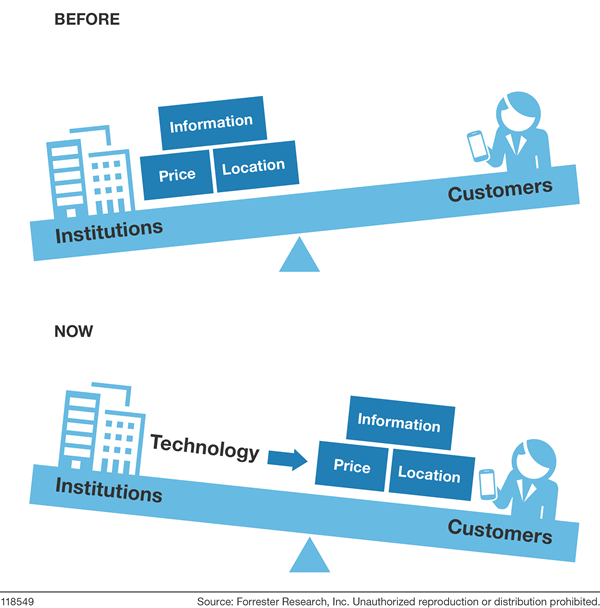
Nearly a decade has passed since Forrester said we were entering The Age of the Customer. That is apparent and has obvious implications. But as the decade of the 2020's dawns, I call out a deeper vision -- The Restoration of the Customer -- that could bring far more fundamental changes in the coming decade.

There are two surprising turns that may be taken in this decade to restore power to customers -- one that can fundamentally change how we conduct business, and one that can fundamentally change how we collaborate.

Those turns might just begin to undo many of the ills of the industrial revolution and of the computer revolution.  Both turns center on a return to enlightened human values:
  • The customer is not just a persona with a bundle of attributes that a business can learn how to manipulate, but a unique human being that has been bred since pre-history to thrive on a cooperative effort to create value and share it.
  • The user is not just a a source of attention that can be engaged to be sold to advertisers, but a customer to be served what they value -- again, a cooperative effort to create value and share it.
What those paying attention see

Forrester put the basic drivers nicely (emphasis added):
In this era, digitally-savvy customers would change the rules of business, creating extraordinary opportunity for companies that could adapt, and creating existential threat to those that could not. ...It requires leaders to think and act differently – in ways that feel foreign, unfamiliar, and counter-intuitive. And honestly, it is simply hard to do. ...These dynamics will endure as new technologies like artificial intelligence and robotics emerge to challenge core notions of what it means to be a company, what it means to build human capital, and what it means to compete and win.
...And, a deeper vision

Here I point to some little recognized ideas on how re-centering on value can change not only the dynamic of commerce, but also a parallel dynamic of customer value that is equally important.
  • First, the commercial dynamic that Forrester describes is just the foundation for reversing how the "progress" of technology cost us the human dimension in commerce -- a dimension that we had when commerce was just the way villagers did business with one another -- with human beings on both sides of an ongoing relationship. 
  • Second, we humans, as "customers" of Web services, have lost control of our experience of the world.  Our central experience of human interaction has been hijacked by platforms who "engage" us in order to profit from bombarding us with advertising and paid propaganda.
First: Back to the future of commerce

Consumers are increasingly alienated from the companies they do business with. Instead of neighbors or shopkeepers, we deal with soulless institutions that we distrust and feel abused by. That has been, increasingly, the price of productivity and material riches. But now technology has advanced far enough to restore the dimension of human values -- if we applied to do so. That does not require that we abandon the miracle of capitalism, but only that we bring it back to the marketplace of human value. Technology now makes it possible for even large faceless institutions to build human interfaces that behave with human values. That will drive institutions to interact with human in ways that are more truly human.

FairPay is a framework for centering on why and how to do that. The key is to recenter on relationships and the creation and sharing of value in ways that are tailored to each individual. Specifics on how to do that are in my FairPayZone blog, some articles written with prominent marketing scholars, and my 2016 book. Some of the best places to begin to understand this are:
Second: Who does it serve? - a course correction in how we experience the world

Social media and other online content services have changed how we experience the world, including how we interact with other people. Computer-mediation began with great hopes, but now it seems we have built a Frankenstein's monster.  As growing calls for change are beginning to focus on new levels of regulation, it is not enough to regulate against specific harms. Instead we must refocus on what we want to regulate for -- who these "services" serve, and what we want these platforms to facilitate. They were supposed to make us happy and smart -- instead they are making us angry and stupid. But technology can reverse that, if we incentivize that.

We can design new architectures for our interactive media that create value for us.  The key is to recognize that each of us is an individual, and we should be able to individualize our services, mixing and matching offerings to make just the service we want for what we are doing now. The most urgent part of that is to shape our media services to give each of us what we value. The Web stated out seeking to do that, and we can return to that vision. It won't be free, but it can be affordable. And we have seen that "free" is not really affordable (because it is not really free). If we do not change direction, our democracies and our civilization will collapse. Some starting points for seeing how:

(Cross-posted with my other blog, Smartly Intertwingled.)

Thursday, August 22, 2019

A Platform for Teaching Men to Fish -- "Revenue-as-a-Service" for Non-Profit Impact

Fund development of a platform that enables non-profits to sustain themselves
Give a man a fish and you feed him for a day;
Teach a man to fish and you feed him for a lifetime.
The same applies one level up:
Fund teachers of fishing and you feed their teaching for some days;
Fund a platform that supports teaching men to fish and you feed all of them for all of their lifetimes.
This could be a very high leverage opportunity! Making a transformative new tool widely available and affordable.

Foundations and others who fund charitable service organizations face a huge problem:
  • Current strategies for funding non-profit services have yet to exploit the power of digital relationships to transform how they work with their customers and donors.
  • Digital technology is already enabling transformative tools, especially for businesses on the leading edge of relationship commerce. Businesses are shifting to recurring revenue models, managing customer journeys and loyalty loops, and the most enlightened are engaging in dialog the brings a mutual focus on co-creation of value. The FairPay framework described in this blog and elsewhere supercharges value-centered relationships, and applies to non-profit organizations  (NPOs) as well as for-profit businesses.
  • But non-profits lack business sophistication and can rarely afford to put resources into developing, testing, and applying similar methods to their relationships. The FairPay framework can transform revenue management at a full range of levels, but much of this potential remains out of reach for many organizations. 
  • Meanwhile foundations and others are looking for ways to support worthy non-profit organizations, and for ways to make those services more cost-effective in their funding and operations.
***Note that much the same applies to news organizations that struggle to sustain socially valued journalism -- even where there is a for-profit element.***

"Revenue as a Service" for Non-Profits -- platforms as a universal leverage point

Viewing this from a systems perspective, this opportunity appears: Fund development of a platform to enable non-profits to sustain themselves by drawing more systematically on support from their community of customers, patrons, and donors. This can provide leverage across a broad swath of service organizations.
  • Non-Profit Organizations (NPOs) -- as well as others, such as news providers -- need a systematic, ongoing way to obtain funding to sustain their operations.
  • That can now be done in very sophisticated ways -- and that sophistication will be constantly increasing -- drawing on advancing technology. 
  • The FairPay framework outlined here suggests a path to transformational improvements in relationship-based revenue models. 
  • Doing that will take skills and resources that may not be economically feasible for small or even mid-sized organizations (even if they would pay back handsomely).
  • That is just the kind of problem that "Software as a Service" was designed to solve: a platform provider (whether for-profit or non-profit) can develop, operate, and continue to enhance a high quality service that non-profit organizations can outsource to. 
  • This can bring economies of scale and network effects to solving the problem of nurturing revenue relationships with large numbers of patrons. (Venture capitalists love platform businesses because of their scalability and high return on investment.)
  • The impact of a non-profit platform could be so transformational that such projects should be very attractive to the charitable foundations that support non-profits and/or journalism. (VCs might be concerned that profit potential of such a platform may be limited by the tight budgets of the NPOs that would use it -- all the more reason for foundations to step in.)
Such a platform would provide "Revenue as a Service." Just what is that outsourced service?:
  • The platform provides the common base of operational software services (based on marketing and behavioral science, technology, and systems analysis), that can facilitate relationship-based revenue management strategy and execution for each of many organizations. Build it once, use it many times. Spread the cost of research, development, and support across many client organizations.
  • Each of those client organizations can retain full control -- setting all the key policies and retaining control of all exception handling. Each decides on all the parameters that define how the system works for them (the platform service may offer suggestions to guide that). Each  gets to have its people handle all human-to-human contact (but can outsource parts of that as well).
There are some existing models for revenue platforms for NPOs. They range from cooperatives like Tessitura, to for-profit services like The News Project, and less structured services for recurring crowdfunding like Patreon. FairPay provides methods for making such services far more powerful, across a far broader range of NPOs. The paths forward are 1) to add advanced FairPay features to existing platforms, or 2) to create new platforms that are clearly focused on FairPay strategies.

"Impact Data as a Service" -- platforms as instrumentation

Funders not only want to get good results, but to get the data to validate whether they are in fact succeeding in that. Common platforms lead to common data and metrics, and common reporting practices.

FairPay drives organizations to increase the quality and frequency of their operational dialog with their community, creating a new level of impact data. Platforms that manage and add new layers of communication with an NPOs's customer/donor community will create new kinds of fine-grained data and metrics -- on just what services are consumed by whom, with what outcomes, how those are valued by those individuals, and how they add value to each community member -- interaction by interaction, over the lifetime of the relationship.
  • That creates a new level of rich data on just what services were consumed and the impact they achieved. 
  • That enables the organization to be more dynamically adaptive and self-tuning, to maximize their co-creation of value with their community. 
  • Funders can use that data to manage their funding and maximize their own impact.
The following sections explain how this is achieved.

The heart of the platform opportunity -- the FairPay framework

FairPay is a radically innovative framework for relationship-centered, “customer-value-first” revenue strategies for the digital era. Its varying forms can be adapted across a wide spectrum of business contexts, both for-profit and non-profit.  (It is an open architecture in the public domain, not a product, and I am working on this as a pro-bono project.)

The original focus of FairPay was on advanced strategies for sustaining for-profit enterprises (especially for digital products and services) -- but the framework spans non-profit services as well, and can be even simpler to apply in non-profit contexts. The core strategies of FairPay have gained recognition in business and scholarly publications. It has strong foundations in behavioral economics, and sheds light on many knotty issues and perverse incentives that are often poorly understood.

What can FairPay do for service organizations? FairPay provides a framework for applying elements that can be mixed and matched to provide a powerful solution to engage customers and donors, and build ongoing relationships with them in a way that motivates them to cooperate in sustaining services that they value. (I use the term "customer" in the broad sense, as including those served as wells as those who donate, regardless of whether they are overlapping or distinct sub-groups. The term "patron," in its broad sense, also conveys that inclusiveness.)
  • Modern behavioral economics has shown that people want to be fair and even generous when asked in the right way to support a service they find valuable. 
  • Game theory teaches that relationships can operate as repeated games, and that well-designed repeated games that are rewarding motivate cooperation to continue the game. (Subscriptions and memberships are forms of repeated games, sometimes well-designed, sometime not so well-designed.)
  • Marketers have learned that they can build profitable recurring revenue businesses based on ongoing relationships (a simple form of repeated game) rather than one-shot transactions, and are beginning to apply the lessons of behavioral economics to enhance that process. They are managing customer journeys and loyalty loops, and engaging in dialog the brings a mutual focus on co-creation of value.
  • FairPay adds more advanced elements to the mix, and combines them to re-align the repeated game to maximize cooperation in creating lifetime value. FairPay builds on transparency and trust to build relationships. It applies empowerment of stakeholders (to show trust), dialog about value given and received (to achieve transparency and motivate willingness to pay to sustain that), and reputation (to sustain trust). 
  • FairPay works best when the business can position itself as a benevolent and fair partner in value co-creation that is worthy of the "price" it needs to sustain the relationship.
  • Non-profit organizations can apply the same methods, and are more naturally seen as benevolent and fair partners in value co-creation.
  • Therefore non-profits have more power to motivate fair contributions from their "customers," and therefore they are able to yield more power to their customers than for-profit businesses are. 
  • That enables them to make contributions voluntary (as is already common practice, but not yet effectively managed with modern relationship-building tools). Such voluntary forms of the more advanced methods of FairPay are relatively easy to apply. 
  • These methods center on regular and ongoing dialogs about value that remind customers of the value co-creation they have benefited from (looking backward to what has been experienced, not just promised for the future), how much they have contributed to sustaining that, and what more can and should be done to add value (in whatever forms are agreed to) in this relationship. That points to what else of value can be done. 
The FairPay framework informs an architecture that can enable NPOs (and journalism organizations) to enhance their revenue-related operations -- to apply the latest business systems, methods, and communications media in a way that optimizes their relationships with their "customers" (again, including donors) to maximize their ongoing sustaining revenue. 
  • This process applies a new kind of leverage -- as a self-adapting engine to create real and valuable impact, measure its perceived value, and adjust the process to do even better.
  • From this perspective, the FairPay framework clarifies how little most businesses and NPOs are currently doing to maximize that, and how much more they could be doing.
More detail on just how this FairPay framework works follows, but first, what does it take to make it happen?    

The platform that supports teaching men to fish

A basic platform for bringing these tools to fund-raising and revenue operations could be built in stages. This is a natural candidate for applying an open source strategy (or a cooperative) to become self-funding beyond a certain initial pump-priming:
  1. Do a basic proof of concept. This could demonstrate the synergy of the combined elements and make the case for further investment. It might take something like 1/2 person-year in total, split between technology and business analysis.
  2. Enhance that to a "minimum viable product" level to be a useful service for a large number of organizations.
  3. Facilitate cooperation of that user community to continue further development, and to attract experts to aid in developing and testing more advanced methods.
  4. Build all of that out into a vibrant, self-sustaining platform ecosystem (much as has been done with other platform or SaaS services like Linux, Mozilla, and Wikipedia).
NPOs (and/or news organizations) could then use this platform to get far more effective and sophisticated in managing their activities as a revenue-generating business, in ways that deepen their social contract with their community.

(As noted above, existing revenue platforms might also be enticed to take the lead in adding FairPay features.)

The FairPay social contract

FairPay works by creating a new social contract for sustaining the creation of desired services.

Consider this change in the game:
  • From today’s conventional repetition game: “Here is our requested price/donation, take it or leave it. We hope you will take the risk — and be satisfied enough to continue this game.”
  • To the FairPay game: “We will grant you the power to pay/donate what you think fair for you after each period of service — we will remind you of the services you got (or funded for others), and will encourage you to pay/donate accordingly.”
This voluntary form of FairPay relies on dialogs about value to frame the value proposition, and to remind patrons of the value they received. It empowers them to determine the "price," engages in transparent dialog about the value that the price should relate to, and tracks reputation to build trust and to know how to nudge fair levels of support.
  • It draws on all available information on when and how services are actually consumed by each patron. Increasing availability of fine-grained usage data will make that increasingly meaningful.
  • It may seed its dialog with individually-calculated suggested prices based on the value and cost of those services. (Even if services may be offered to some at no charge, it may be fair to gently nudge others who have greater means to pay for those services for themselves (and others) as they can afford.) 
  • It regularly solicits payments to sustain ongoing services in an open and transparent way, framing and managing the dialogs about value to remind patrons of the value they (and others) got, and what and when they have paid in the past to sustain that, why they should now pay again, and what new value to expect. 
  • It learns which patrons are fair or even generous in their corresponding payments, so that they can be most effectively nurtured, and resources can be directed to serving those who most appreciate the value offered.  
  • It can suggest additional benefits (perks, tiers of services) based on how fair or generous the customer is. 
  • In selected uses, it can also withdraw benefits -- for-profit businesses can use that "stick" to enforce fairness, but non-profits might stick to more positive "carrots" (but might still use "sticks" in limited situations).
That is how it drive revenue operations, building on that basic social contract. This is simple in in its core concept, but it is amazing how few organizations engage in real and regular dialogs about value with each customer at this fine-grained level.

  • Engaging an NPO's community on what it offers each of them, what each of them values, and what it needs in the way of support from each of them is the way to build strong sustaining support, enabling it to co-create the maximum value. 
  • Some managers fear getting customers to think about value and price, and some fear that customers will not be willing to engage in such dialog. But behavioral economics shows that customers are far more responsive to productive dialog about value and price than most businesses realize (my latest journal article cites a number of compelling studies, and the most relevant are listed in my Resource Guide). 
  • Managers also tend to forget how much their value propositions vary from one community member to another. (A simple thought experiment can help recenter on the importance of these individual value propositions.) 
  • That, in turn, enables a funder to leverage its impact -- the value it co-creates with its NPO portfolio and each member of their communities.
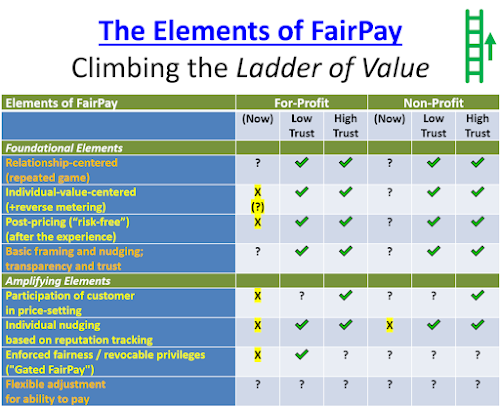
There is of course much more to how this is done, and it will vary greatly from context to context. Background on these variations is in my previous post, The Elements of Next-Gen Relationships and Pricing -- A Unifying Framework. It provides this summary table of the elements, and then comments on each:

 (with minor updates 10/27/19)

The columns to the right show that while most of these elements are applicable to both for-profit and non-profit organizations, the details will vary, and it will further depend on the level of trust and cooperation in the customer segments to be addressed.

As indicated, most non-profits currently use fewer of these elements than for-profit businesses, but greater use could improve their results (including increasing the satisfaction and generosity of their community). This presents a broad opportunity for a platform to make it easy for non-profits of all sizes to gain leverage.

Again, the clearest difference from how FairPay is used by for-profits is that fairness will often be left as voluntary, to be gently nudged with positive "carrots" rather than enforced with negative "sticks" (such as the revocation of privileges). But motivating fairness should be relatively easy for non-profits, since they can readily point to both the individual value and broader social value of their cause. (And non-profits can generally avoid the most complex element of FairPay, the business logic and policy issues of revocation or other negative incentives.)

The foundational elements are already used to some degree in many contexts, to build on the power of ongoing relationships. Now the amplifying elements can be added in and combined, to bring new synergy to revenue operations.

The general implication of the differences across columns is that the more advanced elements of the FairPay framework are most effective when the parties are perceived as holding up their side of the social contract:
  • for service providers who are perceived as offering real value and warranting trust and commitment from customers/patrons for being fair, transparent and responsive to their value creation needs and desires.
  • for customers who are perceived as fair and honest about communicating their needs and desires, and being fair (even generous) in making contributions to sustain that desired value creation. 
Concrete use-case examples

If this still seems abstract or unclear, please see my other posts with more concrete details of how FairPay applies in specific use-case examples:
Simpler "80/20" solutions with the same platform

Organizations using this proposed Revenue as a Service platform need not use its more advanced features, except as they are ready and wish to. The platform can be configured to deliver just the features each organizations wants. Thus it can provide a service that scales gracefully, from very basic, to very advanced.

One very important simplification of FairPay can serve as a high-leverage 80/20 solution in both voluntary and payment-required contexts. That is the "risk-free" subscription model that relies on post-pricing (after the experience). That can be done without using any of the participative pricing elements of more advanced FairPay solutions (and need not even exploit nudging). That is less of a departure from traditional set-price subscription or membership pricing. But unlike the high hurdle of an all you can eat, fixed price membership paywall, it works as a gentle "pay ramp." (This, too, is explained in my Elements post, and the Whitney and Metropolitan Museum use-case examples listed above.)

Similarly, the platform, itself, can be built in stages, beginning with the more basic elements, then gradually adding the more advanced ones.

Crossing the lines between donors and those served

As explained in my 2016 post on non-profits, FairPay provides new and better way to address the complex issues of pricing and sustainability across the spectrum from donors to those served.  Consider how this works for these two often overlapping constituencies:

·         Recipients -- direct customers/patrons of direct services (the mission). Here, pricing takes on two interrelated dimensions -- what is the fair value of the service, and what is the fair contribution from the recipient (to both the cost of the service to them, and to the added overheads needed to sustain the organization -- and optionally to the cost of service for those who can less afford it).
·         Benefactors -- indirect customers/patrons of indirect services (the altruistic value of supporting services to others, and the value of being a benefactor, including perks and recognition).  Here, the key dimensions are the value of direct services to others enabled by the benefactor’s donations, and the value of the indirect benefits to the benefactor.

The details will vary with the type of customer/patron and the nature of the organization and mission, but the essential task is the same -- to generate sustaining revenue by cooperatively setting prices (for service or donation) that make the value proposition "win-win." (That also includes recognition of non-monetary contributions by those who give in kind.)

The platform as a universal leverage point for achieving impact

The problem that limits the uptake of these methods is the implementation effort, and the need for ongoing testing and refinement (including "devops," the work of enhancing and maintaining the operation). Fund a platform for that, and many more organizations will be able to teach men to fish -- or give them fish -- or whatever other good works they do. The platform is a universal leverage point.

A platform solution across many organizations also has other kinds of economies of scale and network effects, beyond simply outsourcing that service. FairPay dialogs about value generate valuable data about exactly what each customer values at a fine-grained transaction level, as well as reputation data about the fairness of each customer (and how that varies with context). While that data is sensitive, if managed with care it could potentially be used in win-win ways to help guide service providers to engage with those customers who most value their service (for a single service provider, or across all the service providers that use the platform, subject to appropriate privacy controls). That can lead to more effective co-creation of value for everyone.

------------------------
Posts that are specific to non-profits and social welfare:
...and focused on journalism:
------------------------

[Update 4/14/20:]  An excellent article on how one platform service, Network for Good, is bringing some of the relationship-building methods I describe here, is How NonProfits are Doubling Down on Relationships with Subscription Giving. The article is by Tien Tzuo president of Zuora, who wrote the excellent book, Subscribed, that I reviewed in 2018.

------------------------
More about FairPay

A concise introduction is in Techonomy, "Information Wants to be Free; Consumers May Want to Pay"

For a full introduction see the Overview and the sidebar "How FairPay Works" (just to the right, if reading this at FairPayZone.com). There is also Selected items (including links to videos and decks). 

(FairPay is an open architecture, in the public domain. My work on FairPay is pro-bono. I offer free consultation to those interested in applying FairPay, and welcome questions.)

Wednesday, August 15, 2018

Deeper Lessons From MoviePass -- From Tickets to Subscriptions to Relationships

Many have commented sagely on the folly of MoviePass, but, at a deeper level, it is something of a caricature of how we are just at the baby-steps stage of The Subscription Economy. It is easy to laugh at what seems to be a Wyle E. Coyote model: "we lose money on each customer, but we will make it up in volume."  Of course it is not quite that simple, the intent being to monetize consumer data to compensate, but still the value proposition seems to defy gravity. There are important lessons here, as recently noted in the Washington Post, Price Intelligently, and Harvard Business Review.

These commentaries point to many dots that we have yet to fully connect into the larger image. There are many excellent insights about what Tien Tzuo of Zuora calls "The Subscription Economy" in his recent book Subscribed, and in these recent articles. The bigger picture I see here is what I call "The Relationship Economy." Subscriptions are an important way to structure profitable customer relationships, but what matters is how a business co-creates value in its relationship with each customer. If you focus on creating and sharing value with each customer, the rest will follow. That is explored in some depth in my recent post, The Relationship Economy -- It's All About Valuing Customer Experiences.

The core lesson of co-creating value is the shift from the Goods-Dominant Logic of tickets, through the more Service-Dominant Logic of subscriptions, to a fuller understanding of that logic in the value of service relationships. As the head of Stanley Tools was reported to say long ago, "our customers don't want drills, they want holes."

Eddie Yoon's article in HBR lists five lessons that serve as nice examples of some of the dots I refer to -- which I would connect into this larger picture of value-centered relationships. My perspective on his five points:
  1. Price elasticity is powerful -- and highly variable -- "playing with it requires great skill and precision." The issues are so dynamic that an adaptive, mass-customized approach to pricing is needed to profitably serve more than narrow niches. We need to go much farther down that road.
  2. "MoviePass serves as a cautionary tale of treating consumers with a transactional mindset" and "seeking to monetize them through advertising." I believe the age of services that are predominantly advertising-supported is giving way to models that are predominantly customer-supported (even if they retain some advertising value exchange in a way that is more customer-value focused, such as with a "reverse meter").
  3. All you can eat models are economically inefficient for both customers and businesses. Highly engaged "superconsumers" should be a prime asset to a business, not a gaping liability. Pricing and value propositions must adapt to different consumer needs.
  4. The movie ticket is only one aspect of the consumer experience. The customer wants holes (a good experience), not drills (tickets). A service relationship, value co-creation perspective points to ways to get more "share of wallet" from each customer.
  5. Yes, "bullying is a bad business plan." Long term success models are win-win, not zero-sum -- for consumers and business partners/suppliers.
Changing an industry like movies with essential entrenched players (theaters and studios) wedded to rigidly antiquated models will be challenging, but even so, the ultimate direction of relationship=value-focus seems clear.

My work on FairPay points to how such a new logic can work, but there may be other paths. The future of The Relationship Economy will be more mass-customized, and more win-win, drawing on deeper customer "dialogs about value." The power of businesses and customers will be more evenly balanced, and cooperation in co-creating value over the ongoing relationship will be the key to success.

------------------------
More about FairPay

For a full introduction to FairPay see the Overview and the sidebar on How FairPay Works (just to the right, if reading this at FairPayZone.com). There is also a guide to More Details (including links to a video). 

My article in the Journal of Revenue and Pricing Management, "A Novel Architecture to Monetize Digital Offerings" also provides an overview of FairPay (summarized more briefly in the ESADE Knowledge article "Three building blocks to monetize a digital business," and previously in Harvard Business Review, "When Selling Digital Content, Let the Customer Set the Price.").

Even better, read my highly praised book: FairPay: Adaptively Win-Win Customer Relationships.

(FairPay is an open architecture, in the public domain. My work on FairPay is pro-bono. I offer free consultation to those interested in applying FairPay, and welcome questions.)

Friday, March 23, 2018

Zuckerberg: How to Fix Facebook -- Stop Hanging Us With the Ad Model! -- A New Economics

"Zuckerberg’s Answers to Privacy Scandal Raise More Questions" as Kevin Roose recaps his 3/21 NY Times interview: "Here, for example, is how he answered a question about Facebook’s business model, which is based on selling advertisers and developers the ability to target Facebook users based on their personal data." Zuckerberg says:
...having it be free and have a business model that is ad-supported ends up being really important and aligned.
Now, over time, might there be ways for people who can afford it to pay a different way? That’s certainly something we’ve thought about over time. But I don’t think the ad model is going to go away, because I think fundamentally, it’s important to have a service like this that everyone in the world can use, and the only way to do that is to have it be very cheap or free."
What Zuckerberg says translates as "yes, we capitalists are selling bad-actors (and value-subtractors) the advertising rope to hang us with (to paraphrase Karl Marx). We do it because we have not figured out a better way to scale services sustainably, especially to those with low ability/willingness to pay." But this is just a failure of imagination and experimentation.

Beyond the Ad Model - New Economics for Media

 As I said in "Beyond the Ad Model - A New Economics for Media" on MediaPost in 2012:
It is time to rethink payment for media in the digital age. Most users of Facebook, or any media service, would be willing to pay a fee -- if it were commensurate with the value they actually perceive, and their ability to pay. Charging for Facebook seems impractical only because we have not figured out how to create a payment model that works for a wide range of consumers.
How can a vendor understand the right price for each user, at each point in time? This seems intractable until we consider letting the user tell us -- the user knows.  
The concern is that the user will not be fair, and will understate what he is willing to pay--or will fail to appreciate the cost of service. But we are in an era of relationship commerce – now we can build personalized relationships on mass scale.  The solution is to build relationships with customers based on dialogs about value -- so that we can maintain relationships with those that set values fairly, nudge them to recognize the value, and cut off [or dial back] relationships with those who are unfair.  The same technologies that enable ad targeting, individualized merchandising, and automated customer service can enable this too.  I have been talking to companies of all sizes about just such an approach -- I call it “FairPay” (short for “fair pay what you want”).
Advertising and data sales can still have a significant place in adding economic value, but can be limited to not detract from the core value proposition between the consumer and the business.  The same FairPay process can let users individually determine what level of advertising and data usage they will tolerate, in return for reduced payments.
Can that be done? Can we get users to pay, and can we sustain our businesses with prices that consumers will accept as fair for varying levels of use -- and varying abilities to pay? Even if some know that others are paying less? A large body of business experience and behavioral economics studies show that it can be done -- if we shift from a short-term transaction mind-set to build ongoing customer relationships into a repeated game that motivates cooperation and fairness.

My article in the Journal of Revenue and Pricing Management, "A Novel Architecture to Monetize Digital Offerings" provides an overview (summarized more briefly in the ESADE Knowledge article "Three building blocks to monetize a digital business," and previously in Harvard Business Review, "When Selling Digital Content, Let the Customer Set the Price.").

Another post, How Market Commerce Can Become More Cooperative, Fair, and Human, explores these ideas, drawing on the example of Twitter (when some people got excited about the idea of turning it into a cooperative). The same principles can apply to any digital service to consumers.

Other posts in this FairPayZone.com blog explain the key principles that enable this:
------------------------
More about FairPay

For a full introduction to FairPay see the Overview and the sidebar on How FairPay Works (just to the right, if reading this at FairPayZone.com). There is also a guide to More Details (including links to a video). 

Even better, read my highly praised new book: FairPay: Adaptively Win-Win Customer Relationships.

(FairPay is an open architecture, in the public domain.)  

(My work on FairPay is pro-bono. I offer free consultation to those interested in evaluating and applying FairPay, and am happy to address questions.)

Wednesday, January 24, 2018

Making "Pay As You Wish" More Equitable -- Sustaining the Met Museum (and Others)

The Metropolitan Museum of Art in NYC stirred up a lot of heat and raised some interesting questions when it announced a partial end to its "pay as you wish" (= pay what you want, PWYW) admission policy earlier this month. Under financial pressure, it is ending PWYW admissions for all but residents of NY state (plus students from NJ and CT).

The underlying issue is how can a museum build relationships with "patrons" that are fair and affordable, while encouraging them to be true patrons, paying what they can afford to sustain the museum. Modern technology enables new ways to solve this knotty problem, but few have begun to exploit that.

An industrial strength variant of PWYW -- for profits -- and for non-profits

While for-profit businesses currently tend to fear giving any pricing power to customers, PWYW works surprisingly well in many situations. PWYW is common in museums, and has become popular for digital content and services (and has other well-established uses such as tipping). What I suggest is that the Met -- and others -- look at how to make it work better.

My work on FairPay points to new technology-enabled strategies to make enriched forms of PWYW "ready for prime time" -- by balancing pricing power more fairly on both sides in an ongoing relationship. FairPay was developed for for-profit businesses, but it is very well-suited to non-profits, such as the Met, as well.

FairPay membership relationships

My post from last year, A Better Revenue Strategy for Non-Profits in the Digital Era, explains how FairPay (short for Fair Pay What You Want) can change the game in ongoing patron relationships.
  • The idea is to seek to personalize a level of payment that is fair and affordable to each patron, and to motivate each patron to pay at that fair level. 
  • The problem is that patrons have very different value propositions -- different levels of usage, of value obtained, and of willingness and ability to pay.
  • Addressing that variability is facilitated by shifting to a relationship view: from one-off admissions, to the total being paid by an individual patron over an ongoing period. 
  • This shifts all sides from a transaction mind-set to a relational mind-set -- and turns price-setting into a repeated game that centers on value instead of price, and encourages cooperation, transparency, and trust. 
  • That relational mind-set builds mutual dialog and engagement -- which is good for both the museum and the patron. Technology enables this to become far stronger.
FairPay works much like a membership, but with fully personalized pricing that adapts to the value each member gets, as well as their willingness and ability to pay. Because FairPay is highly flexible and adaptable in its pricing, it can work for anyone who is likely to make repeat visits. It can provide for free or low-price admission in cases where that is fair, given the circumstances -- and enable simpler forms of premium patronship for those willing and able to provide greater financial support to a cause they think worthy. (Another post explores FairPay memberships in more depth: The Missing Piece of the Membership Puzzle -- Agreeing on Value for Each Member.)

Even for institutions not ready to move to FairPay, understanding the principles behind it suggests a direction to move toward (as encapsulated by the thought experiment described in another post).

From visitors to members ...to become true patrons

Of course many who visit the museum will be one-time visitors. FairPay is primarily aimed at ongoing "member" relationships, and that was the focus of my prior post on non-profits. However, FairPay can be adapted to address the issue of new and one-shot relationships, and to provide a smoother path from visitor to ongoing patron. That leads to pricing that is both more win-win, and more economically efficient -- raising more funds from more people.

Much of the negative response to the Met's PWYW change is about how it may reduce access to disadvantaged visitors. FairPay's flexibility in customizing relationships adapts to patrons with both low and high ability to pay.

Here, I sketch out some suggestions on how a new visitor might be addressed with FairPay, and highlight some of the underlying principles.
  • The idea is to invite those who want to pay less than full price -- as well anyone who expects to be a repeat visitor -- to join a special "FairPay patronship program." 
  • This can work for any visitor who is willing to build a relationship that is more value-centered, even those of means -- many of whom might pay at premium levels, just as in other membership programs.
  • While this may not be well suited to the out-of-area visitors now being excluded from the PWYW policy (at least those who will not visit regularly), it offers a way to get more, on a more cooperative basis, from those who are still permitted to pay as they wish. (And it should be able to pass muster with NYC as being no more onerous to those who cannot pay than the current PWYW policy mandated by the Met's lease of public parkland.)
  • It also provides a tool for the Met to build a direct relationship with the many visitors who have not joined as members. Membership now costs $100 for unlimited visits (if within 200 miles) versus the suggested $25 per visit.
  • FairPay provides a smoother and more rational range of value propositions -- less that $100 for those who might visit 2-3 times per year, and a basis to suggest those who visit many times per year should pay more, if they can. Instead of pre-set bundles of perks for higher level memberships, FairPay can provide for individually customized on-demand bundling.
FairPay relationships generate personalized prices and value propositions based on the following key principles:
  • Post-pricing: set the price after the experience, when the value of the experience is known. That eliminates the patron's pricing risk (the risk that the experience is disappointing). Note that the Met has little pricing risk at an individual level (since its marginal cost per person is near zero), only the overall risk that the aggregate pricing level (over all people) is too low. [See update at end on "risk-free membership" as a partial step toward FairPay.]
  • Post-bundling: a further aspect of post-pricing -- enable the patron to select the package or bundle of services they desire, one piece at a time, when they know what they want -- not as some pre-set package that is arbitrarily bundled (often with undesired pieces that are not used, as in the Met's current $200 and $600 membership bundles).
  • Participatory pricing: get the patron involved in setting a personalized price that they consider fair and affordable for them. That avoids misunderstanding the value proposition (as they perceive it), and helps build a deeper and more cooperative relationship. Some patrons will push for lower prices, while some can be "nudged" to pay more than now suggested.
  • A repeated game: shift the focus to the continuing relationship, rather than the one-shot transaction, to focus on value rather than price, and to draw on human values of cooperation:  fairness, reciprocity, trust, and altruism (especially powerful for museums and other public services).
Together, these principles lead to prices that are fair for each patron, whatever their level of activity and their ability to pay.

The repeated game of relationship

How does this game work?  Think of it as something like "running a tab," but with a new kind of cooperative price-setting process. See the diagram (fully explained in another post, with some basics here):
  1. Visitors seeking this FairPay admission would join as "FairPay patrons," providing and confirming their email (and maybe presenting a credit card for validation only, with no payment), thus beginning a basic, ongoing relationship with the Met. 
  2. They could immediately be given a membership card (or an app) with a coded tag that allows tracking of their entry and exit times (and which exhibits they visit).
  3. After their visit, the Met would email them to request a payment -- reminding them of how much time they spent, and any special exhibitions visited, with a suggested price for them. The Met would emphasize the importance of the patron's financial support to maintain its offerings, and emphasize the benefits offered to ongoing patrons. 
  4. The patron could then "pay what you think fair" -- and indicate the reasons why they feel it is fair to pay less (or more) than the amount that had been suggested for them to pay. They would be free to be unfair and not pay much (or at all), but that would be tracked. Note the important difference between "pay what you think fair" and "pay what you wish" -- the emphasis is on fairness, not whim. 
  5. On their return for another visit, the card or app could be used again on the same terms -- if the holder is in good standing, based on their prior usage and payment history. Thus repeat visits would be enabled, with all payment requests for that month processed together. 
Note how tracking visits provides a way for the Met to make the value obtained more evident, and more personalized. These repeated visits could be discounted on a sliding scale to work much like an annual membership, but still be priced to reflect individually varying levels of activity. There could also be cap on total payments in a given year, as with conventional memberships.

But unlike conventional memberships, it could be made clear that those who visited often, and for longer times (and visited premium exhibits) might be expected to pay more than those who visited less. Similarly, students, retirees, and other categories with limited means might be empowered to claim discounts (with more flexibility and privacy than at a ticket window). Conversely, visitors who can afford to pay more could be "nudged" to do so. Seniors and students who are affluent could be discouraged from seeking discounts.
Another important benefit these methods would provide to the Met is that new visitors are immediately brought into an email-based relationship with the museum. That has numerous obvious benefits.

There are strong behavioral economic underpinnings to making this strategy fair and sustaining -- this should be primarily "carrots," but there are also some "sticks:"
  • Some might try to abuse FairPay and not return, or could return with another email address. But FairPay's tracking process makes such abuse harder -- and more conspicuously at odds with maintaining one's own positive self-image. 
  • Such abuse might have results similar to the current PWYW policy -- but probably for fewer people, and less aggressively -- and abusers could now be tracked and cut off from repeated abuse. (Enforcement of fairness criteria could be lenient, or as whatever level the Met and the city agree to be appropriate.)
  • Other methods proven by behavioral economics could be applied to nudge patrons to pay fairly, and even generously. 
  • More direct, proactive programs could be applied to encourage participation by the disadvantaged (or others) -- and even to encourage them to volunteer non-cash support that might be credited toward their membership obligations.
Thus total revenue should be higher than with the current PWYW policy -- and relationships should be much stronger.
Naturally the Met would want to test this to learn how to manage the process well, starting with selected segments of visitors who can be expected to be most deserving and appreciative of this increased level of cooperation, transparency, and trust.


From visits to relationships, from price to value

FairPay is all about building value-centered relationships, and being smart about how to motivate and value such relationships. Technology is providing much more powerful ways to do that than ever before.

The institution's challenge is to exploit these new ways to make museum pricing work better for all of us -- whether with full forms of FairPay, or with partial steps in that more win-win direction.

---
[Update 7/11/19]: For an important "80/20" variant on FairPay, see "Risk-Free" Subscriptions to The Celestial Jukebox? This outlines a simpler solution to the Met's membership offer that does not get into the participatory pricing of a full FairPay solution described above, but makes simple $100 memberships "risk-free." Why not offer a plan that starts with a first visit, tracks member visits, and guarantees a refund at the end of the year for any unused visits (less than the break-even level of four)?  Of course there will be some revenue loss from the refunds. But how many added memberships would there be? How many additional members would keep renewing if they did not fear they would lose money by doing so? What is the value of the added connection to all those additional members who would otherwise just be anonymous visitors (and the value of all the activity data you can continue to obtain about them)?]

----

For a full introduction to FairPay see the Overview and the sidebar on How FairPay Works (just to the right, if reading this at FairPayZone.com). There is also a guide to More Details (including links to a video). 

Even better, read my highly praised new book: FairPay: Adaptively Win-Win Customer Relationships.

(FairPay is an open architecture, in the public domain.)

Monday, October 16, 2017

Thaler's Nobel, Surge Pricing, Fairness, and Long-Term Relationships

Some very nice insights on this theme are woven together in the latest Upshot reporting by Neil Irwin. It shows how Richard Thaler's behavioral economics adds deeper dimension to the debates about surge pricing -- and how that ties to underlying issues of fairness and long-term relationships, beyond the usual conflicting simplistic responses ("not fair"/"sound economics").

My congratulations to Thaler on winning the 2017 Nobel Prize in Economics last week for his work in creating the field of behavioral economics. That is a key foundation for my work on FairPay, and I am very appreciative to have gained his encouragement, as noted below.

When we look beyond the surface, we see that fairness in long-term relationships is what really matters for economics to work well, and that leads to the values (fairness) that we all seek. Thaler developed behavioral economics to look deeply at those deeper issues of human value and behavior. FairPay makes that the center of an new logic for consumer commerce that is badly overdue in our new digital age.

Some relevant quotes from Irwin's article:
For artists, no one show exists in a vacuum. And the things that might maximize revenue for any given night might not be the elements that matter in the longer term in developing devoted fans.
...So one view of the Springsteen approach is that it is economically irrational. But another is that it is part of a long-term relationship between a performer and his fans.
...Utilities and regulators, in other words, have to think a little like Mr. Springsteen: It’s not just about maximizing the efficiency of the energy market on any one day, just as the Boss isn’t trying to maximize his revenue from any one concert. Rather, it’s about maintaining a relationship in which people do not feel like they have been exploited.
...People’s perceptions of what is fair and just are not set in stone; they evolve over time. But companies looking to use variable pricing have to be cognizant of how important it is to respect those perceptions.
...What the successful examples of variable pricing have in common is that they treat customers’ desire for fairness not as some irrational rejection of economic logic to be scoffed at, but something fundamental, hard-wired into their view of the world. It is a reality that has to be respected and understood, whether you’re setting the price for a highway toll, a kilowatt of power on a hot day, or a generator after a hurricane.
“If you treat people in a way they think is unfair, then it will come back and bite you,” Mr. Thaler said. And it doesn’t take a Nobel to understand that.

Numerous posts on this blog address similar underlying issues related to consumer perceptions of price discrimination (including surge pricing) -- and how a more enlightened variation that I call "value discrimination" can be very fair and broadly beneficial to consumers.

I was privileged to get Richard Thaler's attention and encouragement when I wrote to him in 2015 about how nudging is a key aspect of the FairPay strategy, referring to my blog post, How Consumers Can Nudge Corporations for Good (which commented on a piece by him in the NY Times). He then connected me to his colleague, Heather Caruso, executive director of the Center for Decision Research at the University of Chicago Booth School. After some encouraging discussion, she indicated that their center would be interested in possibly being a resource for help in conducting experiments when a company is ready to do a trial.

With regard to trials, businesses, entrepreneurs, researchers, or others who might have interest in applying FairPay or related strategies are invited to contact me for pro-bono assistance. (FairPay is an open architecture in the public domain.)

More detail on how behavioral economics supports the strategies that underlie FairPay is in my earlier post, Thinking Fast and Slow about FairPay: A New Psychology for Commerce in a Networked Age, and in Making Customers Want to Pay You -- Research on How FairPay Changes the Game. (I previously had brief interchanges with Daniel Kahneman, the first winner of a Nobel for related work in behavioral economics, and author of Thinking Fast and Slow.)

We are just beginning to see the real world results of the more human side of economics that Kahneman, Tversky, and Thaler shined their light on.

----

For a full introduction to FairPay see the Overview and the sidebar on How FairPay Works (just to the right, if reading this at FairPayZone.com). There is also a guide to More Details (including links to a video).

Even better, read my highly praised new book: FairPay: Adaptively Win-Win Customer Relationships.


(FairPay is an open architecture, in the public domain.)

Monday, October 9, 2017

WTF?: A New, Better, Warm-Blooded Capitalism -- Linking Profit to Human Values


We can start now, one company at a time. What company will take that step? -- to shift from the cold-blooded zero-sum logic of dinosaurs, to the more dynamic and cooperative logic of mammals? All it takes is one imaginative business to lead the way (most likely starting in digital).

I just finished an advance copy of Tim O'Reilly's important new book, WTF?: What's the Future and Why It's Up to Us.* My focus was Tim's perspective on how we are now confronting "the beginning of the end of a failed economic theory," because my work on FairPay is aimed at a simple change in how we structure customer relationships that can enable individual companies to lead toward "an economy where people matter, not just profit."

Tim's WTF? provides a sweeping and insightful synthesis of how technology has been reshaping all aspects of our civilization -- not all for the best. It paints a compelling picture of the forces driving the problems we now face, and of the wide variety of hopeful vectors for change that are emerging. But it only hints at the idea that there are simple things that companies can do now on their own initiative (with the aid of consumer support) to begin to change the game unilaterally, in a way that can begin to shift perspectives more broadly. Just as Eastern sages say "there is nothing you must do first to achieve complete and perfect enlightenment," there is nothing we must do first to allow companies to align profits with human values (at least to a far greater degree than we do now, in some contexts).

First some initial comments on why Tim's book is important and compelling, then some observations on how FairPay highlights possibilities now at hand that promise to enable us to change direction even faster than Tim seems to suggest.

WTF?: What's the Future and Why It's Up to Us

Tim draws on his established position as thought leader with ties to the increasingly broad range of "alpha geeks" and entrepreneurs that have shaped our digital world, and his perspective as a publisher and communicator concerned about the broad human effects of technology on our civilization. He richly explores the double-edged effects of technologies such as platforms, automation, algorithms, and AI, and how they seem to be making life worse in many ways, even as they work miracles.

Tim makes his case in terms of a fitness function, the quantified objective function that guides the evolutionary optimization of an organism (or a system) to fit an environment. Through a wide range of contexts and examples, Tim suggests that we need to change the rules and incentives of our markets -- not only markets for goods and services but also financial markets -- and layers of internal and governmental rules that regulate them -- to better address the conflicts between people and profit, to turn the invisible hand to guide corporations fairly. On the long-term effects of algorithms and automation, he wisely observes that we need to not only manage these to protect and augment people (rather than simply replace them), but also to shift our focus to not simply protect jobs, but to the guide ourselves to the work that needs doing.

Tim points not only to emerging problems, but also to many signs of hope, and to how to build on that. He draws our attention to the many vectors of change (forces characterized by both intensity and direction) that shape the future. He points to both the urgent need, and the rich potential, that we have at this pivotal time, to remold the world closer to our heart's desire.

WTF?: What steps can a business take now to jump-start  that future?

My focus here is to synthesize and build on some of the vectors that are already pointing to ways to do this without waiting for systemic change in the underlying rules and regulations of our markets. There are already shoots we can build on, to work within the logic of our markets, to be more focused on human values.

There is nothing we must do first: we have already entered an age where profit can be increased by better serving customer values. Just be customer-value-first. 

What does that mean? Many businesses are realizing that it is not enough to be customer-centered (just seeking to extract maximum value from customers). We are entering an age of relationship capitalism -- most visibly in the emerging subscription economy where it is now understood that the key metric is not quarterly profit but customer lifetime value (CLV). Companies of all kinds are looking to customer journeys and loyalty loops, and seeing the need to be customer-value-first -- to work with each customer to maximize the value they perceive (and thus get the most from them in return). CLV is maximized when the company looks not to what its customers can do for it, but what it can do for its customers.

Value-based pricing has emerged in the B2B world as a way to align the business with the value it co-creates with its customers, to share fairly in that value surplus, and to drive that directly to the bottom line of pricing and thus profits. Less need for multiple bottom lines that tack on social values, if those values are priced in to the financial bottom line. Less need for external controls to manage externalities, if those are baked into value-based prices. Less conflict with investor demands, if prices and profits are aligned with customer values.

Translating that value mind-set into the B2C world has lagged because doing value-based pricing in a scalable way for mass-consumer markets has seemed so impractical that few even think about it. But we are seeing hints of a sea-change. Tim mentions Patreon and other new crowdfunding strategies for consumer funding of creation as "having a lot to teach us about [the economy's] future direction." Similar shoots can be seen in the move toward membership models in which readers fund journalism (or other services) that they care about. Behavioral economics has studied such participative pricing models (including the often-too-extremely customer-value-first model of pay what you want) to find that they are surprisingly effective, and that the classical economic model of a purely financially motivated homo economicus misses the actual behavior of real people. (Tim also mentions cooperatives, like the Green Bay Packers, REI, and Vanguard, and how they succeed at better aligning profit with human values.)

It is encouraging that a theoretical base for deep changes in corporate mind-set has been coalescing in the work of some marketing scholars and businesses who are re-examining the “goods-dominant logic” of the past, versus the “service-dominant logic” that we now are faced with. This meshes with recognition that value is not created by “producers” and purchased by “consumers,” but that “actors” in ecosystems work together to co-create value, which flows in multiple directions. Customer-value-first thinking is just one aspect of that (and platforms are another).

Tim quotes William Gibson, "The future is already here -- it's just not evenly distributed." My work on FairPay seeks to build on these shoots of a more participative, win-win future, to drive simple changes to the structure of the game that a business offers to play with its customers, changes that can make that relationship far more cooperative in seeking a fair sharing of the business and consumer surplus.

FairPay and the invisible handshake

Tim describes how the invisible hand of competition in our markets does its work to balance supply and demand. The invisible hand works by rationing scarce supply against demand. But, increasingly, we have markets in which supply is not scarce, but essentially infinite (especially markets for digital goods and services). Furthermore, increasingly we expect our markets to work for goods and services that are not commodities, but experiences that have very different values to different people.

We still think with the economic logic of the invisible hand, but it no longer works so well in many domains (especially digital). For example, many digital businesses feel driven to create artificial scarcity, in an effort to prop up the invisible hand to maintain their profits under this obsolete fitness function. Customers easily see through that, and wonder why they should pay what is demanded (or anything at all) -- they resent being manipulated in ways that they see as patently unfair. Even publishers are realizing that information wants to be ubiquitous (except in special markets like time-sensitive financial information in which customers want scarcity and are willing to pay a premium for that). Furthermore, artificial scarcity is an enemy of the economies of scale that benefit business, customers, and society alike -- it limits the fruits of creation to those with high ability to pay.

Tim says "I am a strong believer in the social value of business done right. We should aim to build an economy in which the important things are a natural outcome of the way we do business, paid for in self-sustaining ways rather than as charities to be funded out of the goodness of our hearts." I agree completely -- that is the objective of FairPay.

Tim is concerned about how capital markets get distorted to focus on the narrow interests of shareholders (and management), and looks to ways to change that. That is a deep and urgent concern -- I do not mean to suggest any weakening of Tim's points regarding that. But I suggest there are complementary ways to make our fitness functions work better -- for businesses, customers, and society -- from inside our businesses, in the current market environment. Let's do what we can to change from inside, now!

FairPay builds on the recognition that many businesses are now much more strongly a matter of relationships. Subscription businesses are beginning to see that they are living a new kind of social contract with their customers. Customers rightly question why they should pay for existing content (since it can be provided at negligible cost). They understand what they need to pay for instead is the continuing creation of more such content. (The recent dramatic increases in news subscriptions is an example.)

A business applying FairPay makes this social contract explicit, in the form of a repeated game that motivates cooperation. "I will be more flexible (and give you more say) in how I price my services, as long as you are fair about paying for the value you receive" (as explained in FairPay Changes the "Game" of Commerce). Instead of an invisible hand, think of this social contract as an invisible handshake that drives pricing toward equitable sharing of the value surplus, however that varies in any specific context (including widely varying abilities to pay). (This is explained in An Invisible Handshake for The Digital Wealth of Nations and Harnessing the Demons of The Digital Economy.)

No one else needs to change any rules to apply this invisible handshake -- it is just a matter of a single business being clear about the structure and intent of the game it offers to play, and being smart about framing its offers, learning what the customer values and working to deliver it, and nudging the customer to accept and hold up his end of this social contract. This can be done in many market sectors, among selected segments of users who (1) value the service, (2) want more flexibility in pricing and offers, and (3) are willing to make an effort to be fair about it.

Businesses of all sizes using current emerging models like Patreon and membership are pointing in this direction already. (And effective SaaS platforms can facilitate this to make it easy for small businesses and even individuals -- with significant scale economies and data network effects -- a major entrepreneurial opportunity there! Think not just of CRM, but of pricing and relationships as a service.)

Tim emphasizes the importance of tight feedback loops to achieve fitness functions, and to ensure product-market fit. FairPay is driven by an adaptive feedback loop that underlies every touch-point between the customer and a business and its products/services, to seek to jointly measure and maximize value at all levels -- as both the business and customer agree to define it.

Tim explores the dark side of business models that seek engagement (like Facebook and other ad- or commerce-driven businesses). FairPay fosters a form of consumer engagement that is win-win for all of us.

Tim suggests thinking of the economy as a game. FairPay shifts our micro-economics to see commercial relationships as a repeated game that works not for single transactions, but over a relationship, to align business and customer incentives to produce what we want, when and how we want it, for everyone who values that -- and to divide the surplus value so that both profit well from doing that. That harnesses the law of attractive profits to incentivize companies to profit from competing on creating customer relationships that maximize human values. That in turn leads to a macro-economics in which bottom-line revenues and corporate profits correlate with the creation of real human value.

A vector to broader human values (and other WTF? improvements)

Taking this farther will take skill and continuous learning and refinement, but, if done with care on the part of the business, customers will increasingly see that it delivers the value they seek, on terms they are be happy with. That value can include not only the narrow aspects of value addressed by the invisible hand, but whatever human and social values the customer wants to factor in (including people, planet, and purpose, to the extent the business will agree that is reasonable).** All of the vectors that Tim describes support and facilitate moving in this direction. Early success will lead to wider use across broader segments of consumers. Even costly real goods can be partly amenable to this logic, especially if they are based on human creative work (which Tim points to as another important vector).

Seeing this invisible handshake work will help create a climate for the more broadly systemic changes in business (and how it is regulated) that Tim points to. Businesses and the capitalist system will find themselves driven closer to our heart's desire. That will reduce the need for external remedies, and will create a more cooperative climate in which those remedies that are still needed will be seen as less objectionable.

...All it takes is one company to give this a try. (...Maybe O'Reilly Media?)

---------
On a personal note -- as one who has spent his career watching, developing, forecasting, and inventing the future since the 1960s -- I very much relate to Tim's perspectives. I hope many will think seriously about this future and "why it is up to us." Now, more than ever, our future depends on that.

----

For a full introduction to FairPay see the Overview and the sidebar on How FairPay Works (just to the right, if reading this at FairPayZone.com). There is also a guide to More Details (including links to a video).

Even better, read my highly praised new book: FairPay: Adaptively Win-Win Customer Relationships.


(FairPay is an open architecture, in the public domain.)

--------

*A preview of WTF? is provided in Tim's August post on Medium (which I commented on). A sample chapter is also available. Publication date is tomorrow, 10/10/17.

--------

**[UPDATE -- comment from Tim O'Reilly] 
Thanks very much Tim!  To your very relevant point of concern, I should expand on how FairPay enables customers to have a much greater say about that...

FairPay seeks to define value to "include not only the narrow aspects of value addressed by the invisible hand, but whatever human and social values the customer wants to factor in (including people, planet, and purpose, to the extent the business will agree that is reasonable)."

When pricing is sufficiently participative, through a process like FairPay, customers can nudge businesses to have their price factor in whatever aspects of value they want it to include. That can be soft customer values like service and support, but can also include broader social factors like how a company treats its employees, sources its goods, supports its community, and protects the environment. It can include bonuses to journalists or musicians or other contributors. It can factor in credits for being a good corporate citizen (much as some companies already enjoy a level of premium pricing because of their good reputation), and, conversely, can factor in debits for bad behavior (much as the market now punishes known bad actors). Just as old fashioned negotiation or tipping often factor in such broader considerations, the new invisible handshake of FairPay can do that in a way this is more explicit and powerful.

This is not to suggest such "customer nudging for good" will fully address all important aspects of human and social values, but that it can lead to enough of a shift in how prices reflect such values to have dramatic effect -- and thus can reduce the need for external measures (and "multiple bottom lines").

This is expanded on in my post, How Market Commerce Can Become More Cooperative, Fair, and Human.

[UPDATE 1/16/18] 
An interesting complement to WTF? is Niall Ferguson's new book, The Square and the Tower: Networks and Power from the Freemasons to Facebook. It provides interesting historical perspective, which I explore and expand on in a review on my other blog: "The Square and the Tower" — Augmenting and Modularizing the Algorithm (a Review and Beyond)