My thanks to New York Angels for hosting this Webinar, and to all who participated and their excellent questions. The video and the deck are now online.
Showing posts with label bundling. Show all posts
Showing posts with label bundling. Show all posts
Tuesday, April 2, 2019
Friday, March 15, 2019
Rethinking Revenue Models for Digital Services (Webinar 3/28/19)
Reisman to lead a Webinar hosted by New York Angels
Thursday, 3/28/19, 4-5:30 pm (EDT).
 Registration is on the Meetup site. (I expect a recording will be posted for those who are unable to attend live.)
This presents a broad rethinking of a full range of current and future revenue models in light of insights drawn from my work on FairPay, including discussions with many businesses representing a full range of content/services, sizes, and stages, as well as leading-edge research in marketing and behavioral economics. It is relevant to investors, startups, and growing businesses - across for-profits, non-profits, and platforms/aggregators.
Thursday, 3/28/19, 4-5:30 pm (EDT).

This presents a broad rethinking of a full range of current and future revenue models in light of insights drawn from my work on FairPay, including discussions with many businesses representing a full range of content/services, sizes, and stages, as well as leading-edge research in marketing and behavioral economics. It is relevant to investors, startups, and growing businesses - across for-profits, non-profits, and platforms/aggregators.


Tuesday, November 13, 2018
"The Case Against Micropayments" versus "Subscription Hell" -- Finding Flexibility
This was initially published as"The Case Against Micropayments" -- From Fear and Surprise to The Comfy Chair
Both subscriptions and micropayments, as currently applied, are far too inflexible to satisfy more than a small fraction of potential paying customers. What is needed is a more flexible strategy that blends elements of both in a way that minimizes risk to the customer -- whether they access, and enjoy more or less than they expect in any given period. This more descriptive title reflects that core message. [2/1/19]
Part 1: Micropayments...and, see the update at end on how the beautiful theory of NFT micropayments is being murdered by a brutal gang of customers. [1/18/22]
(Followed by Part 2: Subscriptions and a unifying perspective)
 Micropayment hope springs eternal. Clay Shirky and Andrew Odlyzko drove a stake in its heart way back in the dot-com era, but here it is again -- with new, more frictionless payment solutions and new content aggregators, some counting on the magic of blockchain and cryptocurrencies. Some micropayment content services have gained limited traction, primarily in Europe. But as Shirky said, "their weakness is systemic." Decades later, these systemic problems remain unsolved.
But that is true of micropayments as currently conceived: small payments at pre-defined rates. When the rates at which micropayments are charged become more reflective of the dynamics and behavioral economics of actual value -- as received and perceived by the customer -- that systemic problem can be solved. How can that be?
The problem as we now conceive it
Shirky summarizes the systemic problem:
The Short Answer for Why Micropayments Fail
Users hate them.
The Long Answer for Why Micropayments Fail
Why does it matter that users hate micropayments? Because users are the ones with the money, and micropayments do not take user preferences into account.
In particular, users want predictable and simple pricing. Micropayments, meanwhile, waste the users' mental effort in order to conserve cheap resources, by creating many tiny, unpredictable transactions. Micropayments thus create in the mind of the user both anxiety and confusion, characteristics that users have not heretofore been known to actively seek outOdlyzko pinpoints the behavioral problem, drawing on the century old history of micropayments, and quoting Kara Swisher:
What was the biggest complaint of AOL users? ...Their overwhelming gripe: the ticking clock. Users didn’t want to pay by the hour anymore. ... Case had heard from one AOL member who insisted that she was being cheated by AOL’s hourly rate pricing. When he checked her average monthly usage, he found that she would be paying AOL more under the flat-rate price of $19.95. When Case informed the user of that fact, her reaction was immediate. ‘I don’t care, I am being cheated by you.’Odlyzko's conclusion: "The lesson of behavioral economics is thus that small payments are to be avoided, since consumers are likely to pay more for flat-rate plans/"
Even if you make the micropayment process totally frictionless, surprise and fear remain.
The pricing theory of relativity -- removing surprise and fear
We think of micropayments as immutable quanta of price. So many cents or micro-tokens for so many units of service. But why are we stuck with such Newtonian pricing, when Einstein showed us that clocks and meters can expand or contract relativistically?
We forget that prices need not be pre-set, but can be dynamic, and that they should adapt to whatever the customer and the business agree is fair. Prices should be relative to value, as I said above: reflective of the dynamics and behavioral economics of actual value -- as received and perceived by the customer.
The most systemic solution to the problem with micropayments is to apply post-pricing, in the form of post-bundling. We are talking about micropayments for digital "experience goods," which are unlike traditional "goods:"
- They have little marginal cost.
- Their value is not really known until after the experience.
- They are typically bundled such that the mix of items and amount to be metered is not known until the entire bundle is chosen by the customer, on demand, during the course of a billing period.
- The vendor can afford to take on most of the pricing risk (since the marginal cost of service is negligible).
- The unit price should be discounted to provide quantity discounts (and to adjust for items sampled but not finished).
- Price caps can be applied to ensure reduce surprise and fear. Such a cap might be higher than the corresponding rate for a simple flat-rate subscription, to compensate for the expectation that the customer will often pay less than the cap or even the usual flat-rate, but still low enough to eliminate the customer's fear.
I have written about simple forms of doing this:
- How Blendle Could Do Much Better with FairPay explores the example of Blendle, one of the more prominent uses of micropayments for news (which had some success in Europe, but now seems to be stalled in the US). (I comment on Blendle's "instant refund" feature as one valuable step toward reducing fear a bit, one that even Clay Shirky was impressed by, but I suggest it is too binary.)
- Post-Bundling -- Packaging Better TV/Video Value Propositions with 20-20 Hindsight explains how this could be applied to TV subscription bundles.
The core idea is that micropayments are most relevant to recurring business relationships, whether with a single content/service provider, or with an aggregator of such content/services. In either case we need to look beyond individual transactions to the aggregate value transfer over a period, in the context of the ongoing relationship. Subscription businesses already recognize that Customer Lifetime Value (CLV) is their primary success factor.
Advanced forms of FairPay take this farther, eliminating fear by allowing the customer to pay no more than they think fair for any given billing period -- as long as they do not abuse that privilege. That is just another level at which to leverage the "free" replication of digital content/services to eliminate the customer's pricing risk.
Whatever degree we take it to, when we shift to this relationship view, we realize that the vendor can absorb most of the short-term pricing risk, as long as the overall relationship is profitable over the lifetime of the customer. They can use the meter as just a guide, applying it to get a price that is adaptive to the nature of the relationship. The business can track each customer's fairness reputation over time, and use that to decide how much pricing power to grant and when. That enables prices to be set in a way that eliminates the customer's fear of nasty surprise. If we can remove that "anxiety and confusion," users' hatred of micropayments will turn to love. Good relationships build and thrive on comfort -- give customers the comfy chair!
Part 2: Subscriptions and a unifying perspective
"Subscription hell" -- the case against flat-rate subscriptions
Interestingly enough, the critics of micropayments argue that the success of flat-rate subscriptions dooms micropayments, but now it is becoming apparent that the success of subscriptions is self-limiting. So many services are turning to flat-rate subscriptions that consumers are facing what Danny Crichton called "Subscription Hell."
Another week, another paywall. ...I’m an emphatic champion of subscription models, particularly in media. Subscriptions align incentives in a way that advertising can never do, while also avoiding the morass of privacy and ethics that plague ad targeting. ...Incentive alignment is one thing, and my wallet is another. All of these subscriptions are starting to add up. ...Worse, subscriptions aren’t getting any cheaper. ...I’m frustrated with this hell. ...And I’m frustrated that subscription pricing rarely seems to account for other subscriptions I have, even when content libraries are similar.
...For product marketers, the default mentality is to extract a lot of value from the 1% of readers or users that are going to convert to paid. Subscriptions are always positioned as all-or-nothing, with limited metering or tiering, to try to force the conversion. To my mind though, the question is not how to get 1% of readers to pay an exorbitant price, but how to get say 20% of your readers to pay you a cheaper price. It’s not about exclusion, but about participation.
...Subscription hell is real, but that doesn’t mean the business model is flawed. Rather, we need to completely transform our thinking around these models, including the marketing behind them and the features that they offer. We also need to consider consumers and their wallets more holistically, since no one buys a subscription in a vacuum. For too long, paywall playbooks have just been copied rather than innovated upon. It’s time for product leaders to step up and build a better future.I have made similar points in a number of posts, most pointedly in Beyond the Deadweight Loss of "All You Can Eat" Subscriptions.
Relationships and share of wallet -- a unifying perspective
With a broader relationship view, we see that the apparent dichotomy between flat-rate subscriptions and discrete "pay per view" micropayments is an artifact of our narrow, transaction-level thinking.
- We think of micropayment transactions as isolated quanta that add up in ways that cause "anxiety and confusion" because we do not think about how the metered units map to actual value.
- We think of flat-rate subscriptions from the isolated perspective of a single provider, because our vendors do not think about the whole customer, and what other subscriptions make competing demands for "share of wallet."
But if we look past those blinders, we see that we exchange variable levels of value, and each should draw a fair share from the consumer's painfully finite wallet. To solve the systemic problems of payments that sustain the creation of digital services -- whether micropayments or subscriptions -- we must take a systemic view of value, share of wallet, and pricing risk. That is why my book has the subtitle "Adaptively Win-Win Customer Relationships."
Most of us can have nearly all of the content and services we want, at a fair and affordable price -- if businesses get smarter about sustainably exploiting the nature of digital services in a cooperative relationship context. Total removal of surprise and fear from pricing is inefficient and impractical, and benefits few. Even with flat rate, we have the converse fear that we will not get our money's worth in any given month. But businesses can leverage digital abundance (that costs them nothing) to put limits on the fear. They can seek to put each of their customers into a comfy chair that is cooperatively and adaptively designed to fit them just right. Failing to do that will be a tragic waste, for businesses and consumers alike.
[Update 2/16/19:] Many advanced examples of better flexibility are on this blog, but one of the simplest is this one: Post-Bundling – Packaging Better TV/Video Value Propositions with 20-20 Hindsight.
[Update 7/2/19:] FairMicroPay -- simple, relationship-value-based adjustments to micropayments. Simplified forms of FairPay might be applied to make micropayments more flexibly value-based. Consider how this might be done in a blockchain-based micropayment system. Relationship-value-based adjustments can be overlaid on micropayment models. The idea is to add a FairPay layer that identifies the user, and that allows the user to modify a standard base price within limits permitted by a smart contract -- downward as a refund/discount for lack of desired value, or upward as a value-based bonus or sustaining contribution.
[Update 1/18/22:] Crypto Enthusiasts Meet Their Match: Angry Gamers: "Game publishers are offering NFTs, but skeptical gamers smell a moneymaking scheme and are fighting back...Much of their resentment is rooted in the encroachment of micro transactions in video games." It seems the beautiful theory of NFT micropayments is being murdered by a brutal gang of customers.
[Update 2/16/19:] Many advanced examples of better flexibility are on this blog, but one of the simplest is this one: Post-Bundling – Packaging Better TV/Video Value Propositions with 20-20 Hindsight.
[Update 7/2/19:] FairMicroPay -- simple, relationship-value-based adjustments to micropayments. Simplified forms of FairPay might be applied to make micropayments more flexibly value-based. Consider how this might be done in a blockchain-based micropayment system. Relationship-value-based adjustments can be overlaid on micropayment models. The idea is to add a FairPay layer that identifies the user, and that allows the user to modify a standard base price within limits permitted by a smart contract -- downward as a refund/discount for lack of desired value, or upward as a value-based bonus or sustaining contribution.
[Update 1/18/22:] Crypto Enthusiasts Meet Their Match: Angry Gamers: "Game publishers are offering NFTs, but skeptical gamers smell a moneymaking scheme and are fighting back...Much of their resentment is rooted in the encroachment of micro transactions in video games." It seems the beautiful theory of NFT micropayments is being murdered by a brutal gang of customers.
------------------------
More about FairPay
For a full introduction to FairPay see the Overview and the sidebar on How FairPay Works (just to the right, if reading this at FairPayZone.com). There is also a guide to More Details (including links to a video).
 My article in the Journal of Revenue and Pricing Management, "A Novel Architecture to Monetize Digital Offerings" also provides an overview of FairPay (summarized more briefly in the ESADE Knowledge article "Three building blocks to monetize a digital business," and previously in Harvard Business Review, "When Selling Digital Content, Let the Customer Set the Price.").
Even better, read my highly praised book: FairPay: Adaptively Win-Win Customer Relationships.
(FairPay is an open architecture, in the public domain. My work on FairPay is pro-bono. I offer free consultation to those interested in applying FairPay, and welcome questions.)
Friday, June 22, 2018
Upending the TV Pricing Model -- Why Pay For What You Don't Watch???

This seemingly simple change represents an important break from tradition -- a necessary step toward more sensible, value-based pricing models for TV/video. It opens the way for a variety of new consumer-value first pricing models.
I have written about why this is urgently needed and where this should go, in “Post-Bundling – Packaging Better TV/Video Value Propositions with 20-20 Hindsight.” Updates to that post explain why this is increasingly a life or death issue for pay-TV providers.
("Post-bundling," alone, is a fairly straightforward half-step toward the much more advanced customer-value-first models suggested by my FairPay strategy -- as also noted in that prior post.)
Let's hope this crack in the dam of tradition will lead to an increasing range of better offerings.
Monday, September 25, 2017
Open Letter to Robert Iger on "Designing" the ESPN Fan's Experience
Robert Iger of Disney recently made a very interesting statement about where ESPN will be going:
Not "to design" -- the way to design is to be
That next step forward will be to recognize that the sports fan does not want “to design what their sport media experience can be” – they just want it to be what they want it to be. Designing it is a hassle -- and has risk. How can a fan know what they want their package to be until the time comes? Good post-pricing can let them just experience it as their desires take them, then pay a reasonable price (after the fact). That removes the hassle and risk of “designing” the experience in advance.
According to The Way of Life, the founding wisdom of Taoism, "the way to do is to be." If we try to design how we will be, that is distracting, and makes it hard to "be here now." Of course it is desirable that ESPN move toward letting fans "design what their sport media experience can be." But they don't really want to have to think about designing it, and they can't really know in advance how they will want to design it.
Reducing the pricing risk
So what fans really want is to just let their experience be what they want it to be -- as that varies through time and circumstance -- as long as they have some confidence they will not regret how much it costs.
The challenge is in enabling that confidence. We do a poor job of that now, but we can do much better, by applying more flexible and adaptive strategies for setting prices.
Now: Current subscription bundles for TV (and other kinds of content) require customers to pre-select a bundle of services they will pay for -- excluding other services they don't think they want to pay for (during that pre-selection). For cable TV bundles, that defines which channels I can and cannot watch. For the new ESPN service, it may be which sports, leagues, or teams I can and cannot watch. Of course I may have a good idea of what I expect, but things change over the course of a season. Some things get less interesting and some more interesting, in ways that are unpredictable.
Soon?: A relatively simple "post-pricing" strategy that I have proposed -- "post-bundling" -- sets a framework for finalizing prices after each month of viewing, but still applying volume discounts and price caps comparable to those for a conventional, pre-set bundle. That would enable ESPN to retain full control of how it prices these bundles, but give the customer free range, run-of-the-house access to compose the bundle on the fly. The experience could just be, with a level of confidence the price will be reasonable. (Perhaps I am just reading what I want into that quote, but I hope that is what Iger plans to offer.)
And beyond?: A further step toward letting the experience be, with assurance the price will be fair, is something like the FairPay strategy. That recognizes that the value of the experience is co-created with the customer, and that only the customer knows how much value they actually obtained. That depends on how they watch (engagement, replays, etc.), who they are, what they value, and their ability to pay. The business can infer some of that (from usage stats and other data), but some of it is known only to the customer. To achieve a level of value discrimination that fully takes that into account -- to set prices that neither leave money on the table nor exclude customers who could be profitable -- the customer must participate at some level in how the price is set. FairPay offers an architecture for variable levels of customer participation -- at the discretion of the business. The business can maintain more or less strict control (for customers it lacks confidence in), or can give up various degrees of control (for customers who prove they use their power fairly). This blog and my book explain how that can be done in a relationship that works as a repeated game -- a game that motivates cooperation over a relationship, based on trust and reputation.
I do not know what Disney plans to do, but the ideas I suggest here have been out there -- in Harvard Business Review, on my blog, and in my book, and in other publications. Many of the underlying concepts of customer-value-based and participative pricing are becoming widely accepted as best practice. I have had discussions (at least elevator pitches) with top executives at many of the largest media companies, and many consultancies. Many are already tuned in to these general directions and excited by the prospects, at least to some degree. Most find the new ideas in FairPay thought-provoking. They recognize that it will take time, testing, and adaptation, but see the potential to change the game (at least in some business sectors and market segments).
I take this as a sign that Disney sees the importance of this vision at the highest levels, at least in part -- it sounds like they are moving in the right direction. I hope they will fully commit to the customer-value-first path that enables each fan's experience to be what they want it to be -- with the freedom and flexibility they want, and with high assurance that the price will be reasonable. That means working with each unique customer, individually -- not just offering one or a few "one-size fits all"cop-outs. Disney has shown at least some research interest in pricing innovation along these lines -- including seminal work with leading scholars.
Many businesses are beginning to think along these lines. The path will take work, and experimentation, but the rewards are compelling: happier and more loyal customers, and more of them -- yielding more customer lifetime value -- on average, and in aggregate. Those who move early and well stand to gain the high ground of a loyal customer base.
 For a full introduction to FairPay see the Overview and the sidebar on How FairPay Works (just to the right, if reading this at FairPayZone.com). There is also a guide to More Details (including links to a video).
Even better, read my highly praised new book: FairPay: Adaptively Win-Win Customer Relationships.
You'll be able to pick and choose over time what it is you want, it won't necessarily be a one-size fits all. … the goal eventually is to create something that a sports fan can essentially use to design what their sport media experience can be.

...you will be able to...buy...a sport, a sporting event, a season, a league, maybe a conference.This represents a big step forward -- but it is just a beginning. I assume this means not just old-fashioned a la carte (at single-item prices), but some kind of pricing for personalized bundles -- with bundle discounts that make the monthly cost reasonable.
- That would be a step toward more customer-value-first thinking about selling digital content.
- It recognizes that the future of media is in building relationships with each customer that recognize that each customer is different, and needs a different package of value
- ...and that each personalized package should be priced in the context of the relationship, not just as one-off transactions.
Not "to design" -- the way to design is to be
That next step forward will be to recognize that the sports fan does not want “to design what their sport media experience can be” – they just want it to be what they want it to be. Designing it is a hassle -- and has risk. How can a fan know what they want their package to be until the time comes? Good post-pricing can let them just experience it as their desires take them, then pay a reasonable price (after the fact). That removes the hassle and risk of “designing” the experience in advance.
According to The Way of Life, the founding wisdom of Taoism, "the way to do is to be." If we try to design how we will be, that is distracting, and makes it hard to "be here now." Of course it is desirable that ESPN move toward letting fans "design what their sport media experience can be." But they don't really want to have to think about designing it, and they can't really know in advance how they will want to design it.
Reducing the pricing risk
So what fans really want is to just let their experience be what they want it to be -- as that varies through time and circumstance -- as long as they have some confidence they will not regret how much it costs.
The challenge is in enabling that confidence. We do a poor job of that now, but we can do much better, by applying more flexible and adaptive strategies for setting prices.
Now: Current subscription bundles for TV (and other kinds of content) require customers to pre-select a bundle of services they will pay for -- excluding other services they don't think they want to pay for (during that pre-selection). For cable TV bundles, that defines which channels I can and cannot watch. For the new ESPN service, it may be which sports, leagues, or teams I can and cannot watch. Of course I may have a good idea of what I expect, but things change over the course of a season. Some things get less interesting and some more interesting, in ways that are unpredictable.
Soon?: A relatively simple "post-pricing" strategy that I have proposed -- "post-bundling" -- sets a framework for finalizing prices after each month of viewing, but still applying volume discounts and price caps comparable to those for a conventional, pre-set bundle. That would enable ESPN to retain full control of how it prices these bundles, but give the customer free range, run-of-the-house access to compose the bundle on the fly. The experience could just be, with a level of confidence the price will be reasonable. (Perhaps I am just reading what I want into that quote, but I hope that is what Iger plans to offer.)
And beyond?: A further step toward letting the experience be, with assurance the price will be fair, is something like the FairPay strategy. That recognizes that the value of the experience is co-created with the customer, and that only the customer knows how much value they actually obtained. That depends on how they watch (engagement, replays, etc.), who they are, what they value, and their ability to pay. The business can infer some of that (from usage stats and other data), but some of it is known only to the customer. To achieve a level of value discrimination that fully takes that into account -- to set prices that neither leave money on the table nor exclude customers who could be profitable -- the customer must participate at some level in how the price is set. FairPay offers an architecture for variable levels of customer participation -- at the discretion of the business. The business can maintain more or less strict control (for customers it lacks confidence in), or can give up various degrees of control (for customers who prove they use their power fairly). This blog and my book explain how that can be done in a relationship that works as a repeated game -- a game that motivates cooperation over a relationship, based on trust and reputation.
I do not know what Disney plans to do, but the ideas I suggest here have been out there -- in Harvard Business Review, on my blog, and in my book, and in other publications. Many of the underlying concepts of customer-value-based and participative pricing are becoming widely accepted as best practice. I have had discussions (at least elevator pitches) with top executives at many of the largest media companies, and many consultancies. Many are already tuned in to these general directions and excited by the prospects, at least to some degree. Most find the new ideas in FairPay thought-provoking. They recognize that it will take time, testing, and adaptation, but see the potential to change the game (at least in some business sectors and market segments).
I take this as a sign that Disney sees the importance of this vision at the highest levels, at least in part -- it sounds like they are moving in the right direction. I hope they will fully commit to the customer-value-first path that enables each fan's experience to be what they want it to be -- with the freedom and flexibility they want, and with high assurance that the price will be reasonable. That means working with each unique customer, individually -- not just offering one or a few "one-size fits all"cop-outs. Disney has shown at least some research interest in pricing innovation along these lines -- including seminal work with leading scholars.
Many businesses are beginning to think along these lines. The path will take work, and experimentation, but the rewards are compelling: happier and more loyal customers, and more of them -- yielding more customer lifetime value -- on average, and in aggregate. Those who move early and well stand to gain the high ground of a loyal customer base.
----
For a full introduction to FairPay see the Overview and the sidebar on How FairPay Works (just to the right, if reading this at FairPayZone.com). There is also a guide to More Details (including links to a video).Even better, read my highly praised new book: FairPay: Adaptively Win-Win Customer Relationships.
Friday, August 7, 2015
Post-Bundling -- Packaging Better TV/Video Value Propositions with 20-20 Hindsight

WSJ report on cost, viewership,
Disney's ESPN moving in this direction?
"Risk-Free" Subscriptions to The Celestial Jukebox?]
The increasing shift from bundles of TV channels to Over the Top (OTT) and "a la carte" -- or at least "skinny bundles" or re-configurable bundles -- has raised cheers and fears -- and now a broad stock market decline -- but I suggest we should be thinking about a different kind of "post-bundling" future.
 The answer is for bundles to become dynamic, and on-demand -- not post-bundling as in after bundles go away, but post-bundling as in defining bundles after the viewing. Alfalfa, one of "Our Gang" comedies' "Little Rascals" had the answer in 1936: "Pay As You Exit."
This may seem strange, but think about it. What sense does it make for me to choose ahead of time what channels I want to be able to watch in a given month? Does Spotify ask me to choose what record labels I will want to listen to? How would I know?
This also bears on the broader migration from pay TV networks on cable and satellite, to OTT services like Netflix, as given new immediacy by this week's market sell-off of traditional TV companies. Still more broadly, this idea of post-pricing and post-bundling can be beneficial for almost any kind of content aggregation, as expanded on below.
What I propose is that TV/video distributors let viewers select a special post-bundled plan that offers "run of house" access to all available programming, and then applies bundled package rate discounts to that month's viewing -- after the viewer household has made its choices, program by program. Note that this differs from simple "a la carte" which charges a non-discounted rate for a given channel or program. (It has been suggested that a la carte will actually raise costs to consumers, but that does not reflect the idea that a sensible a la carte plan should include package discounts.*) It also differs from skinny or changeable bundles, which still must be pre-set in advance, even if easily changed from month to month. The idea is to apply quantity discounts, much like in current bundling, but do it in a way that lets viewers choose what to watch with a minimum of constraints.
Such a scheme can give viewers full choice, match that with appropriate levels of billing, and open up a whole world of programming that has been walled off. It may hurt some programmers who have gotten a monopoly benefit by locking in a channel slot, but will help programmers who are able to find a public, without being arbitrarily gated by the distribution system.
This can be done with conventional pricing methods, but can be far more effective with the more flexible, value-based FairPay model described in this blog, as explained further below.
Busting the dam of bundling
Channel bundling is a historical accident, based on the fact the cable and satellite TV distribution systems could only carry a limited number of channels, and had no on-demand capability. The distributor had to allocate those channels well in advance to match demand. Furthermore, it was impractical to charge consumers based on programs watched, so prices were for unlimited viewing of a bundle of channels. Since different households had different viewing habits and budgets, a range of bundles were offered at different price levels, and with some flexibility as to which channels were in the bundle.
None of that makes sense in our new world of Internet-based TV, where any program can be provided on demand. It remains a knotty problem for the economics of distributors and TV programming networks, but that too shall pass. They have resisted fiercely, but the dam seems to be breaking as a growing list of incumbent players test the waters or consider it.
Similar issues apply in a somewhat different form to OTT SVOD "channels" like Netflix and Hulu -- see my post "Beyond the Deadweight Loss of 'All You Can Eat' Subscriptions." Hints at the turbulence resulting from the busting of the dam, even for these OTT services, is provided in a VideoNuze article, "Why SVOD Services Are At Risk Of Being Downgraded by Consumers to Transactional VOD," showing how our current business models just do not make sense, and concluding:
All of this underscores how uncertain things are for everyone in the TV and video ecosystem. In our Uber-crazed world, consumers are being trained to expect services on-demand and pay only for what is valued and used. Continuously fine-tuning their video services for those actually being watched will become the norm, a huge departure from the traditionally inert world of pay-TV subscriptions. [emphasis added]Simple Post-bundling
The idea is simple. Let viewers pay for what they use, and do it in a sensible way that corresponds to the value they get. Current bundles (regular or skinny) do not do that, a la carte does not do that (not without discounts), and flat-rate SVOD does not do that. Viewing is irregular and unpredictable -- the only way to determine its value is after it is logged.
Instead of selecting a bundle from a menu beforehand, we need to be able to consume dim sum-syle, and then see what we used, and then price that with an aggressive discount schedule (unlike simple dim sum). A simplistic un-discounted dim sum at a la carte prices would be overpriced, and consumers will fear running up unexpectedly high charges. But it is easy to do better, with discount tiers for various levels of viewing, and for various mixes of premium content.
- Pricing should factor in not only which channels were viewed, but how many shows (and maybe even which ones).
- Tiered plans could give prices similar to current bundles, but with the flexibility to dynamically alter the bundle.
- Usage factors could reasonably be set so a bundle of many lightly viewed channels might cost no more than a bundle of a few heavily viewed channels.
- A degree of usage related pricing would better track to value. That could limit the cord-cutting of light viewers, and obtain fair increases in revenue from heavy viewers (with price caps to maintain affordability).
- Consumers could be alerted when they approach various budget thresholds, so they need not fear nasty surprises.
Even greater tracking to value -- and consumer friendliness -- can be obtained with the FairPay cooperative pricing process (see overview). This provides greater flexibility in matching the value proposition to the consumer, and in protecting the consumer from pricing shocks to their budget.
- With FairPay, the distributor can propose prices for the past month based on a post-bundling discount schedule, but the consumer has leeway to soften the effect of spikes due to high usage (in terms of number or type of programs viewed).
- The distributor balances this consumer power by determining whether the consumer is being fair over the life of the relationship, and the ability to revoke the FairPay privilege of those who are consistently not fair enough, sending them back to conventional set-pricing plans for their future viewing.
- Since there is little actual cost to short periods of unfairly low pricing, this serves to grow a larger and more loyal customer base, while weeding out those found not to pay fairly for the value they receive.
As the VideoNuze article points out, subscribing to channels makes no sense in an on-demand world. This actually applies to both cable channels and OTT services, since either way, a la carte pricing threatens their survival.
- Traditionally, channels got viewer revenue by being packaged in cable/satellite systems. Post-bundling can readily apply there, administered by the distributor. Some long tail channels that enjoyed subsidies in excess of their value will have to retarget their production models, but those that had no channel slots could find new life in a more open post-bundling world.
- For OTT, free-standing long tail services will find it hard to justify $5-10 per month from more than a small cadre of dedicated viewers. But aggregators like Netflix and Hulu can make them accessible to an entire world of viewers.
- Even high-end channels will find the going tough. Is CBS really worth $5.99/month? To some maybe, but to most people, probably not -- not once every other channel tries to get a fixed slice of our wallet.
- And even Netflix should move on from its one-size-fits-all model. Holding its fees to a set $8.99/month means it cannot offer much premium content (nor can it appeal to those on very low budgets) -- sooner or later that inflexibility will become a real problem -- and the spotty availability of prime movies already is a problem. With flexible post-bundling, Netflix could afford to offer all of CBS, HBO, ESPN, etc., and a full catalog of movies. Netflix should be the Spotify of video!
The very idea of a long tail channel becomes questionable -- their curation model must shift from a channel (24 hours of content) to a brand (a continuing supply of desirable content, maybe less continuous, but well curated).
Content wants to be free ...as in free speech, not free beer
This is the whole new value proposition of the Internet age -- its an "inter-network," remember! Content providers keep trying to wall-off their content (in "walled gardens"), but the manifest destiny of the Internet keeps breaking those walls down. Post-bundling is the pricing model for the Internet age, the age of the Celestial Jukebox. Why can't we access anything we think we will value, and then pay a fair price for whatever that turned out to be? This obviously applies to music (Spotify) and why not news, magazines, books, etc. An earlier post explained how a similar form of post-bundling could expand the market for travel guides, such as when taking a multi-country cruise to one city (=program) in each of several countries that were each covered in different guidebooks (=channels).
The Celestial TV Jukebox
It is time for TV/video providers to embrace the new consumer-driven on-demand world. I don't care if I watch my programs from CBS or HBO or Showtime or Netflix -- I care about watching specific programs. Channels are no longer "channels." They are simply content brands that I may come to have some interest and trust in. Why should I buy a "channel" and pay for programs I don't watch?
It is time to think about the answer Alfalfa found: "Pay As You Exit" -- bundle in arrears -- post-bundle. Finding the right way to do that will take some experimentation, and be disruptive to the incumbent networks and distributors, but the sooner we get started, the sooner we will find our way out of the wilderness to reach the land of milk and honey. It seems clear that some of the incumbents have begun to take this sea change seriously, and this week's wake-up call in the stock market adds evidence that we are approaching an inflection point.
[More on post-pricing and value-based strategies in this newer post: Finding Value in The Subscription Economy]
====================================
*The analysis of a la carte pricing in the Barro NYTimes article, Irwin's follow-up, and in Wikipedia, seems flawed not only by ignoring the role of volume discounting, but also by assuming that the technology of pay TV distribution will continue unchanged. Barro says that channelized distribution argues for bundles:
Think of it this way: If I put my bag in an overhead luggage bin, you can’t put your bag in the same spot, so it makes sense to charge me personally for my use. But if I watch Bravo, that doesn’t stop anyone else from watching the same show. When a good is “nonrivalrous” like a cable signal, giving it to me doesn’t stop anyone else from using it or add production costs at the margin. In those cases, it can make sense to throw lots of stuff into one package, whether or not I’ll actually use it.But that is obsolete technology. It may take time to change over, but cable operators already send a mix of TV channels along with a separate Internet stream down the same pipe to our cable modems -- that can carry any channels desired, as it now does for OTT services like Netflix. (Even the "cable TV" channels now use Internet Protocol in their dedicated channel slots.) As I pointed out in a 2006 post, cable operators can shift capacity between these pipes, and they continue to gradually increase the capacity of the Internet pipe. With some simple equipment changes their plant can shift to all IPTV, with no fixed channels. (Doing that system-wide will take some time and money, but not that much.) So the technical reason that made bundling economical is now disappearing.
The skeptics also point to the psychic cost of being nickel-and-dimed, but there are ways to counter that as well. I suggest that post bundling goes a long way toward softening that, and the even softer post-bundling of FairPay makes that even more comfortable.
As to the more fundamental economics, a recent WSJ article puts it plainly: "Selling packets of channels to subscribers once made sense, but not so much anymore." It makes even less sense once you think about post-bundled packaging discounts.
====================================
[UPDATE 4/2/19: See this generalization and expansion,
"Risk-Free" Subscriptions to The Celestial Jukebox?
[UPDATE 8/30/18: The Information reports on "AT&T's Plans for Changing TV"]
The Information published a very interesting interview with AT&T Communications CEO John Donovan that shows movement toward the more value-based pricing that I am suggesting. I commented there:
Looks like it takes a telcom guy to realize the TV industry biz model has no clothes!
"The existing television business is hugely lucrative because channel owners get paid regardless of who watches." The telcom industry has long known that flat-rate subscriptions are economically inefficient for everyone, and consumers can be happier with usage based models when done with "the customer value proposition" in mind.
I don't agree that mid-range bundles need to be ad-subsidized if they are smartly usage based (all levels could be, if desired to reduce costs -- or not). What Donovan calls "engagement pricing" I would view as volume-discounted usage pricing, and would design pricing to map to the value of whatever usage level that is. To do that, apply what I call "post-bundling" -- let the user watch whatever they want, and price it based on what they actually watched -- with a discounted price that corresponds to that specific mass-customized bundle -- after the distributor and the customer both know just what it is for that month. Details are in my post, “Post-Bundling – Packaging Better TV/Video Value Propositions with 20-20 Hindsight” [this post]---
[UPDATE 3/22/17: WSJ report on cost, viewership]
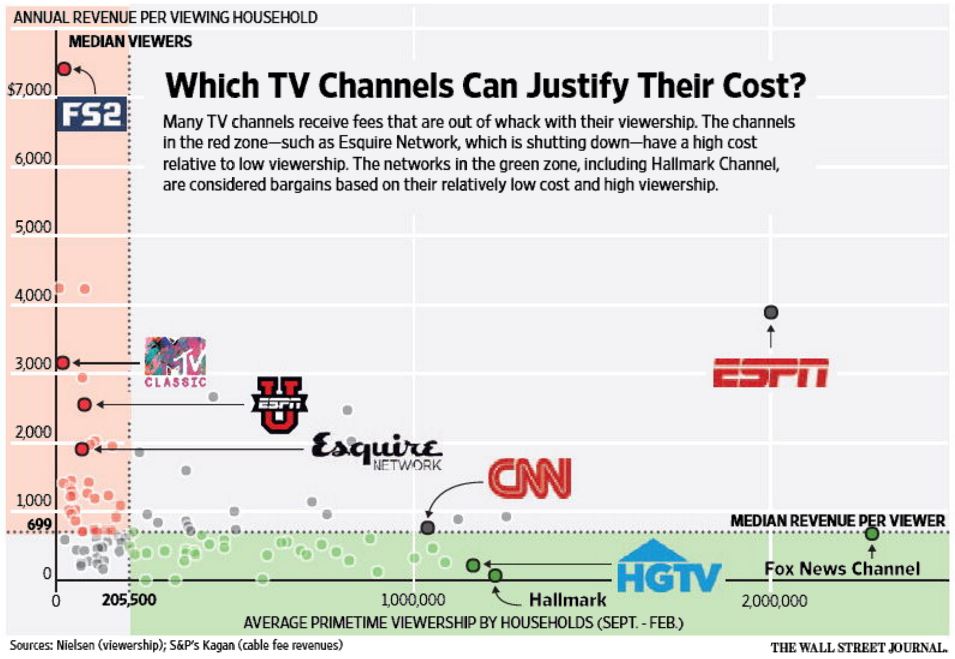
This report points out how dramatically the cost per viewer varies. with rarely-watched channels like Fox Sports 2 and MTV Classic costing many thousands of dollars per year per viewing household, compared to a median of $699 (and of course the more highly viewed cost outlier, ESPN at $3,885, for its barely over 2 million viewers). Some of the channels are nothing but reruns! What a waste! Some channels have made a killing on this, but it is time the industry got its house in order, and moved on to provide real value at a fair price.
There is a constant drumbeat of news reports on the decline of pay-TV bundles, and of the difficulties faced by the growing number of skinny bundles.
When will the industry move beyond all of these silly bundles? We don't need no stinking bundles! What we need is value-based pricing for what customers actually watch.
[More Updates:
Subscribe to:
Posts (Atom)