Showing posts sorted by relevance for query co-creation. Sort by date Show all posts

Friday, July 24, 2015

The Naples Forum on Service -- Co-Creation of Value, and FairPay as Co-Pricing


The presentation deck is online:
Co-Pricing: Co-Creating Customer Value Through Dynamic Value Propositions


I presented the concepts of FairPay -- in collaboration with two prominent professors of marketing -- to international leaders in an emerging branch of marketing theory at the Naples Forum on Service on June 11th. It was very encouraging to see how the work I have done from a pragmatic, non-academic perspective resonates with those at the leading edge of theory.

This 5th Naples Forum on Service is dedicated to the areas of Service Science, Service-Dominant Logic (in contrast to traditional Goods-Dominant Logic), and Network Theory, which all relate to emerging recognition that business is really about the "co-creation of value" by consumers, service providers, and other "actors," and that the production and sale of goods (which provide "value-in-use") is just one aspect of this larger concept of service. This has become a focus not only in academia, but in forward-thinking companies like IBM.

FairPay and Co-Pricing

My collaboration with Adrian Payne and Pennie Frow began when I contacted Adrian about his pioneering book on Relationship Marketing, with the idea that FairPay was very aligned with his thinking.  That led to discussions of his more recent work on business as co-creation (see Strategic Customer Management by Adrian and Pennie), and how that involves many co-creation activities, including co-pricing.  The theoretical ideas of the co-pricing aspect have not yet been well developed, partly because examples of co-pricing (like value or outcomes-based pricing, and pay what you want) have been limited in applicability relative to other, more studied, aspects of co-creation. 

We think FairPay has immediate potential to radically change business practices in a way that puts a powerful new form of co-pricing at the forefront of digital content businesses (as described throughout this blog).  Likely initial applications are for digital offerings to consumers in markets such as journalism, e-books, music, video and other content, as well as games and other apps -- both directly between service providers and consumers, and via aggregator/distributor platforms. 

The slides from our presentation are now available on online, and the abstract is now published in the book of abstracts (page 51).

Research Directions

My experience at The Forum reinforced my personal view that FairPay (or a variation on its theme) will not only change a wide swath of business, but will also change the theory of marketing and economics more broadly. My work on FairPay highlights how current practices in pricing fail to correlate well to value-in-use -- and it is value-in-use that is at the core of our markets (whether we recognize it or not). Whether in practice, or just as a thought experiment, thinking more about practical ways to make prices better correlate to value-in-use (and to view that over relationships, not just transactions) will enable us to change how our economy works, and very much for the better for all.

Collaborators?

Adrian, Pennie, and I have started on a more formal paper -- and we seek other collaborators who can help us do field trials of FairPay.  This could be an unusual opportunity to do research that not only advances theory, but potentially gains wide recognition from managers and the general public -- by solving urgent problems in finding good business models for the rapidly evolving digital space. (If you have interest in assisting, or suggestions of those who might, please contact me: fairpay [at] teleshuttle [dot] com.)

Thursday, August 22, 2019

A Platform for Teaching Men to Fish -- "Revenue-as-a-Service" for Non-Profit Impact

Fund development of a platform that enables non-profits to sustain themselves
Give a man a fish and you feed him for a day;
Teach a man to fish and you feed him for a lifetime.
The same applies one level up:
Fund teachers of fishing and you feed their teaching for some days;
Fund a platform that supports teaching men to fish and you feed all of them for all of their lifetimes.
This could be a very high leverage opportunity! Making a transformative new tool widely available and affordable.

Foundations and others who fund charitable service organizations face a huge problem:
  • Current strategies for funding non-profit services have yet to exploit the power of digital relationships to transform how they work with their customers and donors.
  • Digital technology is already enabling transformative tools, especially for businesses on the leading edge of relationship commerce. Businesses are shifting to recurring revenue models, managing customer journeys and loyalty loops, and the most enlightened are engaging in dialog the brings a mutual focus on co-creation of value. The FairPay framework described in this blog and elsewhere supercharges value-centered relationships, and applies to non-profit organizations  (NPOs) as well as for-profit businesses.
  • But non-profits lack business sophistication and can rarely afford to put resources into developing, testing, and applying similar methods to their relationships. The FairPay framework can transform revenue management at a full range of levels, but much of this potential remains out of reach for many organizations
  • Meanwhile foundations and others are looking for ways to support worthy non-profit organizations, and for ways to make those services more cost-effective in their funding and operations.
***Note that much the same applies to news organizations that struggle to sustain socially valued journalism -- even where there is a for-profit element.***

"Revenue as a Service" for Non-Profits -- platforms as a universal leverage point

Viewing this from a systems perspective, this opportunity appears: Fund development of a platform to enable non-profits to sustain themselves by drawing more systematically on support from their community of customers, patrons, and donors. This can provide leverage across a broad swath of service organizations.
  • Non-Profit Organizations (NPOs) -- as well as others, such as news providers -- need a systematic, ongoing way to obtain funding to sustain their operations.
  • That can now be done in very sophisticated ways -- and that sophistication will be constantly increasing -- drawing on advancing technology. 
  • The FairPay framework outlined here suggests a path to transformational improvements in relationship-based revenue models. 
  • Doing that will take skills and resources that may not be economically feasible for small or even mid-sized organizations (even if they would pay back handsomely).
  • That is just the kind of problem that "Software as a Service" was designed to solve: a platform provider (whether for-profit or non-profit) can develop, operate, and continue to enhance a high quality service that non-profit organizations can outsource to. 
  • This can bring economies of scale and network effects to solving the problem of nurturing revenue relationships with large numbers of patrons. (Venture capitalists love platform businesses because of their scalability and high return on investment.)
  • The impact of a non-profit platform could be so transformational that such projects should be very attractive to the charitable foundations that support non-profits and/or journalism. (VCs might be concerned that profit potential of such a platform may be limited by the tight budgets of the NPOs that would use it -- all the more reason for foundations to step in.)
Such a platform would provide "Revenue as a Service." Just what is that outsourced service?:
  • The platform provides the common base of operational software services (based on marketing and behavioral science, technology, and systems analysis), that can facilitate relationship-based revenue management strategy and execution for each of many organizations. Build it once, use it many times. Spread the cost of research, development, and support across many client organizations.
  • Each of those client organizations can retain full control -- setting all the key policies and retaining control of all exception handling. Each decides on all the parameters that define how the system works for them (the platform service may offer suggestions to guide that). Each  gets to have its people handle all human-to-human contact (but can outsource parts of that as well).
There are some existing models for revenue platforms for NPOs. They range from cooperatives like Tessitura, to for-profit services like The News Project, and less structured services for recurring crowdfunding like Patreon. FairPay provides methods for making such services far more powerful, across a far broader range of NPOs. The paths forward are 1) to add advanced FairPay features to existing platforms, or 2) to create new platforms that are clearly focused on FairPay strategies.

"Impact Data as a Service" -- platforms as instrumentation

Funders not only want to get good results, but to get the data to validate whether they are in fact succeeding in that. Common platforms lead to common data and metrics, and common reporting practices.

FairPay drives organizations to increase the quality and frequency of their operational dialog with their community, creating a new level of impact data. Platforms that manage and add new layers of communication with an NPOs's customer/donor community will create new kinds of fine-grained data and metrics -- on just what services are consumed by whom, with what outcomes, how those are valued by those individuals, and how they add value to each community member -- interaction by interaction, over the lifetime of the relationship.
  • That creates a new level of rich data on just what services were consumed and the impact they achieved. 
  • That enables the organization to be more dynamically adaptive and self-tuning, to maximize their co-creation of value with their community. 
  • Funders can use that data to manage their funding and maximize their own impact.
The following sections explain how this is achieved.

The heart of the platform opportunity -- the FairPay framework

FairPay is a radically innovative framework for relationship-centered, “customer-value-first” revenue strategies for the digital era. Its varying forms can be adapted across a wide spectrum of business contexts, both for-profit and non-profit.  (It is an open architecture in the public domain, not a product, and I am working on this as a pro-bono project.)

The original focus of FairPay was on advanced strategies for sustaining for-profit enterprises (especially for digital products and services) -- but the framework spans non-profit services as well, and can be even simpler to apply in non-profit contexts. The core strategies of FairPay have gained recognition in business and scholarly publications. It has strong foundations in behavioral economics, and sheds light on many knotty issues and perverse incentives that are often poorly understood.

What can FairPay do for service organizations? FairPay provides a framework for applying elements that can be mixed and matched to provide a powerful solution to engage customers and donors, and build ongoing relationships with them in a way that motivates them to cooperate in sustaining services that they value. (I use the term "customer" in the broad sense, as including those served as wells as those who donate, regardless of whether they are overlapping or distinct sub-groups. The term "patron," in its broad sense, also conveys that inclusiveness.)
  • Modern behavioral economics has shown that people want to be fair and even generous when asked in the right way to support a service they find valuable. 
  • Game theory teaches that relationships can operate as repeated games, and that well-designed repeated games that are rewarding motivate cooperation to continue the game. (Subscriptions and memberships are forms of repeated games, sometimes well-designed, sometime not so well-designed.)
  • Marketers have learned that they can build profitable recurring revenue businesses based on ongoing relationships (a simple form of repeated game) rather than one-shot transactions, and are beginning to apply the lessons of behavioral economics to enhance that process. They are managing customer journeys and loyalty loops, and engaging in dialog the brings a mutual focus on co-creation of value.
  • FairPay adds more advanced elements to the mix, and combines them to re-align the repeated game to maximize cooperation in creating lifetime value. FairPay builds on transparency and trust to build relationships. It applies empowerment of stakeholders (to show trust), dialog about value given and received (to achieve transparency and motivate willingness to pay to sustain that), and reputation (to sustain trust). 
  • FairPay works best when the business can position itself as a benevolent and fair partner in value co-creation that is worthy of the "price" it needs to sustain the relationship.
  • Non-profit organizations can apply the same methods, and are more naturally seen as benevolent and fair partners in value co-creation.
  • Therefore non-profits have more power to motivate fair contributions from their "customers," and therefore they are able to yield more power to their customers than for-profit businesses are. 
  • That enables them to make contributions voluntary (as is already common practice, but not yet effectively managed with modern relationship-building tools). Such voluntary forms of the more advanced methods of FairPay are relatively easy to apply. 
  • These methods center on regular and ongoing dialogs about value that remind customers of the value co-creation they have benefited from (looking backward to what has been experienced, not just promised for the future), how much they have contributed to sustaining that, and what more can and should be done to add value (in whatever forms are agreed to) in this relationship. That points to what else of value can be done. 
The FairPay framework informs an architecture that can enable NPOs (and journalism organizations) to enhance their revenue-related operations -- to apply the latest business systems, methods, and communications media in a way that optimizes their relationships with their "customers" (again, including donors) to maximize their ongoing sustaining revenue. 
  • This process applies a new kind of leverage -- as a self-adapting engine to create real and valuable impact, measure its perceived value, and adjust the process to do even better.
  • From this perspective, the FairPay framework clarifies how little most businesses and NPOs are currently doing to maximize that, and how much more they could be doing.
More detail on just how this FairPay framework works follows, but first, what does it take to make it happen?    

The platform that supports teaching men to fish

A basic platform for bringing these tools to fund-raising and revenue operations could be built in stages. This is a natural candidate for applying an open source strategy (or a cooperative) to become self-funding beyond a certain initial pump-priming:
  1. Do a basic proof of concept. This could demonstrate the synergy of the combined elements and make the case for further investment. It might take something like 1/2 person-year in total, split between technology and business analysis.
  2. Enhance that to a "minimum viable product" level to be a useful service for a large number of organizations.
  3. Facilitate cooperation of that user community to continue further development, and to attract experts to aid in developing and testing more advanced methods.
  4. Build all of that out into a vibrant, self-sustaining platform ecosystem (much as has been done with other platform or SaaS services like Linux, Mozilla, and Wikipedia).
NPOs (and/or news organizations) could then use this platform to get far more effective and sophisticated in managing their activities as a revenue-generating business, in ways that deepen their social contract with their community.

(As noted above, existing revenue platforms might also be enticed to take the lead in adding FairPay features.)

The FairPay social contract

FairPay works by creating a new social contract for sustaining the creation of desired services.

Consider this change in the game:
  • From today’s conventional repetition game: “Here is our requested price/donation, take it or leave it. We hope you will take the risk — and be satisfied enough to continue this game.”
  • To the FairPay game: “We will grant you the power to pay/donate what you think fair for you after each period of service — we will remind you of the services you got (or funded for others), and will encourage you to pay/donate accordingly.”
This voluntary form of FairPay relies on dialogs about value to frame the value proposition, and to remind patrons of the value they received. It empowers them to determine the "price," engages in transparent dialog about the value that the price should relate to, and tracks reputation to build trust and to know how to nudge fair levels of support.
  • It draws on all available information on when and how services are actually consumed by each patron. Increasing availability of fine-grained usage data will make that increasingly meaningful.
  • It may seed its dialog with individually-calculated suggested prices based on the value and cost of those services. (Even if services may be offered to some at no charge, it may be fair to gently nudge others who have greater means to pay for those services for themselves (and others) as they can afford.) 
  • It regularly solicits payments to sustain ongoing services in an open and transparent way, framing and managing the dialogs about value to remind patrons of the value they (and others) got, and what and when they have paid in the past to sustain that, why they should now pay again, and what new value to expect. 
  • It learns which patrons are fair or even generous in their corresponding payments, so that they can be most effectively nurtured, and resources can be directed to serving those who most appreciate the value offered.  
  • It can suggest additional benefits (perks, tiers of services) based on how fair or generous the customer is
  • In selected uses, it can also withdraw benefits -- for-profit businesses can use that "stick" to enforce fairness, but non-profits might stick to more positive "carrots" (but might still use "sticks" in limited situations).
That is how it drive revenue operations, building on that basic social contract. This is simple in in its core concept, but it is amazing how few organizations engage in real and regular dialogs about value with each customer at this fine-grained level.

  • Engaging an NPO's community on what it offers each of them, what each of them values, and what it needs in the way of support from each of them is the way to build strong sustaining support, enabling it to co-create the maximum value. 
  • Some managers fear getting customers to think about value and price, and some fear that customers will not be willing to engage in such dialog. But behavioral economics shows that customers are far more responsive to productive dialog about value and price than most businesses realize (my latest journal article cites a number of compelling studies, and the most relevant are listed in my Resource Guide). 
  • Managers also tend to forget how much their value propositions vary from one community member to another. (A simple thought experiment can help recenter on the importance of these individual value propositions.) 
  • That, in turn, enables a funder to leverage its impact -- the value it co-creates with its NPO portfolio and each member of their communities.
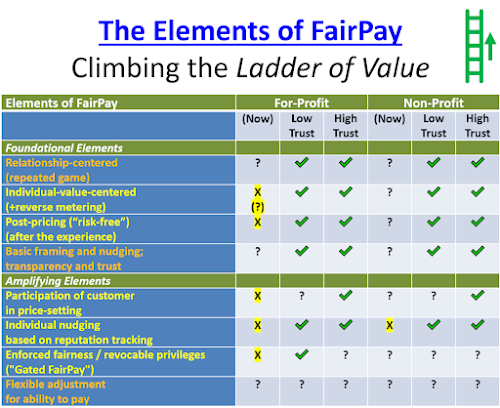
There is of course much more to how this is done, and it will vary greatly from context to context. Background on these variations is in my previous post, The Elements of Next-Gen Relationships and Pricing -- A Unifying Framework. It provides this summary table of the elements, and then comments on each:

 (with minor updates 10/27/19)

The columns to the right show that while most of these elements are applicable to both for-profit and non-profit organizations, the details will vary, and it will further depend on the level of trust and cooperation in the customer segments to be addressed.

As indicated, most non-profits currently use fewer of these elements than for-profit businesses, but greater use could improve their results (including increasing the satisfaction and generosity of their community). This presents a broad opportunity for a platform to make it easy for non-profits of all sizes to gain leverage.

Again, the clearest difference from how FairPay is used by for-profits is that fairness will often be left as voluntary, to be gently nudged with positive "carrots" rather than enforced with negative "sticks" (such as the revocation of privileges). But motivating fairness should be relatively easy for non-profits, since they can readily point to both the individual value and broader social value of their cause. (And non-profits can generally avoid the most complex element of FairPay, the business logic and policy issues of revocation or other negative incentives.)

The foundational elements are already used to some degree in many contexts, to build on the power of ongoing relationships. Now the amplifying elements can be added in and combined, to bring new synergy to revenue operations.

The general implication of the differences across columns is that the more advanced elements of the FairPay framework are most effective when the parties are perceived as holding up their side of the social contract:
  • for service providers who are perceived as offering real value and warranting trust and commitment from customers/patrons for being fair, transparent and responsive to their value creation needs and desires.
  • for customers who are perceived as fair and honest about communicating their needs and desires, and being fair (even generous) in making contributions to sustain that desired value creation. 
Concrete use-case examples

If this still seems abstract or unclear, please see my other posts with more concrete details of how FairPay applies in specific use-case examples:
Simpler "80/20" solutions with the same platform

Organizations using this proposed Revenue as a Service platform need not use its more advanced features, except as they are ready and wish to. The platform can be configured to deliver just the features each organizations wants. Thus it can provide a service that scales gracefully, from very basic, to very advanced.

One very important simplification of FairPay can serve as a high-leverage 80/20 solution in both voluntary and payment-required contexts. That is the "risk-free" subscription model that relies on post-pricing (after the experience). That can be done without using any of the participative pricing elements of more advanced FairPay solutions (and need not even exploit nudging). That is less of a departure from traditional set-price subscription or membership pricing. But unlike the high hurdle of an all you can eat, fixed price membership paywall, it works as a gentle "pay ramp." (This, too, is explained in my Elements post, and the Whitney and Metropolitan Museum use-case examples listed above.)

Similarly, the platform, itself, can be built in stages, beginning with the more basic elements, then gradually adding the more advanced ones.

Crossing the lines between donors and those served

As explained in my 2016 post on non-profits, FairPay provides new and better way to address the complex issues of pricing and sustainability across the spectrum from donors to those served.  Consider how this works for these two often overlapping constituencies:

·         Recipients -- direct customers/patrons of direct services (the mission). Here, pricing takes on two interrelated dimensions -- what is the fair value of the service, and what is the fair contribution from the recipient (to both the cost of the service to them, and to the added overheads needed to sustain the organization -- and optionally to the cost of service for those who can less afford it).
·         Benefactors -- indirect customers/patrons of indirect services (the altruistic value of supporting services to others, and the value of being a benefactor, including perks and recognition).  Here, the key dimensions are the value of direct services to others enabled by the benefactor’s donations, and the value of the indirect benefits to the benefactor.

The details will vary with the type of customer/patron and the nature of the organization and mission, but the essential task is the same -- to generate sustaining revenue by cooperatively setting prices (for service or donation) that make the value proposition "win-win." (That also includes recognition of non-monetary contributions by those who give in kind.)

The platform as a universal leverage point for achieving impact

The problem that limits the uptake of these methods is the implementation effort, and the need for ongoing testing and refinement (including "devops," the work of enhancing and maintaining the operation). Fund a platform for that, and many more organizations will be able to teach men to fish -- or give them fish -- or whatever other good works they do. The platform is a universal leverage point.

A platform solution across many organizations also has other kinds of economies of scale and network effects, beyond simply outsourcing that service. FairPay dialogs about value generate valuable data about exactly what each customer values at a fine-grained transaction level, as well as reputation data about the fairness of each customer (and how that varies with context). While that data is sensitive, if managed with care it could potentially be used in win-win ways to help guide service providers to engage with those customers who most value their service (for a single service provider, or across all the service providers that use the platform, subject to appropriate privacy controls). That can lead to more effective co-creation of value for everyone.

------------------------
Posts that are specific to non-profits and social welfare:
...and focused on journalism:
------------------------

[Update 4/14/20:]  An excellent article on how one platform service, Network for Good, is bringing some of the relationship-building methods I describe here, is How NonProfits are Doubling Down on Relationships with Subscription Giving. The article is by Tien Tzuo president of Zuora, who wrote the excellent book, Subscribed, that I reviewed in 2018.

------------------------
More about FairPay

A concise introduction is in Techonomy"Information Wants to be Free; Consumers May Want to Pay"

For a full introduction see the Overview and the sidebar "How FairPay Works" (just to the right, if reading this at FairPayZone.com). There is also Selected items (including links to videos and decks). 

(FairPay is an open architecture, in the public domain. My work on FairPay is pro-bono. I offer free consultation to those interested in applying FairPay, and welcome questions.)

Wednesday, August 16, 2017

The Missing Piece of the Membership Puzzle -- Agreeing on Value for Each Member

Journalism and many other digital content services face an existential threat to sustainability, and are rightly looking to membership models as a possible solution. Consumers are questioning their value propositions, and advertising and sponsorship models are highly problematic for quality journalism as well as many other kinds of creative content. 

This post looks at the membership puzzle and suggests that the missing piece is a new economic logic for membership that personalizes individual member value propositions. I write in terms of journalism -- as a special, and especially urgent use-case -- but similar logic applies to many other forms of creative content as well. As you read "journalism," think also of music, literature, video, art, or any form of content as a service. Similar models are also referred to as patronship models, and often make use of crowdfunding platforms (like Patreon and IndieGogo) that support ongoing creative efforts

[Update 8/17/17: NiemanLab reports on Press Patron, a patronship platform that is specific to journalism.]

[Update 11/16/18: The Correspondent launched in the US with a "choose what you pay" membership model. I commented on that, applauding the customized pricing, and suggesting some next steps related to nudging, and making membership "risk-free".]
---

The economic logic of membership sustains ongoing value creation efficiently if and only if each member feels that the price he or she is asked to pay for membership tracks well to the value he or she gets from membership. No matter how great and how engaging the value of membership, if the price to each member is not reasonably well aligned with that individually perceived value (as a fair share of wallet), the solution is ineffective.

The survival of journalism -- a guiding principle
The survival of journalism is too important to be left to the journalists! ...unless they refocus on the business and individual value propositions of journalism.  
Journalism is a service -- to individuals and to society. The current existential crisis in journalism is primarily a crisis in the economics of that service. The solution is not just better journalism (important, especially in the age of "fake news") but better economics (essential).
Finding the answer to this crisis is complex, with numerous pieces to be fit together. Many are considering this puzzle and seeking new paradigms, including "membership" -- a more relationship-oriented view of recurring subscription services that focuses on supporting them primarily by member payments (often voluntary payments) -- which requires making these services smarter, more cooperative, and more customer-first.

These efforts have identified many important pieces of the puzzle, but there is a unifying piece missing. I center on the economics of individual member relationships as the unifying piece that aligns the other pieces into their proper place, and outline some strategies for shaping that central piece.
Value exchange is core to the missing piece. That it is not simply a matter of making journalism more valuable. When a value exchange relationship involves a price, value is sustainably exchanged only if the price is right for the individual customer. That requires that value be quantified into a price, and that price be tailored to that customer. 
The missing piece is to build a process of co-creation that looks beyond the co-creation of "valuable" journalism as a thing in itself, to the nature of the co-creation of that value in economic terms, and to use that to continuously optimize the pieces to be offered to each member. The currency for this economic value of journalism is money. Creators of journalism need fees from their members to survive and continue to co-create journalism with them. Each member is different. The fundamental economic question is what should the fees be for each member, as that varies over time. It is widely recognized that trust and transparency are key elements of membership services, and I suggest that financial trust and transparency are critical to that.

For each member, we need to find a balance of value received and value given -- and to do that by adjusting the amount of any monetary payments made.
  • Without a clear understanding of the value each member perceives from the features and activities of their membership, managers of member organization are flying with blurred vision and disconnected controls.  
  • Value varies from member to member and from time to time.
  • Individual member value perceptions are determining factors in how all of the pieces should fit together for each member.
This question of individual value underlies all the decisions of what journalistic value to create, who to deliver it to, and how to manage that.
  • The old walls between the business of journalism and the craft of journalism were relevant to advertising-based journalism that needed so-called walls between "church and state" to protect journalism from pressure from advertisers.
  • Those divisions are now impediments to a reader-supported journalism business that needs to understand the dynamic and individual value exchange with the readers (members) who it asks to sustain this deeper co-creation.
While much is changing as journalism seeks to reinvent itself for the digital era, this division is deeply entrenched -- both in large established publishers, and in newer "membership"-oriented publishers.

Large news publishers are beginning to take a more business-like view of value, but often not in a very customer-first or relationship-oriented way. Directions such as those outlined by David Skok's astute NiemanLab prognostication -- and being pursued by many large publishers -- view journalism as a product to be priced using a dynamic meter, at a transactional level (often per article), drawing on the lessons of analytics-based dynamic consumer-goods pricing. While effective in many contexts, this zero-sum game is antithetical to trust and transparency, and a dead end for journalism. It may help bring in revenue from a diversity of very occasional readers, but does not build real relationships with the regular readers who are the main reservoir of sustaining support.

The membership model moves toward a more member-first, relationship-centered, co-creative view of the value proposition, but does not yet give that a necessary grounding in the core issue of member-specific value exchange. Much attention is being given to what pieces to offer and how to fit them together, to make them most valuable -- but this key piece seems to be largely missing:  value propositions have two sides: what value, for what price.
  • High value at a price that is not perceived to be commensurate to that value (for a particular member), is not really high value. 
  • Member programs are still mostly based on a one-size-fits-all price (even if that price is voluntary). Sometimes membership plans are tiered with different prices for different packages of services, but still that is generally a given package for a given price. 
  • Data on how individual members perceive those prices is very limited, and there seems to be little attention to developing that data on an ongoing basis so it can be used to continually and systematically refine what product mix is offered, to which members, when.
Membership models are based on the understanding that readers (at least a significant portion of them) should pay for the journalism they want. We can do a great job of identifying who to engage about what, and what to offer them -- but if it all devolves to a single pre-set price of membership (even if it is voluntary), we have failed to find the right value proposition.

To solve the member puzzle we need to do the best we can at managing the value propositions offered to each member -- and that centers on managing prices individually:
  • knowing how each member values each available piece/service, as well as the synergistic values of the ongoing services more broadly
  • letting the members select the pieces/services they most value (with respect to price)  
  • adaptively and dynamically adjusting the prices to meet the desires of each member (to the extent they can be profitably served), as they change over time
  • and, whether or not payment levels are voluntary, intelligently nudging each member to be appropriately supportive.
No matter how well you solve the membership puzzle, sustainable success will be all about the value that members feel they are getting -- and whether they feel they are paying a fair and affordable price for that. Some will be generous patrons of journalism, not just for themselves but for the community -- while some will be less generous, depending on their desires and means. With digital content that can be replicated at negligible cost, even those who are just marginally supportive can add sustaining profits.
  • If the price for the value proposition seems too expensive (too much share of wallet), a prospective member will not join or pay (or if they do join or pay, will not be retained) and their contribution will be lost. 
  • If the price for the value proposition is too low for a given member (less than their fair share of wallet), sustainability will be starved. 
What I propose is a new perspective on the economic aspects of the membership relationship. The core of that perspective is that (1) the basis of the journalistic relationship must be economic, and (2) that economic part sustains ongoing value creation if and only if each member feels that the price he or she is asked to pay for membership tracks well to the value he or she perceives from it. No matter how great and how engaging the value of membership, if the price to each member is not reasonably well aligned with that individually perceived value (as a fair share of wallet), the solution is ineffective.

I describe methods for continuously seeking to maximize that alignment in this blog, and in my book. More on that below, but first, some background on membership models.

The Membership Puzzle Project -- a social contract based on trust and transparency

The Membership Puzzle Project (MPP) is a new and important effort to solve the problem of finding a sustainable path for journalism. It seeks to learn from a growing body of success stories in which publishers seek deeper relationships with their readers by becoming "customer first" and seeking new, more cooperative, and more individualized ways to co-create value. I have exchanged emails with the MPP team (an extract is below), and hope to meet with them soon. I have volunteered to contribute to that effort because my work on advanced, adaptively win-win forms of subscription/membership models is very relevant to the project objectives.

The MPP is a laboratory project led by Jay Rosen's team at NYU (along with De Correspondent, an innovative Dutch publication looking to create a US edition) -- supported by $515,000 in funding from three prominent foundations. While this project is specific to journalism, I expect it to provide lessons relevant to digital content services of all kinds.

As stated on the project's about page,
So where is the sustainable path? It seems increasingly likely that readers who value a public service press are going to have to sustain it themselves – by contributing money, sharing knowledge, and spreading the word. A good term for this is membership. But membership won't work if it's just begging for cash. There has to be a social contract between journalists and members. Working out what that contract should say is the core challenge of the Membership Puzzle Project.
In a more recent report, "Members made a moral decision: this is something I should support."

Notice this "social contract between journalists and members." Much of what I see discussed about this social contract involves aspects of the substance and process of collaborative journalism (as outlined in this MPP post) that I am no expert in. But Jay Rosen's NiemanLab article makes it clear that a core aspect of that social contract is the "'pay' model" and whether it works "to maximize trust in a 'readers pay the freight' model." This blog, and my book, are focused on emerging strategies for doing just that.

Trust is not enough -- trust depends on value

Membership projects rightly make much of the importance of trust and transparency as central to the relationship of journalists to readers/members. A recent update by Jay Rosen, on their interviews of De Correspondent members, reports that "Trust through transparency is almost universally seen as a key principle...It shows respect for the reader, and it invites their participation, not just their attention."

That is vital, but trust in the journalistic reporting/creation process is not enough -- trust depends on value. Misaligned value weakens trust. Conversely, trust enables the transparency, responsibility, and fairness needed to agree on value. Seemingly arbitrary pre-set prices detract from perceived value and compromise trust. Even when such prices are voluntary, the process of setting prices and framing the value in the value proposition can add or detract from trust and transparency -- and from revenue.

Other current membership/patronship efforts -- in journalism ...and more broadly

The MPP builds on numerous ongoing efforts to develop membership/patronship models, both relating to journalism and more broadly. NiemanLab features Shan Wang's reports on a variety of them, including the News Revenue Hub's efforts to help news organizations in such efforts. Even well-established major publications like the Guardian are trying membership models (a voluntary, but pre-set, $84/year). Other similar ideas are being applied to a wide variety of other kinds of content.

Notably, some are supported by widely used platform services, such as those offered by Patreon and IndieGogoBen Thompson's Stratechery adds perspective, and expands on the importance of platforms to simplify and pool the mechanics of the back-end tasks needed. Much of the mechanics of FairPay that I describe here could be similarly offloaded to a platform (and some platform providers have shown interest), but whatever the back-end, the fundamental focus on member value remains core to journalists or other creators.

Valuing the pieces of the puzzle

What should the price of membership be, and how insistent should a publisher be about that? The recent update on member interviews by Jay Rosen notes that while De Correspondent charges €60 for its voluntary membership, many members said they would pay much more, €100 to €150, even though they acknowledged that asking for that much up front might have kept them from signing up. Wiktribune takes a more discretionary approach, allowing members to pay what they want. But in any case, the question is how to entice members to pay their fair share -- and to make them feel good and trusting about it, so they continue to do so.

Some of these efforts recognize the diversity of member needs by providing for multiple tiers of membership (or similar forms of patronship), often with different rewards. That is smart in recognizing that different members seek different value propositions. But it gets very complex, and the problem of individual variation is that managing this diversity (both from member to member and from time to time) gets intractable (and just leaving it to member whim risks erratic results). I addressed some examples of that in a previous post, and an interesting NiemanLab review of public media membership efforts by Melody Kramer shows just how complex this can get, (and how far afield of the core value propositions of a service -- tote bags, T-shirts, and coffee mugs -- it can devolve). Pre-set tiers are just not very workable. We need a more dynamically personalized and continuously adaptable approach.

Operationalizing member feedback -- continuing dialogs about value
Think of the membership puzzle as analogous to a jigsaw puzzle that is different for each member -- and so must be solved anew for each member. A puzzle that does not picture value (as seen by the member in question) is like a jigsaw puzzle turned upside down, so that we cannot see the desired pattern of value we seek to solve for. Not being able to see the picture makes solving the puzzle extremely hard.
Another recent post from Emily Goligoski of the MPP highlights the challenges of understanding these value propositions:
Many membership program details are treated ad hoc and roughly benchmarked to competitors’ offerings (a line of thinking that goes if the other station in town costs X per month for members and if subscribing to Spotify costs Y, then we can charge…). Most media companies don’t carefully plan the details of their social contract, including pricing and participation asks.
And this is not just a static problem. Keep in mind that that the puzzle for a given member this month may be very different from the puzzle for the same member last month. The reporting and features change, and the member's needs, attention, and desires change. To really solve this puzzle, we must evaluate the value proposition more or less continuously. Periodic member surveys (such as those being done as part of the MPP as a project effort) are an excellent start, and are current best practice. But I suggest that is just a start.

This is something that FairPay seeks to make routine, and to operationalize it into an ongoing feedback control process that is integrated with the payment request process and the creation process (in an adaptively lightweight way), in the form of ongoing dialogs about value. This ongoing operational feedback from members integrates not only with financial operations data, but also with the core operational data and analytics about member usage. This combination of data and analytics enables ongoing optimization of what services are offered (journalistic and more broadly), to what members, when.

Solving for Value -- A new social contract based on an invisible handshake

FairPay provides strategies for setting pricing and value propositions that can form the core of a new social contract for journalism. While this new logic can be approached in stages, the full form of it is that the publisher offers this social contract:
  • We seek true partners in sustaining the co-creation of journalism for you and our other readers.
  • We will seek to involve you in what we co-create with and for you, to provide you the services you most value.
  • We will permit you to participate in setting prices that correspond to that value -- considering what you get from us, what you contribute to us, and your ability to pay (and how those factors may change over time) -- in order to support our continuing work.
  • We expect you to be fair about that, at whatever level makes sense for you and is fair to us.
I call this social contract an invisible handshake, because unlike the invisible hand of traditional economics (that allocates scarce resources, in this case, news stories, to match demand at a given time), this social contract is about an agreement to find and maintain an equitable relationship:
  • Digital news stories (and subscriptions to them) cost almost nothing to distribute, so are not scarce and cannot be priced by the invisible hand. 
  • What is scarce is the fair share of a reader's wallet that is needed to continue to co-create more news stories
  • Any social contract that does not address payments is un-moored from the economic reality of sustaining journalism. 
  • Because individual members vary widely (and over time), a social contract that expects all members to pay the same price (and a constant price) is bound to be unfair to either the member or the publisher in most cases.
The challenge to this social contract (the invisible handshake) is that different readers (members/subscribers) perceive very different value propositions, and the fair price of membership will vary from person to person (and from time to time) in ways we currently do not get data on. While much of the information needed to assess actual value (as realized in use) can be inferred passively, key aspects of value perception can only be obtained from the beholder. The fair price depends on the nature of their experience, their willingness to pay, and their ability to pay. A publisher can seek to influence these personal aspects, but the final reckoning is best done:
  1. after each cycle of experience, when value is most fully known, and
  2. with the input of the customer, who has unique knowledge of the value as experienced.
FairPay offers a new strategy for enabling publishers to estimate these fair pricing factors through individual dialogs with members about value -- and for doing so repeatedly over the course of the relationship. An explanation of how this can be done in the context of journalism is in my post, Patron-izing Journalism -- Beyond Paywalls, Meters, and Membership. More on the mechanics of the core process, and how it builds cooperation to converge on fair pricing, is in my post, FairPay Changes the "Game" of Commerce. (These posts present the full form of FairPay that balances the pricing power of members with controls by publishers that seek to ensure minimum fairness to the publisher -- but for membership programs that prefer the greater openness and trust of a purely voluntary pricing regime, there is a simplified variant of FairPay that supports a Voluntary Payment Mode. That variant uses similar strategies for nudging members toward fairness, but without enforcing any minimum fairness level.)

Don't panic!

While FairPay may seem complex, it can readily be simplified and reduced to habit, to the point that it becomes largely automatic except when adjustments are needed, as outlined in Profiting from Habit -- Seamless Monetization. It may also seem that consumers may be inclined to be uncooperative and seek to game the system, but FairPay can be initiated for just those segments who will be most amenable, and even eager to cooperate (which is where membership models work best anyway), and then expanded from there, as outlined in Finding Good and Fair Customers -- Where Are the Sweet Spots?

Proven success with value-based pricing -- and value-based relationships

FairPay draws on the concepts of value-based pricing that have already proven very successful in many B2B businesses. It combines three key aspects that are essential to proper estimation of fair prices for individual readers:
  1. Post-pricing: Delaying final price-setting until after the experience, to enable the price to reflect the actual nature of the experience (what stories are read and engaged with, at what level and intensity, with what results).
  2. Participatory pricing: Involving the reader in assessing the perceived and personal aspects of the value exchange (value perceptions, outcomes, interests, objectives, priorities, tastes, as well as willingness and ability to pay).
  3. Bi-directional value propositions: The flow of value is not uni-directional (value to the reader and cash to the publisher). Often value flows in reverse (as Jeff Jarvis suggested), from the reader to the publisher, in the form of participation in journalistic creation, user-generated content, attention to ads (if any), use of personal data, and the many other forms of reader value contribution that are now increasingly recognized as part of the membership puzzle.
To the extent that a pricing process factors in all these aspects, it enables what I call value differentiation. Related to the traditional economic ideal of price discrimination, value discrimination seeks to find the right value proposition for each customer.
  • Price discrimination theoretically leads to an economically optimal price that maximizes revenue -- but it does that in ways that are are narrowly zero-sum and often secret and manipulative, and not reflective of the broader co-creative interests of both the publisher and the reader (detracting from trust and transparency). 
  • FairPay shows how the broader objective of value discrimination leads toward prices that seek cooperatively to optimize the value exchange in a much larger sense -- enabling us to factor in individual human and social values (to the extent mutually agreeable). This brings into the equation the social value of journalism and the need to sustain it, as well as the broader and more personal values of the reader, and solves it in a win-win, cooperative way that builds trust and transparency. 
The key point to remember is that we are not paying for current stories -- we are paying for a relationship that will continue to bring us stories -- doing investigative journalism, and providing other ongoing services in the future. That is the social contract, and its pricing must reflect that.

FairPay is a flexible architecture that a publisher can apply with any of a wide range of policies. Negotiated levels of fairness can be achieved under policies that give the publisher more or less control, using as strong or light a hand as desired. In any case, the strategy is for the publisher to seek to nudge members toward fair (or even generous) levels of sustaining support.
  • At one extreme member payments can be entirely voluntary (pay what you want -- or, more accurately, pay what you think fair) -- and at the other extreme strict fairness minimums can be enforced (mandated prices). 
  • The right choice will depend on the nature of the service and of its membership (and on the sophistication of the system implementation, which can start simply and be enhanced over time). 
  • For journalism, a balanced soft touch is likely to be best, with significant member discretion, but reasonable levels of individualized nudging for each member to to price fairly (for them)
Climbing the ladder of value

The full FairPay process applies rich dialogs about value -- but we need not apply all of its methods (post-pricing, participatory pricing, and bi-directional pricing) to see improvements in value propositions. All pricing methods can be ranked along a "ladder of value," based on the degree to which they apply these three aspects of value differentiation to find the right value proposition. By working our way up the ladder, we can improve our social contract incrementally. Some thoughts on how conventional pricing strategies can be ranked on this ladder of value are in my post, Finding Value in The Subscription Economy (I plan a more nuanced update that addresses all three aspects).

JaaS -- Journalism as a service, not a product

As is highlighted by membership models, many are coming to realize that journalism is not a product but a service, and that those services are not created by journalists alone (to be thrown over the transom at readers, for a price), but must be co-created with readers (at least in part). This parallels a broader awakening in modern marketing.
  • Many marketers are simply applying better technology to old ways of thinking, to apply old logics more efficiently (such as dynamic pricing, as set unilaterally by sellers). Unfortunately, that is a zero-sum logic that that kills trust.
  • The more seminal trend in modern marketing is a shift to a new logic. Many scholars and forward-thinking businesses have recognized that our traditional Goods-Dominant Logic (in which goods are produced by producers and then sold to consumers) is no longer relevant, and a that a Service-Dominant Logic (in which services are co-created, in a win-win process) is far more relevant and powerful. As noted above, membership models take a perspective that is very aligned with Service-Dominant Logic. I propose that value is central to this (Value-Dominant Logic).
Journalists would do well to understand this new logic of services that are co-created -- to see how broadly it can re-shape their view of their profession -- and lead to sustainable success.

Adding value to The Membership Puzzle Project

I hope the MPP team -- and others dealing with these problems (in journalism, and in other fields) -- will take a good look at these economic, business model issues -- issues of personalized value. I stand ready to assist in that.

FairPay is an open architecture, not a product, and I am working on this as a pro-bono project (in collaboration with eminent marketing scholars who can assist with trials). As noted above, even when the full FairPay strategy is not used, understanding the ladder of value can help chart the path toward solutions that get closer to the efficient value differentiation that is needed to make journalism (and other content creation enterprises) broadly sustainable in this new digital era.

------------------------
More about FairPay

A brief introduction is in Techonomy"Information Wants to be Free; Consumers May Want to Pay"
(FairPay is an open architecture, in the public domain. My work on FairPay is pro-bono. I offer free consultation to those interested in applying FairPay, and welcome questions.)

---
Background on how the FairPay relationship pricing strategy can transform the sustainability of journalism:
FairPay is unique in bringing new operational approaches to content businesses in a way that deeply aligns with emerging principles of marketing strategy, with strong foundations in behavioral economics.  It is a new approach to setting value-based prices for digital content (“experience goods” that are really services, not products).  This brings a deeply “member-first” approach to the operational basis of customer/member relationships.


===========================================
Addendum
An extract from my 3/20/17 email to Jay Rosen on the Membership Puzzle Project:

FairPay is fully aligned with, and can extend, the principles that have motivated De Correspondent -- and can point the way for others.
  • It solves the “membership puzzle” with a personalized, adaptive architecture that coexists with set-price models and encourages free viral spreading.
  • It enables memberships to be automatically customized to the interests and values of each member, founded on trust, value, fairness, and ability/willingness to pay.
  • It is driven by ongoing “dialogs about value” with each customer that take De Correspondent’s ideas about dialog to the core of the value exchange.  These include dynamically personalized value propositions (with reverse metering options to factor in the broad range of member contributions to value such as UCG, story leads, feedback, etc., and a rich concept of value that includes broad journalistic values).
  • The dialogs about value directly link members’ financial support to value --  what journalists do, in what domains, and what else is offered -- in a way that drives sustainability of the publication and deepens engagement -- at a fine granularity that optionally can be a factor in individual journalist compensation and their relationships with their “fans.”  It focuses on real value, not T-shirts.
This enables membership fees to be adaptively customized to reflect each member’s situation, as it varies over time:  how much they read, how much they support costly journalism, what they contribute back, and their ability and willingness to pay.  FairPay seeks to approximate optimal price discrimination, so that some members might pay much less that average, while others might pay much more, but with transparent agreement that it is a fair value exchange (and contribution to sustainability) for them.  This can broaden the reach of membership to a wider population of casual readers, and deepen it for “superfans.”

Thursday, December 1, 2016

How Market Commerce Can Become More Cooperative, Fair, and Human


A recent conference on Platform Cooperativism spurred some thoughts on how FairPay offers a path toward a new convergence of traditional ideas about market capitalism and alternative ideas about a "Fairness Economy." (This conference drew added attention from a Wired article about the idea that Twitter should become a co-op, "Let's Build the Next Twitter Like the Green Bay Packers.")

In exploring the concepts of a more win-win approach to commerce called FairPay, I have seen a spectrum of thinking about market capitalism and its limitations as currently practiced, and how to make our economy more in tune with human social values.
  • Market capitalism has created our modern world, and proven efficient, productive, and scalable -- despite a degree of blindness to human values. 
  • That has led to growing concerns about income inequality, slowing productivity gains, and concentration of power in corporations and investors, spawning a wide range of movements to change the game. These range from
    1) incremental steps like "Corporate Social Responsibility," "Creating Shared Value," and "Triple Bottom Lines," to
    2) benefit corporations and other more softly profit-oriented structures, and to
    3) more sharply different forms of organization like cooperatives (and other non-profits).
  • The conference focused on cooperatives, a form of business that has existed for centuries, and harnesses the same spirit as Open Source and Peer Production, and that can now build on the openness of the Internet to put ownership of a business in the hands of its workers and/or customers.
  • All of this occurred with a backdrop of the US election, which highlighted deep concerns about an economy that no longer seems to be serving middle- and working-class people well -- a hard push for change, but one with little consensus as to what kind of change can or should be achieved. 
Meanwhile, most businesses may still be far from meaningful social consciousness in their operational core, but increasing numbers do try to tack on some efforts at "good corporate citizenship." Some would argue this is just lipstick on a pig, but others see real potential to make existing businesses much better.

Hints of convergence -- human-centered marketing

The gulf may seem huge, but deep in the heart of modern marketing, a more direct incentive to being more fair and human is emerging. Companies are realizing that in this networked age, their most important customer relationships are ongoing, and that loyalty and Customer Lifetime Value (CLV) are more important than immediate sales. Companies are beginning to see that Customer Experience (CX) is central, and that they must attend at every touch-point to creating desirable Customer Journeys that build Loyalty Loops to cultivate their best customers. (Forrester recently reported that CX leaders grew at 17% per year compared to 3% for CX laggards.) This re-orientation is starting to drive companies toward deeper, more personalized dialog with their customers and more human, cooperative values.

How FairPay changes the game

FairPay enables a shift in business operations to focus on a more cooperative "co-creation" of value that improves the bottom line. That can help bridge the gap between these two very different models, by making ordinary for-profit corporations more aligned with their customers and what they value -- including human values of people and planet.

The magic of FairPay is that it can be applied in any of these ownership structures. It can work very nicely in alternative structures like co-ops, but can also work as a core operational process in ordinary for-profit businesses. It drives everyday business operations to center on the human values of each customer, in a way that makes it profitable to "do the right thing." No tacking on extra bottom lines, or a veneer of social responsibility, that compete with profit motives. FairPay serves as a kind of cooperative judo that aligns the profit motive with what the customer wants. If the customer is an owner (as with a co-op), that just adds to the alignment.

FairPay provides a structure for building relationships around value, by giving consumers limited power to set prices that correspond to the value they receive -- for as long as the seller considers them to be fair about how they do that (but not longer). This creates a balance of powers (setting prices / continuing the relationship) that rewards cooperation. It changes commerce from largely independent one-time games that are inherently zero-sum, to a repeated game that adaptively seeks win-win co-creation of value.

A new lens on market fairness

So with this new lens of FairPay -- and how it works in any kind of business to fundamentally change customer relationships into a repeated game of cooperative relationship building -- a new path becomes clear.

From one side of the divide, if we use FairPay in conventional businesses, we don't need any new enterprise structures (or any new enterprises) to start with.
  • Conventional corporations can introduce FairPay into their ongoing operations, as an alternative pricing option -- one that drives a new kind of cooperation between a business and its customers (and they can start to do this in limited, controlled market segments).
  • This cooperation focuses on win-win value propositions based on structured dialogs about value that can include broad aspects of value, including "externalities" of people and planet that are typically ignored by our markets (but directly affect the bottom line when FairPay pricing is applied).
  • That in itself should improve things for customers, workers, stockholders, and society at large.
At the same time, we can build from the other side and create new platform cooperatives (or other new models in that vein). They show considerable promise, and FairPay can add to that promise.
  • The same kind of cooperative dialogs about value that FairPay creates in a for-profit business can be applied by a co-op or other non-profit or hybrid form, with the same benefits.
  • Such methods can be expected to be especially effective in such contexts, because of the deeper alignment of values on the part of the alternative business, and the greater willingness to pay of consumer "cooperators" when the business entity is theirs. (More on this in an earlier post, A Better Revenue Strategy for Non-Profits in the Digital Era.)
Thus FairPay offers a common operational logic that can serve as a bridge toward convergence from both sides, wherever along the spectrum we are.
  • Conventional businesses can become more cooperative and aligned with customer and social values, and help instill more cooperative behavioral norms in themselves and their customers -- even in a for-profit, capitalist context. 
  • That sets the stage for further shifts toward cooperation in for-profits -- as well as a more fertile environment for alternative structures.
  • Likewise, alternative structures (non-profits or hybrids) can benefit from the fair and efficient FairPay pricing process that is more attractive and more self-sustaining than conventional pricing. The power of FairPay may be even greater in such alternative structures -- even if such structures are not as operationally efficient as profit-driven structures in some respects, FairPay might enable them to achieve greater price-efficiency to offset that, drawing on their more inherently mutual incentive structure.
Both camps can coexist and seek to flourish as they are able, and each can help drive the growth of an ecosystem that benefits all productive players, as well as society at large. Whatever mix it is that flourishes in any given context, and any point in time, we all can win with FairPay.

----

For a full introduction to FairPay see the Overview and the sidebar on How FairPay Works (just to the right, if reading this at FairPayZone.com). There is also a guide to More Details (including links to a video).

Even better, read my highly praised new book: FairPay: Adaptively Win-Win Customer Relationships.  
coop