Give a man a fish and you feed him for a day;The same applies one level up:
Teach a man to fish and you feed him for a lifetime.
Fund teachers of fishing and you feed their teaching for some days;
Fund a platform that supports teaching men to fish and you feed all of them for all of their lifetimes.

Foundations and others who fund charitable service organizations face a huge problem:
- Current strategies for funding non-profit services have yet to exploit the power of digital relationships to transform how they work with their customers and donors.
- Digital technology is already enabling transformative tools, especially for businesses on the leading edge of relationship commerce. Businesses are shifting to recurring revenue models, managing customer journeys and loyalty loops, and the most enlightened are engaging in dialog the brings a mutual focus on co-creation of value. The FairPay framework described in this blog and elsewhere supercharges value-centered relationships, and applies to non-profit organizations (NPOs) as well as for-profit businesses.
- But non-profits lack business sophistication and can rarely afford to put resources into developing, testing, and applying similar methods to their relationships. The FairPay framework can transform revenue management at a full range of levels, but much of this potential remains out of reach for many organizations.
- Meanwhile foundations and others are looking for ways to support worthy non-profit organizations, and for ways to make those services more cost-effective in their funding and operations.
"Revenue as a Service" for Non-Profits -- platforms as a universal leverage point
Viewing this from a systems perspective, this opportunity appears: Fund development of a platform to enable non-profits to sustain themselves by drawing more systematically on support from their community of customers, patrons, and donors. This can provide leverage across a broad swath of service organizations.
- Non-Profit Organizations (NPOs) -- as well as others, such as news providers -- need a systematic, ongoing way to obtain funding to sustain their operations.
- That can now be done in very sophisticated ways -- and that sophistication will be constantly increasing -- drawing on advancing technology.
- The FairPay framework outlined here suggests a path to transformational improvements in relationship-based revenue models.
- Doing that will take skills and resources that may not be economically feasible for small or even mid-sized organizations (even if they would pay back handsomely).
- That is just the kind of problem that "Software as a Service" was designed to solve: a platform provider (whether for-profit or non-profit) can develop, operate, and continue to enhance a high quality service that non-profit organizations can outsource to.
- This can bring economies of scale and network effects to solving the problem of nurturing revenue relationships with large numbers of patrons. (Venture capitalists love platform businesses because of their scalability and high return on investment.)
- The impact of a non-profit platform could be so transformational that such projects should be very attractive to the charitable foundations that support non-profits and/or journalism. (VCs might be concerned that profit potential of such a platform may be limited by the tight budgets of the NPOs that would use it -- all the more reason for foundations to step in.)
- The platform provides the common base of operational software services (based on marketing and behavioral science, technology, and systems analysis), that can facilitate relationship-based revenue management strategy and execution for each of many organizations. Build it once, use it many times. Spread the cost of research, development, and support across many client organizations.
- Each of those client organizations can retain full control -- setting all the key policies and retaining control of all exception handling. Each decides on all the parameters that define how the system works for them (the platform service may offer suggestions to guide that). Each gets to have its people handle all human-to-human contact (but can outsource parts of that as well).
There are some existing models for revenue platforms for NPOs. They range from cooperatives like Tessitura, to for-profit services like The News Project, and less structured services for recurring crowdfunding like Patreon. FairPay provides methods for making such services far more powerful, across a far broader range of NPOs. The paths forward are 1) to add advanced FairPay features to existing platforms, or 2) to create new platforms that are clearly focused on FairPay strategies.
"Impact Data as a Service" -- platforms as instrumentation
Funders not only want to get good results, but to get the data to validate whether they are in fact succeeding in that. Common platforms lead to common data and metrics, and common reporting practices.
FairPay drives organizations to increase the quality and frequency of their operational dialog with their community, creating a new level of impact data. Platforms that manage and add new layers of communication with an NPOs's customer/donor community will create new kinds of fine-grained data and metrics -- on just what services are consumed by whom, with what outcomes, how those are valued by those individuals, and how they add value to each community member -- interaction by interaction, over the lifetime of the relationship.
"Impact Data as a Service" -- platforms as instrumentation
Funders not only want to get good results, but to get the data to validate whether they are in fact succeeding in that. Common platforms lead to common data and metrics, and common reporting practices.
FairPay drives organizations to increase the quality and frequency of their operational dialog with their community, creating a new level of impact data. Platforms that manage and add new layers of communication with an NPOs's customer/donor community will create new kinds of fine-grained data and metrics -- on just what services are consumed by whom, with what outcomes, how those are valued by those individuals, and how they add value to each community member -- interaction by interaction, over the lifetime of the relationship.
- That creates a new level of rich data on just what services were consumed and the impact they achieved.
- That enables the organization to be more dynamically adaptive and self-tuning, to maximize their co-creation of value with their community.
- Funders can use that data to manage their funding and maximize their own impact.
The heart of the platform opportunity -- the FairPay framework
FairPay is a radically innovative framework for relationship-centered, “customer-value-first” revenue strategies for the digital era. Its varying forms can be adapted across a wide spectrum of business contexts, both for-profit and non-profit. (It is an open architecture in the public domain, not a product, and I am working on this as a pro-bono project.)
The original focus of FairPay was on advanced strategies for sustaining for-profit enterprises (especially for digital products and services) -- but the framework spans non-profit services as well, and can be even simpler to apply in non-profit contexts. The core strategies of FairPay have gained recognition in business and scholarly publications. It has strong foundations in behavioral economics, and sheds light on many knotty issues and perverse incentives that are often poorly understood.
What can FairPay do for service organizations? FairPay provides a framework for applying elements that can be mixed and matched to provide a powerful solution to engage customers and donors, and build ongoing relationships with them in a way that motivates them to cooperate in sustaining services that they value. (I use the term "customer" in the broad sense, as including those served as wells as those who donate, regardless of whether they are overlapping or distinct sub-groups. The term "patron," in its broad sense, also conveys that inclusiveness.)
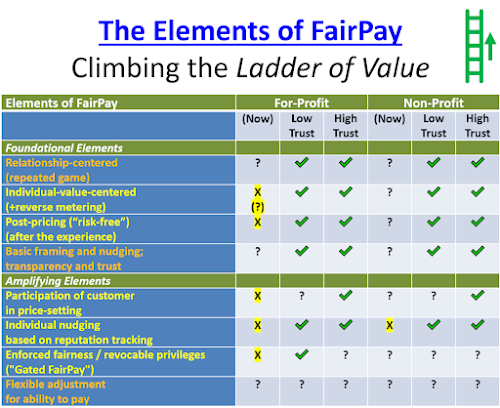
The columns to the right show that while most of these elements are applicable to both for-profit and non-profit organizations, the details will vary, and it will further depend on the level of trust and cooperation in the customer segments to be addressed.
As indicated, most non-profits currently use fewer of these elements than for-profit businesses, but greater use could improve their results (including increasing the satisfaction and generosity of their community). This presents a broad opportunity for a platform to make it easy for non-profits of all sizes to gain leverage.
Again, the clearest difference from how FairPay is used by for-profits is that fairness will often be left as voluntary, to be gently nudged with positive "carrots" rather than enforced with negative "sticks" (such as the revocation of privileges). But motivating fairness should be relatively easy for non-profits, since they can readily point to both the individual value and broader social value of their cause. (And non-profits can generally avoid the most complex element of FairPay, the business logic and policy issues of revocation or other negative incentives.)
The foundational elements are already used to some degree in many contexts, to build on the power of ongoing relationships. Now the amplifying elements can be added in and combined, to bring new synergy to revenue operations.
The general implication of the differences across columns is that the more advanced elements of the FairPay framework are most effective when the parties are perceived as holding up their side of the social contract:
If this still seems abstract or unclear, please see my other posts with more concrete details of how FairPay applies in specific use-case examples:
Organizations using this proposed Revenue as a Service platform need not use its more advanced features, except as they are ready and wish to. The platform can be configured to deliver just the features each organizations wants. Thus it can provide a service that scales gracefully, from very basic, to very advanced.
One very important simplification of FairPay can serve as a high-leverage 80/20 solution in both voluntary and payment-required contexts. That is the "risk-free" subscription model that relies on post-pricing (after the experience). That can be done without using any of the participative pricing elements of more advanced FairPay solutions (and need not even exploit nudging). That is less of a departure from traditional set-price subscription or membership pricing. But unlike the high hurdle of an all you can eat, fixed price membership paywall, it works as a gentle "pay ramp." (This, too, is explained in my Elements post, and the Whitney and Metropolitan Museum use-case examples listed above.)
Similarly, the platform, itself, can be built in stages, beginning with the more basic elements, then gradually adding the more advanced ones.
Crossing the lines between donors and those served
As explained in my 2016 post on non-profits, FairPay provides new and better way to address the complex issues of pricing and sustainability across the spectrum from donors to those served. Consider how this works for these two often overlapping constituencies:
The details will vary with the type of customer/patron and the nature of the organization and mission, but the essential task is the same -- to generate sustaining revenue by cooperatively setting prices (for service or donation) that make the value proposition "win-win." (That also includes recognition of non-monetary contributions by those who give in kind.)
The platform as a universal leverage point for achieving impact
The problem that limits the uptake of these methods is the implementation effort, and the need for ongoing testing and refinement (including "devops," the work of enhancing and maintaining the operation). Fund a platform for that, and many more organizations will be able to teach men to fish -- or give them fish -- or whatever other good works they do. The platform is a universal leverage point.
A platform solution across many organizations also has other kinds of economies of scale and network effects, beyond simply outsourcing that service. FairPay dialogs about value generate valuable data about exactly what each customer values at a fine-grained transaction level, as well as reputation data about the fairness of each customer (and how that varies with context). While that data is sensitive, if managed with care it could potentially be used in win-win ways to help guide service providers to engage with those customers who most value their service (for a single service provider, or across all the service providers that use the platform, subject to appropriate privacy controls). That can lead to more effective co-creation of value for everyone.
[Update 4/14/20:] An excellent article on how one platform service, Network for Good, is bringing some of the relationship-building methods I describe here, is How NonProfits are Doubling Down on Relationships with Subscription Giving. The article is by Tien Tzuo president of Zuora, who wrote the excellent book, Subscribed, that I reviewed in 2018.
------------------------
 A concise introduction is in Techonomy, "Information Wants to be Free; Consumers May Want to Pay"
For a full introduction see the Overview and the sidebar "How FairPay Works" (just to the right, if reading this at FairPayZone.com). There is also Selected items (including links to videos and decks).
(FairPay is an open architecture, in the public domain. My work on FairPay is pro-bono. I offer free consultation to those interested in applying FairPay, and welcome questions.)
The original focus of FairPay was on advanced strategies for sustaining for-profit enterprises (especially for digital products and services) -- but the framework spans non-profit services as well, and can be even simpler to apply in non-profit contexts. The core strategies of FairPay have gained recognition in business and scholarly publications. It has strong foundations in behavioral economics, and sheds light on many knotty issues and perverse incentives that are often poorly understood.
What can FairPay do for service organizations? FairPay provides a framework for applying elements that can be mixed and matched to provide a powerful solution to engage customers and donors, and build ongoing relationships with them in a way that motivates them to cooperate in sustaining services that they value. (I use the term "customer" in the broad sense, as including those served as wells as those who donate, regardless of whether they are overlapping or distinct sub-groups. The term "patron," in its broad sense, also conveys that inclusiveness.)
- Modern behavioral economics has shown that people want to be fair and even generous when asked in the right way to support a service they find valuable.
- Game theory teaches that relationships can operate as repeated games, and that well-designed repeated games that are rewarding motivate cooperation to continue the game. (Subscriptions and memberships are forms of repeated games, sometimes well-designed, sometime not so well-designed.)
- Marketers have learned that they can build profitable recurring revenue businesses based on ongoing relationships (a simple form of repeated game) rather than one-shot transactions, and are beginning to apply the lessons of behavioral economics to enhance that process. They are managing customer journeys and loyalty loops, and engaging in dialog the brings a mutual focus on co-creation of value.
- FairPay adds more advanced elements to the mix, and combines them to re-align the repeated game to maximize cooperation in creating lifetime value. FairPay builds on transparency and trust to build relationships. It applies empowerment of stakeholders (to show trust), dialog about value given and received (to achieve transparency and motivate willingness to pay to sustain that), and reputation (to sustain trust).
- FairPay works best when the business can position itself as a benevolent and fair partner in value co-creation that is worthy of the "price" it needs to sustain the relationship.
- Non-profit organizations can apply the same methods, and are more naturally seen as benevolent and fair partners in value co-creation.
- Therefore non-profits have more power to motivate fair contributions from their "customers," and therefore they are able to yield more power to their customers than for-profit businesses are.
- That enables them to make contributions voluntary (as is already common practice, but not yet effectively managed with modern relationship-building tools). Such voluntary forms of the more advanced methods of FairPay are relatively easy to apply.
- These methods center on regular and ongoing dialogs about value that remind customers of the value co-creation they have benefited from (looking backward to what has been experienced, not just promised for the future), how much they have contributed to sustaining that, and what more can and should be done to add value (in whatever forms are agreed to) in this relationship. That points to what else of value can be done.
The FairPay framework informs an architecture that can enable NPOs (and journalism organizations) to enhance their revenue-related operations -- to apply the latest business systems, methods, and communications media in a way that optimizes their relationships with their "customers" (again, including donors) to maximize their ongoing sustaining revenue.
- This process applies a new kind of leverage -- as a self-adapting engine to create real and valuable impact, measure its perceived value, and adjust the process to do even better.
- From this perspective, the FairPay framework clarifies how little most businesses and NPOs are currently doing to maximize that, and how much more they could be doing.
More detail on just how this FairPay framework works follows, but first, what does it take to make it happen?
The platform that supports teaching men to fish
A basic platform for bringing these tools to fund-raising and revenue operations could be built in stages. This is a natural candidate for applying an open source strategy (or a cooperative) to become self-funding beyond a certain initial pump-priming:
- Do a basic proof of concept. This could demonstrate the synergy of the combined elements and make the case for further investment. It might take something like 1/2 person-year in total, split between technology and business analysis.
- Enhance that to a "minimum viable product" level to be a useful service for a large number of organizations.
- Facilitate cooperation of that user community to continue further development, and to attract experts to aid in developing and testing more advanced methods.
- Build all of that out into a vibrant, self-sustaining platform ecosystem (much as has been done with other platform or SaaS services like Linux, Mozilla, and Wikipedia).
NPOs (and/or news organizations) could then use this platform to get far more effective and sophisticated in managing their activities as a revenue-generating business, in ways that deepen their social contract with their community.
(As noted above, existing revenue platforms might also be enticed to take the lead in adding FairPay features.)
(As noted above, existing revenue platforms might also be enticed to take the lead in adding FairPay features.)
The FairPay social contract
FairPay works by creating a new social contract for sustaining the creation of desired services.
Consider this change in the game:
Consider this change in the game:
- From today’s conventional repetition game: “Here is our requested price/donation, take it or leave it. We hope you will take the risk — and be satisfied enough to continue this game.”
- To the FairPay game: “We will grant you the power to pay/donate what you think fair for you after each period of service — we will remind you of the services you got (or funded for others), and will encourage you to pay/donate accordingly.”
- It draws on all available information on when and how services are actually consumed by each patron. Increasing availability of fine-grained usage data will make that increasingly meaningful.
- It may seed its dialog with individually-calculated suggested prices based on the value and cost of those services. (Even if services may be offered to some at no charge, it may be fair to gently nudge others who have greater means to pay for those services for themselves (and others) as they can afford.)
- It regularly solicits payments to sustain ongoing services in an open and transparent way, framing and managing the dialogs about value to remind patrons of the value they (and others) got, and what and when they have paid in the past to sustain that, why they should now pay again, and what new value to expect.
- It learns which patrons are fair or even generous in their corresponding payments, so that they can be most effectively nurtured, and resources can be directed to serving those who most appreciate the value offered.
- It can suggest additional benefits (perks, tiers of services) based on how fair or generous the customer is.
- In selected uses, it can also withdraw benefits -- for-profit businesses can use that "stick" to enforce fairness, but non-profits might stick to more positive "carrots" (but might still use "sticks" in limited situations).
That is how it drive revenue operations, building on that basic social contract. This is simple in in its core concept, but it is amazing how few organizations engage in real and regular dialogs about value with each customer at this fine-grained level.
- Engaging an NPO's community on what it offers each of them, what each of them values, and what it needs in the way of support from each of them is the way to build strong sustaining support, enabling it to co-create the maximum value.
- Some managers fear getting customers to think about value and price, and some fear that customers will not be willing to engage in such dialog. But behavioral economics shows that customers are far more responsive to productive dialog about value and price than most businesses realize (my latest journal article cites a number of compelling studies, and the most relevant are listed in my Resource Guide).
- Managers also tend to forget how much their value propositions vary from one community member to another. (A simple thought experiment can help recenter on the importance of these individual value propositions.)
- That, in turn, enables a funder to leverage its impact -- the value it co-creates with its NPO portfolio and each member of their communities.
There is of course much more to how this is done, and it will vary greatly from context to context. Background on these variations is in my previous post, The Elements of Next-Gen Relationships and Pricing -- A Unifying Framework. It provides this summary table of the elements, and then comments on each:
(with minor updates 10/27/19)
As indicated, most non-profits currently use fewer of these elements than for-profit businesses, but greater use could improve their results (including increasing the satisfaction and generosity of their community). This presents a broad opportunity for a platform to make it easy for non-profits of all sizes to gain leverage.
Again, the clearest difference from how FairPay is used by for-profits is that fairness will often be left as voluntary, to be gently nudged with positive "carrots" rather than enforced with negative "sticks" (such as the revocation of privileges). But motivating fairness should be relatively easy for non-profits, since they can readily point to both the individual value and broader social value of their cause. (And non-profits can generally avoid the most complex element of FairPay, the business logic and policy issues of revocation or other negative incentives.)
The foundational elements are already used to some degree in many contexts, to build on the power of ongoing relationships. Now the amplifying elements can be added in and combined, to bring new synergy to revenue operations.
The general implication of the differences across columns is that the more advanced elements of the FairPay framework are most effective when the parties are perceived as holding up their side of the social contract:
- for service providers who are perceived as offering real value and warranting trust and commitment from customers/patrons for being fair, transparent and responsive to their value creation needs and desires.
- for customers who are perceived as fair and honest about communicating their needs and desires, and being fair (even generous) in making contributions to sustain that desired value creation.
If this still seems abstract or unclear, please see my other posts with more concrete details of how FairPay applies in specific use-case examples:
- This example of membership based on the Whitney Museum.
- This example of membership based on the Metropolitan Museum.
- This example of reader-funded "patronship" for journalism (and many other discussions of journalism are linked to from the Business Use Cases section of my list of selected items).
Organizations using this proposed Revenue as a Service platform need not use its more advanced features, except as they are ready and wish to. The platform can be configured to deliver just the features each organizations wants. Thus it can provide a service that scales gracefully, from very basic, to very advanced.
One very important simplification of FairPay can serve as a high-leverage 80/20 solution in both voluntary and payment-required contexts. That is the "risk-free" subscription model that relies on post-pricing (after the experience). That can be done without using any of the participative pricing elements of more advanced FairPay solutions (and need not even exploit nudging). That is less of a departure from traditional set-price subscription or membership pricing. But unlike the high hurdle of an all you can eat, fixed price membership paywall, it works as a gentle "pay ramp." (This, too, is explained in my Elements post, and the Whitney and Metropolitan Museum use-case examples listed above.)
Similarly, the platform, itself, can be built in stages, beginning with the more basic elements, then gradually adding the more advanced ones.
Crossing the lines between donors and those served
As explained in my 2016 post on non-profits, FairPay provides new and better way to address the complex issues of pricing and sustainability across the spectrum from donors to those served. Consider how this works for these two often overlapping constituencies:
· Recipients -- direct customers/patrons of direct services (the mission). Here, pricing takes on two interrelated dimensions -- what is the fair value of the service, and what is the fair contribution from the recipient (to both the cost of the service to them, and to the added overheads needed to sustain the organization -- and optionally to the cost of service for those who can less afford it).
· Benefactors -- indirect customers/patrons of indirect services (the altruistic value of supporting services to others, and the value of being a benefactor, including perks and recognition). Here, the key dimensions are the value of direct services to others enabled by the benefactor’s donations, and the value of the indirect benefits to the benefactor.
The details will vary with the type of customer/patron and the nature of the organization and mission, but the essential task is the same -- to generate sustaining revenue by cooperatively setting prices (for service or donation) that make the value proposition "win-win." (That also includes recognition of non-monetary contributions by those who give in kind.)
The platform as a universal leverage point for achieving impact
The problem that limits the uptake of these methods is the implementation effort, and the need for ongoing testing and refinement (including "devops," the work of enhancing and maintaining the operation). Fund a platform for that, and many more organizations will be able to teach men to fish -- or give them fish -- or whatever other good works they do. The platform is a universal leverage point.
A platform solution across many organizations also has other kinds of economies of scale and network effects, beyond simply outsourcing that service. FairPay dialogs about value generate valuable data about exactly what each customer values at a fine-grained transaction level, as well as reputation data about the fairness of each customer (and how that varies with context). While that data is sensitive, if managed with care it could potentially be used in win-win ways to help guide service providers to engage with those customers who most value their service (for a single service provider, or across all the service providers that use the platform, subject to appropriate privacy controls). That can lead to more effective co-creation of value for everyone.
------------------------
Posts that are specific to non-profits and social welfare:- A Better Revenue Strategy for Non-Profits in the Digital Era
- Making "Pay As You Wish" More Equitable -- Sustaining the Met Museum (and Others)
- An Invisible Handshake for The Digital Wealth of Nations
- How Market Commerce Can Become More Cooperative, Fair, and Human
- Turning the Invisible Hand to Create Shared Value -- The FairPay Strategy
- Patron-izing Journalism -- Beyond Paywalls, Meters, and Membership
- What Lies Beyond Paywalls -- A Better Way
- The Missing Piece of the Membership Puzzle -- Agreeing on Value for Each Member
[Update 4/14/20:] An excellent article on how one platform service, Network for Good, is bringing some of the relationship-building methods I describe here, is How NonProfits are Doubling Down on Relationships with Subscription Giving. The article is by Tien Tzuo president of Zuora, who wrote the excellent book, Subscribed, that I reviewed in 2018.
------------------------
More about FairPay
 A concise introduction is in Techonomy, "Information Wants to be Free; Consumers May Want to Pay"
For a full introduction see the Overview and the sidebar "How FairPay Works" (just to the right, if reading this at FairPayZone.com). There is also Selected items (including links to videos and decks).
And these journal articles, A Novel Architecture to Monetize Digital Offerings and Pricing in Consumer Digital Markets: A Dynamic Framework.
Or, read my highly praised book: FairPay: Adaptively Win-Win Customer Relationships.
Or, read my highly praised book: FairPay: Adaptively Win-Win Customer Relationships.


