Showing posts with label CSR. Show all posts

Thursday, October 8, 2020

Technology Can Harness Stockholder Profit to Drive Social Responsibility [a teaser]

Is stockholder capitalism inherently harmful? It is widely felt that that the legacy of Milton Friedman and his “primacy” of stockholder profit have taken us to a bad place. But we have ignored how the digital era enables a new reconciliation of stockholder versus stakeholder capitalism. 
Digital markets can make new levels of stakeholder participation efficient in determining how much of who's money to spend on what Corporate Social Responsibility (CSR) programs – and in ensuring that translates to increases in long-term profit for all to share in. This can break through the still-unresolved dilemma that Milton Friedman cited in his now-maligned article.

This new opportunity that technology creates relates to Friedman’s observation that an executive spending on social responsibility is “in effect imposing taxes” on the shareholders, customers, and employees. He argues that is beyond the ability or proper authority of an executive of a private business. 

But now we can apply increasing levels of “digital democracy” to the workings of Corporate Social Responsibility. Digital democracy can inform mechanisms to poll stockholders, customers, and employees on what level of CSR taxes they will accept, to be spent on what programs.

previously wrote about how my FairPay framework can be expanded to address customer-driven CSR . Recent coverage of Friedman spurred me to expand that to also address stockholders and employees, and have submitted an article on this theme for publication. In the meantime, here is a teaser.

FairPay suggests how computer-mediated dialog and emerging forms of “impact data” can help elucidate the ends that consumers seek and what they are willing to pay toward those ends. This customer participation can apply not only to the pricing of services they purchase, but to the “Social Responsibility-as-a-Service” (SRaaS) ends they agree to be “taxed” on for the benefit of others.  Some detail on how that can work is in my post from a year ago, The Reformation of Market Capitalism in The Age of the Customer -- Profiting From "Social Responsibility as a Service". Since it is the customers who pay directly to fund the business -- including whatever revenue makes its way to stockholders and employees -- it seems only right that customers should have the most say in how their “tax” money is raised and spent for CSR. 

Digital democracy methods can also be applied to learn the willingness of the stockholders and employees to be "taxed" for CSR. Of course any of these stakeholders "could separately spend their own money" on similar ends, as Friedman observes, but the business is in a unique position to be efficient (and nimble) in optimizing the social effects of its own operations.

It is evident that increasing numbers of customers, stockholders, and employees believe CSR is important and want to contribute to such efforts in efficient ways. Markets are unrivaled in seeking efficiency, but have limitations in dealing with unrepresented stakeholders and other externalities. To the extent we can efficiently represent those stakeholders and internalize the externalities in the course of routine business operations, markets become more efficient – and more win-win. 

As such methods mature, SRaaS can have all the efficiency we expect of market-based mechanisms and entrepreneurial incentives, thus enabling an invisible hand to distill the wisdom of the crowd and mass-customize broadened value propositions tailored to individual stakeholders and the impacts they desire. 

Monday, August 26, 2019

Open Letter to Business Roundtable and Council of Institutional Investors on "Social Responsibility"

You both represent critical interests in the current crisis over Corporate Social Responsibility, and you both issued dueling statements last week that seem to do little more than continue a debate that is generating more heat than light.

That was catalyst for my new post, "The Reformation of Market Capitalism in The Age of the Customer -- Profiting From 'Social Responsibility as a Service' [Working Draft]", which suggests a new, win-win way forward.

Both of your interest groups should consider working to achieve that new reality. The thesis is that it is customers, not shareholders who ultimately bear the costs of Corporate Social Responsibility, and it is customers, not your members, that should vote with their wallets on how that is addressed -- but that businesses must facilitate that, as agents of their customers. Your members have the power to make that happen, and will profit from doing that. I hope you will consider making this sorely overdue Reformation of Market Capitalism a reality. A capsule on why:
  • Concern -- and confusion -- about whether and how market capitalism can have social responsibility is reaching a crisis point.
  • An exhorted responsibility of shareholders to be beneficent to other stakeholders (customers, employees, suppliers, community,...) can have only limited and uncertain effectiveness -- even if CEOs truly wish to be more beneficent. 
  • Customers have the prime authority, since the funding comes from the customers. Social responsibility is ultimately a "tax" on the customer. To be "represented," each customer should be able to vote with their wallet on how much tax they pay, for what.
  • Businesses now have new powers to involve each customer in mass-customizing the service value propositions that they pay for -- including payments for Social Responsibility as a Service (SRaaS)
  • That will apply the genius of the market -- enabling businesses to profit from being socially responsible as each customer supports. Think of it as a social responsibility tax that each customer agrees to pay -- at an individualized level that both parties agree is fair for that customer.
(I have been developing the ideas that underlie this, as published in two journal articles co-authored with prominent scholars. This is a pro-bono project and I would be pleased to assist in exploring this new way forward.) [If reading this on my FairPayZone.com blog, the full post is just prior.]

The Reformation of Market Capitalism in The Age of the Customer -- Profiting From "Social Responsibility as a Service" [Working Draft]

[Updated 9/3/19, see update notes at end 
--the 9/3 update on corporate-customer matching funds is especially notable]

We are at a crisis in our view of the role of business in society, as highlighted in front page stories last week. But I suggest both sides of this long-running debate misread the underlying issues. My work points to a new perspective, one that suggests a "reformation" of market capitalism. This is based on a new co-primacy of customer power that will make most reasonable people on both sides happy...
And here we are. Americans mistrust companies to such an extent that the very idea of capitalism is now being debated on the political stage.
So Andrew Ross Sorkin observed in the NY Times, applauding the Business Roundtable's 8/19 "Statement on the Purpose of a Corporation," calling it "a significant shift, and a welcome one." Many others applauded -- but as Sorkin and others noted, there is still good reason to be skeptical of any real change.

On the surface, the Rountable statement may seem pretty mild: "We share a fundamental commitment to all of our stakeholders." But things are hardly that simple. The Council of Institutional Investors (CII) came out expressing strong concerns:
It is government, not companies, that should shoulder the responsibility of defining and addressing societal objectives with limited or no connection to long-term shareholder value.
While it is important for boards and management to have and articulate long-term vision, ...a fundamental strength of the U.S. economy has been and continues to be efficient allocation of equity capital. If “stakeholder governance” and “sustainability” become hiding places for poor management, or for stalling needed change, the economy more generally will lose out.
Since the CII represents "primarily pension funds, state and local entities charged with investing public assets and endowments and foundations," one would expect them to have relatively enlightened view of the shareholder interest.

The WSJ editorial board was so apoplectic they did lead editorials two days in a row, the second quoting the 1970 article “The Social Responsibility of Business is to Increase its Profits” by Milton Friedman of the "Chicago School" of economics (in The NY Times!) that many blame for the current malaise.

(It also seems that the current legal framework for corporate governance and fiduciary duty to shareholders limits the discretion of corporations to fund social responsibility: "a decision by a board that is not grounded in the best interests of the corporation and its stockholders likely would not be protected by the business judgment rule under the current state of the law.")

The dilemma here can be resolved by recognizing that it is not shareholders alone, but customers who share primacy. Customers are the stakeholders who actually fund the costs of social responsibility, and they have the market power to influence the allocation of those costs (or take their business elsewhere).

==================================================================
The Ideas in Brief
  • Concern -- and confusion -- about whether and how market capitalism can have social responsibility is reaching a crisis point.
  • An exhorted responsibility of shareholders to be beneficent to other stakeholders (customers, employees, suppliers, community,...) can have only limited and uncertain effectiveness -- even if CEOs truly wish to be more beneficent. 
  • Customers have the prime authority, since the funding comes from the customers. Social responsibility is ultimately a "tax" on the customer. To be "represented," each customer should be able to vote with their wallet on how much tax they pay, for what.
  • Businesses now have new powers to involve each customer in mass-customizing the service value propositions that they pay for -- including payments for Social Responsibility as a Service (SRaaS)
  • That will apply the genius of the market -- enabling businesses to profit from being socially responsible as each customer supports. Think of it as a social responsibility tax that each customer agrees to pay -- at an individualized level that both parties agree is fair for that customer.
Very basic examples of SRaaS offers: [Added 8/28]
  • Would you be willing to pay an extra $4 for environmentally-friendly, biodegradable packaging and no-fossil-fuel shipping?
  • Matching grant: Would you be willing to pay an extra $1, $5, or $20 (select amount) to fund on-the-job training for ex-coal miners who seek to upgrade their skills to work in our factory in Appalachia, if we match your grant dollar for dollar? [revised 9/3]
  • Do you want to rank your product search results 1) by price alone, 2) by price weighted by ESG score, or 3) by ESG score alone?
  • Do you want to filter your product search to require an ESG score of greater than 1, 2. or 3 stars?
==================================================================

Oversimplifying the problem

There has been a long history of contention (and confusion), and I suggest the issue is not so much a matter of what capitalism is inherently, but of simplistic thinking about how it works. As Sorkin recounts,
For nearly 50 years — following the publication of a seminal academic treatise in 1932 ... — corporations, for the most part, were run for all stakeholders. It was a time defined by organized labor, corporate pension programs, gold-watch retirements and charitable gifts from companies that invested heavily in their communities and the kind of research that promised future growth.
That came to be seen as muddle-headed and inefficient, and Friedman forcefully argued that a business's only duty was to serve its stockholders. Now that view is in growing disrepute -- but the truth is not so black and white.

The Business Roundtable had said in 1997 (as recounted in Quartz) that “The paramount duty of management and of boards of directors is to the corporation’s stockholders.” Now their new statement changes this, to affirm "a fundamental commitment to all of our stakeholders," listing them in this order: customers, employees, suppliers, communities, and shareholders. Some are pleased to see shareholders listed last, some incensed. But others point out that it is not clear 1) whether this has any real operational meaning, and 2) what might actually change, or how.

Making sense of the stakeholders and how they are served

My work on how the digital world changes business relationships provides a new perspective that cuts through much of this confusion with a powerful new simplicity (see my book and/or this post).

It all comes down to the operational roles of the different stakeholders. We have customers, employees, suppliers, communities, and shareholders. We also have managers, who may be the shareholders, but often are the representatives* of the shareholders. Clearly, the shareholders own the business, and the managers are hired to be the shareholders' representatives*. The owners have power because our whole system of private property-based capitalism gives owners special rights. [*See 8/27/19 update below on the agency theory of corporate ownership.]

There have always been critiques of this system, including communism, socialism, cooperativism, and many other variations on shifting ownership/control of the means of production to other stakeholders. But before we throw the baby of market-based capitalism out with the bathwater of its abuses, let's look deeper.

The question is how shareholder's rights interplay with the rights of the other stakeholders, and that is where it gets interesting.

Those who favor market capitalism argue that its genius is that the market creates value with the economic efficiency and emergent wisdom of Adam Smith's invisible-hand of the crowd -- something that other systems are unable to match. Whether you approve of Friedman or not, it is worth reading his 1970 article to understand the mechanism he describes.

I think Friedman oversimplifies how the stakeholder interests interplay, but much of his core argument about how profit-driven market mechanism work is valid, and many critics fail to understand how hard it is to make sound economic decisions without profits as an incentivizing and score-keeping mechanism. Friedman and the CII are right that the Business Roundtable statement offers no meaningful operational guidance to the hard questions of how competing interests are effectively and fairly served.

The co-primacy of the customer

Without customers there is no business. The central role of business is to create value by selling services to customers. Doing that effectively produces revenues, and hopefully some profit, both of which enable the business to continue to create value by selling services to customers. Other stakeholders may be more or less important (sometimes very important), depending on context, but none have as fundamental a role in making a business work.

Businesses can do well by doing good. To the extent a business successfully creates value and obtains revenue from customers, it can share that value (in the form of revenue) with the other stakeholders. Properly managed, it can pay employees and suppliers, and support its community. Good management recognizes that creating and sharing that value enables the creation of more value.

But the only money that comes in is from customers. No value can long be created or shared, except as funded by customers, who pay for the what they value.

You forget one thing, Milton!

Milton Friedman was right, up to a point:
What does it mean to say that the corporate executive has a "social responsibility" in his capacity as businessman? ...the corporate executive would be spending someone else's money for a general social interest. Insofar as his actions in accord with his "social responsibility" reduce returns to stockholders, he is spending their money. Insofar as his actions raise the price to customers, he is spending the customers' money. Insofar as his actions lower the wages of some employees, he is spending their money. ...if he does this, he is in effect imposing taxes, on the one hand, and deciding how the tax proceeds shall be spent, on the other.
But what Friedman seems to forget is that the customer has a say in how much they pay, and will take their business elsewhere if the price does not map to the value they perceive that they get.
  • If the customer will not pay a "tax" to support whatever level of "social responsibility" to other stakeholders they see as desirable and fair, no tax is received. 
  • If the customer willingly allocates part of the price they pay to such a tax, shareholders will be fine with that. 
  • If the customers refuse to allocate any payment for social responsibility, shareholders will not be able to sustain paying to share that value with other stakeholders.
No amount of exhortations to "social responsibility" can change that fundamental reality. Friedman knows that shareholders control the business, and that they do not want to pay an unnecessary tax, but he forgets that the customer may be more than willing to do so, and may go elsewhere if stymied in doing so. It is ultimately the customer, not the shareholder who pays the tax.

Why should we expect the shareholders to spend money on social responsibility unless the customer is willing pay for it? The question is what level of tax will each customer pay, to be spent on what kinds of "social responsibility?" 

This is what the FairPay framework is focused on, as outlined in my blog, and in two journal papers co-authored with eminent marketing scholars (one suggesting where digital business is going, and one digging deeper into its human roots).

A new precision in individual consumer power

This is something entirely new -- a new precision in consumer power, to be applied at the individual level for individual ends. We already see growing consumer power in boycotts and social media, but those are very blunt instruments, with little more wisdom than a mob (and generally reactive, not proactive).

When computer-mediated dialogs and AI work with each customer to decide specifically what to offer to them and what price to accept from them, this can become an effective commercial layer of digital democracy about precisely what social responsibilities the business fulfills -- working as a representative* of each customer and their individual values. That is the theme of this post.

Back to the future of human commerce

First, some perspective -- look back at the history of how humans behave as commercial creatures. We naturally think about the norms of commerce as we experience them, but we are locked in the anomalous mindset of recent decades.

Traditionally commerce was dominated by local economies of individuals and small groups who had long-term relationships with those they traded with. It was natural to view value broadly, to consider the human dimension of the value of goods and services, and their impact on the local stakeholders. Traders who failed to consider their stakeholders did not thrive.

Behavioral economics has rediscovered in the past few decades that people are social creatures. They have an inbred desire to cooperate, to value fairness, transparency, reciprocity, and even altruism, and they are swayed by emotion and self-image. They refer to this as homo reciprocans (reciprocating man). That is in contrast to the older narrow conception of classical economics, of homo economicus (economic man), who acts purely in his rational self-interest. Commerce was very communal, and people evolved over many millennia to develop and thrive on the traits for cooperation and trust that supported that.

That direct connection was lost as business scaled to mass production in factories, and mass-marketing in department stores.  Instead of individually negotiated prices, prices were pre-set, take it or leave it. Customers became just numbers, not people. Businesses became alienated from their customers and both lost sight of this dynamic of win-win co-creation.  Short-term profit became decoupled from long-term sustainability, managers optimized what was easy to measure, and stockholders became fixated on this simple zero-sum game of quarterly profits. There have been ups and downs, but the overall trend has been a devolution of the human center of commerce.

But over the past decade or so, modern marketing has realized that there is a longer game of customer journeys, loyalty loops, and recurring revenue (especially subscriptions and memberships) that it is measured by customer lifetime value (CLV), not current-period profit. That longer game enables a business to grow sustainably and become even larger and more profitable.  Digital customer relationships and digital services are enabling and fueling a re-awakening of more traditional business norms, but we have not really understood where it will lead.

The Age of the Customer

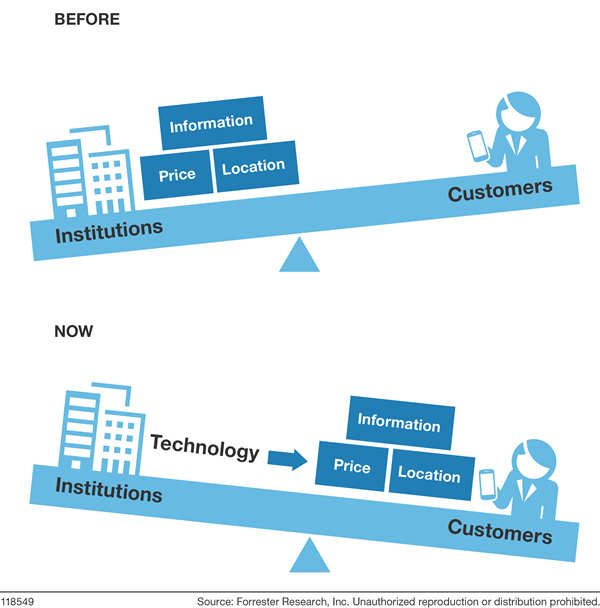
Forrester has called this The Age of the Customer (emphasis added):
In this era, digitally-savvy customers would change the rules of business, creating extraordinary opportunity for companies that could adapt, and creating existential threat to those that could not. ...In this new world, companies have struggled to make hard choices and act. It requires leaders to think and act differently – in ways that feel foreign, unfamiliar, and counter-intuitive. And honestly, it is simply hard to do. ...These dynamics will endure as new technologies like artificial intelligence and robotics emerge to challenge core notions of what it means to be a company, what it means to build human capital, and what it means to compete and win.
Businesses like Amazon and Apple and startups like Warby Parker already profit by delighting the customer, and by listening to what the customer values. FairPay shows how this can go much farther, so that businesses can shift their offers to mass-customize them to what each customer values and is willing to pay for.

That shift can undo the negative, zero-sum turn of the last century, and show companies how to profit from more win-win relationships with their customers.  That is where the new leverage is.
  • If customers will pay for it, it can generate profit. 
  • If customers value it, they will pay for it.  
  • If customers value win-win behavior that benefits not only themselves, but their broader desire to be good citizens, they pay for it, it generates profit, and so businesses profit from that.  
That hits the real bottom line, making their stockholders happy.
  • To the extent that happens, there is less need for exhortations to consider secondary bottom lines and ESG (environmental, social, governance) criteria that are hard to manage without direct market incentives.  
  • The genius of the invisible hand will, itself, drive managers to maximize profit by being socially responsible.
FairPay hearkens back to something reminiscent of old-style negotiation, except instead of negotiating a price for a transaction, we negotiate a logic for how generously to price over a series of transactions, and what forms and levels of value the price should cover.  It is a relationship-based social contract.  Much as the invisible hand sets prices to allocate scarcity of supply across a market, FairPay has the effect of an invisible handshake that sets prices to allocate share of wallet along a relationship.

Each consumer votes with their wallet.  As Milton Friedman said, the manager’s responsibility “will be to make as much money as possible while conforming to their basic rules of the society, both those embodied in law and those embodied in ethical custom.” To do that, the manager will seek to demonstrate whatever level of social responsibility the customers are willing to pay for.  The customers will decide how much they are willing to be “taxed,” and what the manager should spend those “taxes” on.  [This can get very specific, at an individual level, as explained in the 8/28/19 update below.] The shareholders will want that, and external political mechanisms will be less needed because market mechanisms will do the job.

Social Responsibility as a Service (SRaaS)

Consider how this constitutes a more or less explicit category of service -- social responsibility service, analogous to customer service.
  • In the case of customer service, business used to sell naked products, at the buyer's risk. Gradually they added guarantees and support call-centers and white glove service -- all for a fee (more or less explicit) and often with a choice of options as to service levels.
  • Social responsibility service (to other stakeholders) can be similarly customized and funded at different levels by customers, in tiers and sectors. Then it becomes just another service the business can offer to customers who will pay for it. Plenty of behavioral economics assures that customers can be enticed to voluntarily pay for services they value.
Thus every business can offer Social Responsibility as a Service, as a companion service to whatever other services they offer. That can make their customers happier and more loyal -- and they can earn a fair profit for doing it. Smart businesses realize that listening to customers is in their own profit-maximizing interest.  We need only exhort both businesses and consumers to focus on more directly effective dialogs about value of all kinds.

FairPay does this by more explicitly structuring each customer's ongoing journeys as a repeated game that builds cooperation on adaptively customizing value propositions that provide that customer the  value they desire at a price both parties agree is fair. It draws on a synergistic combination of elements, each proven individually. It also points to simpler combinations of just some of those elements that can be good enough in many use cases.

>>>>>>For more specifics on just how FairPay does this, see the 
>>>>>>"Sidebar: Pricing, FairPay and Allocation by the Customer" (below).

Reforming capitalism from inside

What we need to do, is not to try to heal capitalism from outside (which no one has a good solution to), but to encourage managers to reform it from inside (thus exploiting the genius of market economics). I refer to this as a reformation because the Protestant Reformation was driven by the realization that what mattered was the relationship between each man and God, with the priesthood as facilitator, not as intermediary. The Capitalist Reformation will be driven by the realization that what matters is the relationship between each customer and each business, with government as facilitator and guardrail, not as intermediary.

So before we throw out the baby of market incentives with the bathwater of perverse incentives, we should see if the baby of reformed capitalism in the 21st Century can learn to walk with social responsibility. I think we will be very happily surprised.

The challenge is that we are still stuck in our old logic.  In an economy dominated by scarcity and uniformity, being responsive to the customer is hard, and done only at the margins.  But as the digital economy gains from automation, abundance, and personalized relationships, being responsive and customizing value propositions gets easier and more essential. Businesses are just beginning to understand the new logic of how to leverage that.

As businesses learn to elicit what each customer values at a fine-grained level, and to seek to deliver it, they will learn to actually profit from social responsibility.  As they do that, we will all benefit from the fairness, altruism, and reciprocity of homo reciprocans, We will awaken their willingness to support Corporate Social Responsibility (CSR) with their own wallets, and to fairly reward the businesses that cooperate with them in that, working as their representatives.*  Friedman’s title will become correct, but just not quite as he understood it: “The Social Responsibility of Business is to Increase its Profits.” The customers will see to directing that properly, using their power of the purse.

Perhaps we should be calling it “Corporate/Customer Social Responsibility.” (CCSR? C2SR?)

==================================================================

SIDEBAR
Pricing, FairPay and Allocation by the Customer

To clarify my points, we need to go back to basics -- pricing. Pricing may seem boring, but it is at the heart of how we allocate resources among stakeholder "actors." The power of pricing calculations to ensure desirable allocations is at the heart of debates over capitalism and socialism. It is also at the heart of FairPay and my points about customer power. FairPay suggests a broad reformation of how businesses relate to their customers, and how we consider all aspects of value, not just social responsibility.

Pricing is where digital changes everything, and that is what FairPay seeks to reform. We are seeing it first for digital services like news and other content. But over time, increasing automation will shift the economics of scarcity for almost everything. Scarcity of materials and labor, and other marginal or variable costs needed to replicate goods and services, was the core of classical economics, but is now becoming a non-issue. The scarcity that remains is increasingly in the human effort to create new services (and new factories and robots and AI) that then run and replicate services with little added cost. Adam Smith's invisible hand works by using price to allocate scarce supply against demand -- but it cannot allocate abundance. That is why we have confusion over what the price of digital information should be, and why we need a new logic for pricing. This new logic is primarily applicable to ongoing relationships, but more and more of commerce is moving from isolated transactions to recurring relationships.

One early and very telling example is the business of news. Most publishers are still stuck in the old logic – to counter the death of scarcity they seek profit by imposing artificial scarcity, locking their news behind a one-size-fits-few paywall that only their most avid readers can afford.  More enlightened publishers (like The Guardian) have learned that readers will voluntarily pay for news (for themselves, as well as for those who do not or cannot not pay) -- just because they value having the quality news available to all. Similarly, creators of all kinds have learned to use crowdfunding services -- and that the seemingly crazy logic of pay-what-you-want can actually be sustaining. These may seem very narrow markets, but most markets have a blend of elements that are costly and not shareable, and elements that are abundant and shareable.

The repeated game of fairness

The new fairness game that we have outlined shows how this new logic may be applied with increased power and controllability, in a way that works for both the business and the customer. Consider how we can change the game for a subscription, from:
Here is our monthly price, take it or leave it.  We hope you will take the risk -- and be satisfied enough that you will continue this game.
to:
We will reduce the risk and let you help decide the fair price after each month’s use -- but we will continue this game (beyond a few trial cycles) only if we agree that you are being reasonably fair.
The logic of the FairPay game is that each customer pays for what that customer values, within limits of fairness that the business can accept. Thus each customer decides what social responsibilities they are willing to pay for. They vote with their wallet, and the business collects those votes as dollars going into their bottom line.

So, with a new logic like this, how can we hack Milton Friedman's concerns about social responsibility?  Consider these examples that address the growing trend toward digital and experience goods that cannot be effectively valued until after they are purchased and used:
  • A digital newspaper lets readers subscribe and decide what to pay after each month of use. It reminds them what they read, what writing those stories cost per reader, and what share of its revenue goes to the reporters and investigative expenses.  It reminds them of how its recent reporting benefited the community and the prizes earned. It lets readers pay bonuses specifically to reporters they wish to support.  (A non-profit Guardian might accept any level of fairness, but a for-profit New York Times might warn a reader who it thinks is being repeatedly unfair that it will shunt them back to a conventional set-price subscription unless they meet higher standards of fairness.)
  • An online retailer of furniture lets established customers pay for items in two stages, first, at-sale, to cover the marginal costs of the items (and perhaps a small profit margin), then, after it has been experienced for a month, with an added bonus that reflects the customer’s perceived value of the purchase, plus the perceived value of the business’s employment, sourcing/curation, and sustainability practices.  (Again, customers it deems to be repeatedly unfair might be shunted back to standard set prices.)
In each of these cases the business has a dialog with customer in which price relates to value received. The customer has co-equal power to define what aspects of value matter.
  • For the newspaper, value is not just how many weeks the subscription was accessible, or how many stories were read, but whether those stories had real value, what costly investigative journalism or analysis was done, how much was paid to valued reporters, what community values were supported, what waste was prevented, and the like. Some of these "social" values might be segregated to be paid for with explicit "bonus" payments to these other stakeholder categories. To the extent customers value those elements by paying for them, that is no longer "taxation without representation" as Friedman claimed. (See operational details for this example.)
  • For the retailer, value is not just the raw utility of an item, but the quality and style of design, the conditions for employees and at supplier factories, support of local and source communities, environmental practices, and the like. Again, these could be identified as "bonus" payments and again, "taxation" voluntarily paid. (See operational details for this example.)
[Update 8/28/19>] Examples of discrete social responsibility offers to customers

This can get richly nuanced, but to clarify how these SRaaS offerings can be made discrete and easy for individual customers to opt in (or not), at whatever level they choose, consider these simple forms of SRaaS offers:
  • Would you be willing to pay an extra $4 for environmentally-friendly, biodegradable packaging and no-fossil-fuel shipping?
  • Matching grant: Would you be willing to pay an extra $1, $5, or $20 (select amount) to fund on-the-job training for ex-coal miners who seek to upgrade their skills to work in our factory in Appalachia, if we match your grant dollar for dollar? [revised 9/3] 
  • Do you want to rank your product search results 1) by price alone, 2) by price weighted by ESG score, or 3) by ESG score alone?
  • Do you want to filter your product search to require an ESG score of greater than 1, 2. or 3 stars?
Just like any other product pricing, packaging and bundling decision, such offers can be put to the customers as a menu of options. A business can start with a few narrow trials with selected segments of customers with a propensity to support social responsibility -- to begin this new kind of cooperation, and then grow from there. (The specifics of such offers and the corresponding usage of funds can be validated to customers with independent impact certifications and metrics, very much as is now being demanded by impact investors.)  [See further update 9/3 on matching funds, below.] 

The invisible handshake -- one-to-one markets for social responsibility

Increasingly, businesses will earn premium profits by catering to customers' desires to support social responsibility. Customers who cannot afford to pay such premiums could be supported by more affluent customers who see that as their duty to support, not only for themselves but for those less fortunate. (Those who could pay but refuse to might be shunted to set-price models -- FairPay can be offered as a revocable privilege.) Some businesses will cater to the segment of recalcitrant customers who refuse to allocate any of their wallet to that kind of social responsibility, but the profit margins for doing so will be smaller.

(Further detail on FairPay is here, including a variety of use cases, and discussion of how and where to start, and how to grow from there.)

Instead of exhorting managers and shareholders to pay out of the customers' wallets for competing social benefits that that the managers have no clear basis to decide among (and perhaps in conflict with their legal fiduciary duty), we should be exhorting customers to pay from their own wallets for the social benefits they want to support.

If we do that, we may solve 80% of the problem, and do it with high market efficiency, leaving just the remaining 20% to be addressed by regulatory protections.

The greatest danger in times of turbulence is not the turbulence, it is to act with yesterday's logic.

 -- Peter Drucker 


------------------------

[*UPDATE 8/27/19:] Terminology: agency vs representation

My original use of the term "agent," now replaced by "representative," may have been too strong and loaded with issues, for reasons outlined in the 2017 HBR article, The Error at the Heart of Corporate Leadership. I now use "representative," to make it clear that it is the possibly contingent role as a representative of an interest, whether as agent, fiduciary, or otherwise, often in balance with other interests, that I refer. 

The relevant thrust of my argument is that managers are naturally driven by financial incentives to themselves and to the shareholders they serve (in whatever legal capacity) in the calculus of their decision-making and allocation of resources. The surplus of the revenue they take in, net of costs and reinvestment, goes to the shareholders. The revenue comes from the customers. One can shift from agency theory to entity theory and broader views of roles and constituencies to be served, but the question remains -- what objective function are boards and managers to maximize in each resource allocation decision? I suggest that rather than an undifferentiated mix of interests to be balanced in vaguely defined ways, the best claim to a vote generally goes to the customer (especially when the customers are a broad base of consumers). That argument may be situation dependent, and market forces may to some extent enable the votes of other stakeholder constituencies to be quantified into bottom line terms. But it is usually customers who have by far the clearest bottom line market power with respect to each business -- it is customers that businesses must increasingly listen to. 


Thus it seems both desirable and practical that primacy of the customer in driving a market calculus for resource allocation will be the best way to manage allocations of resources to all forms of social responsibility. My argument is that we need to get far more systematic and granular in getting the customers to vote with their wallets on all of those allocation decisions. That is not at odds with efforts to quantify effects on other stakeholders -- it is supportive of them, in that a customer-driven social value calculus is the most practical driver for the balancing of other social value quantification efforts. We are already moving to customer-driven enterprise -- this just applies that driving force to social responsibility.


This HBR article notes that the key weakness to company/entity-centered governance is "complex relationships and responsibilities; success is difficult to assess." What I suggest here is a new and sensible way to balance those responsibilities and to assess success at the bottom line.


[UPDATE 8/28/19:] Social responsibility down the value chain - B2B2C

While this was written with primary focus on B2C companies, it should be understood that it applies equally to B2B2C. 

B2B business is primarily driven by homo economicus, but the ultimate customer of B2B businesses is usually a customer in a B2C relationship. Consumers want social responsibility down their supply chain, so that implies a corresponding social responsibility chain. B2C businesses will want to be able to demonstrate that social responsibility to their customers, and so their B2B suppliers will need to demonstrate that social responsibility along each step in their chain so they can pass it up the chain to their consumers. Sounds complicated, but not really very different from any supply chain value issue.

[UPDATE 9/3/19:] Matching funds, for new leverage in CSR

An important variation on the above suggestions for customer-funded CSR is to add a "matching funds" feature. To offers to facilitate CSR efforts like this one suggested above...
  • Matching grant: Would you be willing to pay an extra $1, $5, or $20 (select amount) to fund on-the-job training for ex-coal miners who seek to upgrade their skills to work in our factory in Appalachia, if we match your grant dollar for dollar? [as revised 9/3]
...the business could make a matching funds offer: "We will put in $1 for every $1 you put in."

This has two significant benefits:
  1. It explicitly shares in the cost. Instead of putting all of the burden on the customer to fund such efforts (and even possibly taking a profit margin out of that, as suggested above), the business may invest some of its own funds. That would be a "tax" on the shareholders  only to the extent that it is not recouped in higher profit margins, and only for efforts that the customers signal with their wallets that they really care about. (That results in high likelihood that the investment will lead to higher profits as well as greater social welfare, so it is less likely to really be a "tax.")
  2. It motivates the customer to contribute. Matching funds are accepted as effective practice in charitable and political fundraising, and have also been proven to motivate pay what you want business payments (see the Gneezy paper in my Resource Guide). This brings clear business-customer cooperation to directing and funding CSR efforts.
Matching gift programs are widespread for business-employee cooperation, but I am not aware of similar efforts to enable business-customer cooperation in directing and funding CSR. Why not adapt that already proven model to this most important stakeholder?


------------------------
More about FairPay

A concise introduction is in Techonomy"Information Wants to be Free; Consumers May Want to Pay" and the broader perspective in The Relationship Economy -- It's All About Valuing Customer Experiences.

For a full introduction see the Overview and the sidebar "How FairPay Works" (just to the right, if reading this at FairPayZone.com). There is also Selected items (including links to videos and decks). 


(FairPay is an open architecture, in the public domain. My work on FairPay is pro-bono. I offer free consultation to those interested in applying FairPay, and welcome questions.)

Thursday, December 1, 2016

How Market Commerce Can Become More Cooperative, Fair, and Human


A recent conference on Platform Cooperativism spurred some thoughts on how FairPay offers a path toward a new convergence of traditional ideas about market capitalism and alternative ideas about a "Fairness Economy." (This conference drew added attention from a Wired article about the idea that Twitter should become a co-op, "Let's Build the Next Twitter Like the Green Bay Packers.")

In exploring the concepts of a more win-win approach to commerce called FairPay, I have seen a spectrum of thinking about market capitalism and its limitations as currently practiced, and how to make our economy more in tune with human social values.
  • Market capitalism has created our modern world, and proven efficient, productive, and scalable -- despite a degree of blindness to human values. 
  • That has led to growing concerns about income inequality, slowing productivity gains, and concentration of power in corporations and investors, spawning a wide range of movements to change the game. These range from
    1) incremental steps like "Corporate Social Responsibility," "Creating Shared Value," and "Triple Bottom Lines," to
    2) benefit corporations and other more softly profit-oriented structures, and to
    3) more sharply different forms of organization like cooperatives (and other non-profits).
  • The conference focused on cooperatives, a form of business that has existed for centuries, and harnesses the same spirit as Open Source and Peer Production, and that can now build on the openness of the Internet to put ownership of a business in the hands of its workers and/or customers.
  • All of this occurred with a backdrop of the US election, which highlighted deep concerns about an economy that no longer seems to be serving middle- and working-class people well -- a hard push for change, but one with little consensus as to what kind of change can or should be achieved. 
Meanwhile, most businesses may still be far from meaningful social consciousness in their operational core, but increasing numbers do try to tack on some efforts at "good corporate citizenship." Some would argue this is just lipstick on a pig, but others see real potential to make existing businesses much better.

Hints of convergence -- human-centered marketing

The gulf may seem huge, but deep in the heart of modern marketing, a more direct incentive to being more fair and human is emerging. Companies are realizing that in this networked age, their most important customer relationships are ongoing, and that loyalty and Customer Lifetime Value (CLV) are more important than immediate sales. Companies are beginning to see that Customer Experience (CX) is central, and that they must attend at every touch-point to creating desirable Customer Journeys that build Loyalty Loops to cultivate their best customers. (Forrester recently reported that CX leaders grew at 17% per year compared to 3% for CX laggards.) This re-orientation is starting to drive companies toward deeper, more personalized dialog with their customers and more human, cooperative values.

How FairPay changes the game

FairPay enables a shift in business operations to focus on a more cooperative "co-creation" of value that improves the bottom line. That can help bridge the gap between these two very different models, by making ordinary for-profit corporations more aligned with their customers and what they value -- including human values of people and planet.

The magic of FairPay is that it can be applied in any of these ownership structures. It can work very nicely in alternative structures like co-ops, but can also work as a core operational process in ordinary for-profit businesses. It drives everyday business operations to center on the human values of each customer, in a way that makes it profitable to "do the right thing." No tacking on extra bottom lines, or a veneer of social responsibility, that compete with profit motives. FairPay serves as a kind of cooperative judo that aligns the profit motive with what the customer wants. If the customer is an owner (as with a co-op), that just adds to the alignment.

FairPay provides a structure for building relationships around value, by giving consumers limited power to set prices that correspond to the value they receive -- for as long as the seller considers them to be fair about how they do that (but not longer). This creates a balance of powers (setting prices / continuing the relationship) that rewards cooperation. It changes commerce from largely independent one-time games that are inherently zero-sum, to a repeated game that adaptively seeks win-win co-creation of value.

A new lens on market fairness

So with this new lens of FairPay -- and how it works in any kind of business to fundamentally change customer relationships into a repeated game of cooperative relationship building -- a new path becomes clear.

From one side of the divide, if we use FairPay in conventional businesses, we don't need any new enterprise structures (or any new enterprises) to start with.
  • Conventional corporations can introduce FairPay into their ongoing operations, as an alternative pricing option -- one that drives a new kind of cooperation between a business and its customers (and they can start to do this in limited, controlled market segments).
  • This cooperation focuses on win-win value propositions based on structured dialogs about value that can include broad aspects of value, including "externalities" of people and planet that are typically ignored by our markets (but directly affect the bottom line when FairPay pricing is applied).
  • That in itself should improve things for customers, workers, stockholders, and society at large.
At the same time, we can build from the other side and create new platform cooperatives (or other new models in that vein). They show considerable promise, and FairPay can add to that promise.
  • The same kind of cooperative dialogs about value that FairPay creates in a for-profit business can be applied by a co-op or other non-profit or hybrid form, with the same benefits.
  • Such methods can be expected to be especially effective in such contexts, because of the deeper alignment of values on the part of the alternative business, and the greater willingness to pay of consumer "cooperators" when the business entity is theirs. (More on this in an earlier post, A Better Revenue Strategy for Non-Profits in the Digital Era.)
Thus FairPay offers a common operational logic that can serve as a bridge toward convergence from both sides, wherever along the spectrum we are.
  • Conventional businesses can become more cooperative and aligned with customer and social values, and help instill more cooperative behavioral norms in themselves and their customers -- even in a for-profit, capitalist context. 
  • That sets the stage for further shifts toward cooperation in for-profits -- as well as a more fertile environment for alternative structures.
  • Likewise, alternative structures (non-profits or hybrids) can benefit from the fair and efficient FairPay pricing process that is more attractive and more self-sustaining than conventional pricing. The power of FairPay may be even greater in such alternative structures -- even if such structures are not as operationally efficient as profit-driven structures in some respects, FairPay might enable them to achieve greater price-efficiency to offset that, drawing on their more inherently mutual incentive structure.
Both camps can coexist and seek to flourish as they are able, and each can help drive the growth of an ecosystem that benefits all productive players, as well as society at large. Whatever mix it is that flourishes in any given context, and any point in time, we all can win with FairPay.

----

For a full introduction to FairPay see the Overview and the sidebar on How FairPay Works (just to the right, if reading this at FairPayZone.com). There is also a guide to More Details (including links to a video).

Even better, read my highly praised new book: FairPay: Adaptively Win-Win Customer Relationships.  
coop

Wednesday, November 4, 2015

Price = Value

Price = Value. The essential logic of FairPay is that Price = Value ...in context, and over time.  Or at least it should, and an efficient economics will seek to approximate that.

Isn't that only fair? -- the only win-win way to do business? Why should we -- both producers and consumers -- settle for prices that are anything less than the best reasonable approximation of the actual value we receive?

FairPay is a new logic for conducting ongoing relationships that adaptively seek win-win value propositions in which price = value.

  • The core idea is that prices should equate to value. Not the producer's preconception of value for an average consumer, but what value a particular consumer actually perceives as realized  in the experience of using the product or service, in the fullness of their individual context.
  • Such a concept of price = value is win-win for both the producer and the consumer. They agree to do business if they expect a value surplus over cost, and both benefit if they divide that value surplus fairly -- fair value to the consumer, while providing a fair profit to sustain and motivate the producer. It allows a producer to provide value to a maximum number of consumers who seek it, in a way that can maximize revenue and profit as well -- especially for products and services (such as digital content) for which consumers may challenge any pre-set price as arbitrary and unfairly out of line with their actual perceived value.
  • Adaptively seeking such win-win value propositions is required because the valuation considerations are complex. It is hard to do this accurately for any one transaction (which is why value-based pricing is now done only in high value B2B contexts). But an adaptive, intuitively reasonable approximation can be cooperatively converged upon over a series of transactions -- and can continuously adjust as things change over time.
  • Ongoing relationships provide an environment that justifies and enables the process of adaptively seeking those win-win value propositions. If the marginal costs of the product/service are low, producers can afford to take limited risks at the start of a relationship (just as they do with free trials or freemium), in hopes of building a productive and loyal relationship that is profitable over the lifetime of the relationship.
  • FairPay is a new logic in that this idea -- that price must be co-created, as a dynamic and personalized approximation of value as exchanged -- creates a very different conceptual framework for how our markets work. It shifts us from a mentality of take-it-or-leave-it prices pre-set by producers, which are often unfair, to a cooperative process of creating value in a way that explicitly seeks to be fairly win-win.
From this perspective, FairPay is a form of co-pricing for services, in which buyer and seller agree on a process to adaptively seek a win-win value exchange -- not focused just on single transactions, but over the life of their relationship. That ongoing relationship perspective opens up a whole new dimension in customer relationships that can deeply alter how we do business -- transforming the nature of the customer journey, as well as the workings of our broader business ecosystems.

This formulation encapsulates the core conceptual perspective that I have absorbed over the past year, drawing on current marketing and service science theory (see my recent posts about ISSIP and the Naples Forum on Service).


Those with a purely practical focus might skip the rest of this post and turn to more pragmatic information on FairPay. The core dynamic of the FairPay choice architecture is described in the sidebar and the practical implications and applications to various businesses are discussed throughout this blog. Check out the Overview, and More Details

Conceptual Perspectives on this New Logic for Business
The greatest danger in times of turbulence is not the turbulence, it is to act with yesterday's logic.   --Peter Drucker
That quote is one of the inspirations behind an emerging reformulation of marketing -- the idea of a "Service-Dominant Logic" (S-D-L), in contrast to the "Goods-Dominant Logic" that developed over the past centuries -- "yesterday's logic." Now we are in a service economy, and are beginning to see that the value of goods is really in how they enable a service -- for example, the value of a car has little to do with the physical product in itself -- its value is in how it provides the service of transportation, in a particular use and context. Is it reliable, comfortable, safe, economical, fun? ...in what mixture, to meet what needs? (Long ago a wealthy friend of mine owned an expensive new Jaguar, but was afraid to drive it far from home for fear it would break down -- high price, costly to create, but low value.) The value of services is understood to be "co-created" by the provider and the consumer in a particular use-context. This has many important implications that have been the subject of an extensive body of work. Proponents of this thinking (including the related field of service science) have been among the most receptive to the ideas of FairPay, such as at my Naples Forum and ISSIP presentations.

I pick up on this further now, by suggesting that what FairPay adds might be thought of as a Value-Dominant Logic (V-D-L) -- as opposed to yesterday's Price-Dominant Logic (P-D-L). FairPay offers a process for seeking fair value, in which price becomes emergent from buyer's and seller's interactions over time. Thus price remains the metric of net value-in-exchange, on which our economy is centered, but now price tracks to value-in-context instead of being pre-set in ways that track poorly to value. The processes of FairPay -- as embodied in cycles of customer journeys -- set price to approximate value. This not only can transform business, but makes a better economics, because prices that track to value make the economy more efficient and productive.

This builds on an earlier post that describes a thought experiment based on imagining an economic demon that reads the minds of buyers and seller to determine the actual value-in-context for each transaction, figures out the value surplus (over cost), and negotiates an equitable sharing of that value surplus between the producer and consumer. Prices set by such a demon would be win-win for both sides. The FairPay process of repeating dialogs about value over a series of transactions serves as a way to approximate what that demon knows, at least on average, over time.

Another post describes how this can be viewed as an invisible handshake -- an agreement between the producer and consumer to work together through the FairPay process to try to come to a common understanding of individual value propositions over time. While this emergent approximation may not be very accurate for any one transaction (especially when the relationship is new), the process seeks to converge on a level of fairness over time, as the parties get to understand one another.

This is win-win for producers and consumers because it allows producers to sell to all consumers who find value in the producer's service, at prices that are dynamically personalized to approximate ideal price discrimination.  That leads to a near-maximum number of profitable and loyal relationships, to maximize total revenue and total value creation. It also enables a near-maximum number of risk-free trials by consumers who think they might find value. All of this brings more value to more people.

Price ≠ Value

We are so used to our current practices of seller-pre-set prices that discriminate poorly (yesterday's logic), that we tend to not realize how that distorts our economy and makes it inefficient. Why do all users of a service -- such as digital newspaper or digital music or video subscription service -- pay the same price? Some use such services heavily, others lightly. Some obtain high value from the services, others just minimal levels of value. Yet they all pay the same price. Not only is that unfair, but it distorts our markets, as a deadweight loss. Many pay less than they should -- and many forgo using such services at all because they the price is too high, even though a lower price would create value and profit.

At a theoretical level, one of the open challenges of service research is that its focus on value-in-context works well at a microeconomic level, but does not translate well into macroeconomics, because value-in-context is hard to measure at a macro level. I suggest the reason is that macroeconomics is centered on price, and in current practice Price ≠ Value. How can our macroeconomics be effective when Price ≠ Value? Revenue is the total of a firm's prices, but total revenue tracks poorly to total value. Similarly for GDP. If we can get prices to track better to value, then our whole economics will be centered on that, and will work better.

Broad considerations of value

Another implication of this Value-Dominant Logic is that value should be very broadly defined to include all aspects that matter to the producer and consumer. Many of the current challenges in getting businesses to better address social values stem from the limited scope of prices, since they are not set to reflect such broader values. We speak of Corporate Social Responsibility (CSR) and Creating Shared Value (CSV) and triple or quadruple bottom lines because our current bottom lines are missing many important components of value. Here again, FairPay provides a rich broadening -- Price = Value, including whatever social aspects of value matter to the consumer. If the consumer values broader social benefits, they can reflect that directly in the price they pay, which then adds directly into the bottom line..

Making it happen

It seems clear that we should be seeking prices that map better to value. We should be exploring how to do that. FairPay suggests an architecture for a process that does that. If the particular process I suggest is found to not work as well as hoped, perhaps understanding why, in detail, will lead us to variant processes and/or process architectures that will work better. One way or another, going down this path should lead us to more value for all of us.


Wednesday, March 21, 2012

Turning the Invisible Hand to Create Shared Value -- The FairPay Strategy

"Creating Shared Value," the influential 2011 HBR article by Michael Porter and Mark Kramer, points to the need to reinvent capitalism with broader ideas about value creation that will unleash a wave of innovation and growth. They propose that "creating shared value represents a broader conception of Adam Smith's invisible hand."

I suggest that the FairPay revenue model provides a new market regime that reorients the invisible hand toward shared value, one that can be operationalized in business today, to offer an entirely new micro-economics for profit-seeking business transactions.

Porter and Kramer nicely draw the big picture for shared value, noting that, unlike calls for "Corporate Social Responsibility" that are at odds with profit motivations,
Shared value focuses companies on the right kind of profits - profits that create societal benefits rather than diminish them. ...
The moment for an expanded view of value creation has come. A host of factors, such as the growing social awareness of employees and citizens and the increased scarcity of natural resources, will drive unprecedented opportunities to create shared value.
We need a more sophisticated form of capitalism, one imbued with a social purpose.
They suggest what we need is not "a redistribution approach," but one for "expanding the total pool of economic and social value.

FairPay takes this CSV big picture and provides methods for "doing business as business" that support that vision. These methods can be applied now, in a wide range of businesses, and will point the way to applying similar new thinking more generally. (FairPay was designed for, and clearly applies now, in markets in which marginal costs are low, such as for digital products or services. Digital markets, especially for content, are widely recognized as being markets in which traditional capitalism has been unable to adapt effectively to the new digital economy, and new business models are urgently needed.)

FairPay turns the force of the invisible hand to span ongoing relationships. It guides pricing to create shared value between customers and businesses over long-term relationships (in which customers have a say in the creation of shared value). It looks beyond one-time transactions, to ongoing dialogs about value.
  • Adam Smith's invisible hand works at a transaction level:  it optimizes the balance of  supply and demand in terms of prices for large numbers of individual transactions.  Transaction prices drive supply and demand into balance, by shifting supply or demand until balance is achieved. This invisible hand does not know or care about repeat business or shared value (except as it affects demand in aggregate).
  • FaiPay turns the invisible hand on its side, to work over time, at the relationship level: it optimizes the balance of supply and demand in terms of prices over time, with respect to individual customers. Relationship pricing is balanced through an ongoing series of pricing conversations, to achieve an agreed upon level of shared value in each of a multitude of ongoing buyer-seller relationships. Shared value is integral to these pricing conversations.
The invisible hand of FairPay creates a new kind of balance that emerges over a series of transactions, with a simple balancing dynamic:
  • For each transaction, the buyer is given the full power to set prices based on the value actually received (Fair Pay What You Want). This is done retrospectively, when the value is known to the buyer.
  • The seller must accept the buyer's price for that transaction, but the seller holds the power to decide if the buyer's pricing is fair enough to want to extend the relationship by continuing to make FairPay offers for future transactions (considering what has been learned about the buyer's pricing behavior and reasons).
This leads to an ongoing balancing process based on longer-term considerations of shared value:
  • Buyers have full freedom regarding the pricing of single transactions, but have the incentive to be fair to sellers and divide the shared value surplus in a way that is fair to the seller. They are also invited to give reasons for their pricing that indicate why they think their perception of shared value is more or less than the seller has suggested. Based on guidance from the seller on suggested prices, costs, usage, social norms, and the buyer's reasons, both sides can learn whether and how they can agree over time on criteria for fair pricing that creates the maximum shared value (even if they do not agree on each transaction).
  • Sellers yield power over a limited number of individual transactions, but gain new power to truly understand the value they provide to individual sellers in each transaction, and to engage in a substantive dialog with their customers about that value and how they should share in it. Sellers manage the "choice architecture" that frames the value proposition and the factors to be considered, and can signal what buyer pricing behaviors they accept as fair or unfair. The seller learns how loosely or rigidly to manage each customer relationship to create profit and grow its share of the pie.
The new invisible hand of Fairpay emerges from this balancing mechanism for discovery and maximization of shared value between buyers and sellers over time.
  • FairPay pricing can be used in combination with conventional pricing as a back-stop, and positioned as a privilege offered to those who desire a relationship based on shared value and respect for the obligations of fairness that entails. 
  • Sellers can manage the "choice architecture" by using premium tiers and perks as rewards, and the threat of withdrawal of such premiums as penalties, to nudge buyers to price at the highest levels the buyers consider justifiable.  Sellers also hold the threat of complete withdrawal of future Fairpay privileges (returning an "unfair" buyer to fixed pricing for future transactions) as a powerful incentive to deter abuse. 
The essence of Fairpay is that buyers and sellers engage in a continuing individualized dialog about shared value--both at a personal and a social level--as actually realized in every transaction
  • FairPay seeks maximum shared value for each customer, by being specific to the value sought and received by that consumer, at that time, in that context. 
  • It reflects individual variations in need, value perception, willingness to pay, ability to pay, and all relevant criteria. It provides sellers with fine-grained, in-context "market" data for segments of one, that enable the sellers to fully understand market needs, and learn new ways to meet them, and to delight their customers, one by one. 
  • It naturally reflects broader considerations of shared social value beyond the individual customer, by sharing responsibility with the customer for the social valuation process. Buyers are free to consider whether a seller is socially responsible in the larger sense, and to factor that into their willingness to pay (to whatever extent they desire). What might have been an externality to the seller may be internalized by the buyer, so that the seller must internalize it as well. Social values shift from external constraints at odds with profit maximization to natural subjects of the value dialog with the buyer.
  • It changes the equation from a zero-sum game of buyers shopping around for the lowest prices and sellers seeking to be the low-cost provider, to a win-win collaboration for achieving shared value. 
  • Instead of consumers seeing profits as coming at their expense, profits are framed as a valid and deserved sharing of their value surplus with a company that is a respected partner in value creation. This gives a new legitimacy to profit-seeking, as integral to collaborative creation of shared value.
Traditional transaction-level pricing models foster a purely price-based race to the bottom, which makes it hard for a company to see at a micro-economic level how social responsibility to their customers and the larger public can benefit their bottom line, well intentioned as they may be. We can talk of shifting the view to long term profit maximization, but how do we do that? The ongoing, relationship-based structure of FairPay micro-economics directly considers shared value, at both the individual and larger level, in a way that removes the conflict.  It aligns profit maximization for the firm with maximization of social value (at least as perceived by individual buyers). Thus Fairpay provides a new micro-economic mechanism to seek long-term profit maximization in ways that directly align with social value maximization.

Where and when can FairPay fit in? It is most clearly applicable to businesses in which marginal costs are low. A major segment is in markets for digital products and services. Such markets already make extensive use of free trials, freemium models, and even pay what you want promotions. These markets already exploit the low incremental cost of producing additional (marginal) items, to give away some product in order to sell more in the future. FairPay can be introduced immediately, to do this in a much more economically efficient way. Some controlled level of zero-revenue transactions are accepted as a market learning cost, in order to discover what buyers are willing to pay and whether they are good partners. With FairPay, instead of "free" offers, the offers are value-based (but are similarly risk-free to the buyer). Similar immediate opportunities for FairPay arise in markets where physical goods and services are perishable (such as those currently addressed by Priceline's "name your price" model). As businesses and consumers get used to FairPay, opportunities to exploit it will expand.

Turning the invisible hand to the broader aspects of shared value. FairPay naturally guides better economic efficiency, while significantly reflecting the broader context of shared value. When this new turn of the invisible hand gives consumers a say in pricing, social values will be served as just another corporate profit opportunity, not a "Corporate Social Responsibility" cost.
  • Price efficiency and legitimacy:  FairPay provides a structure for pricing that is dependent on buyer acceptance in a way that legitimizes differential pricing - to efficiently address varying value perceptions, usage patterns, and abilities to pay. Price "discrimination" becomes an equitable method for maximizing shared value when the buyer participates in the discrimination and accepts the rationale for paying more or less than other buyers. This can enable usage-based and other value-based pricing in ways that buyers can agree to and temper as desired (such as paying little extra for an unintended and atypical overage in usage). Many current markets are very inefficient because of consumer aversion to metering and other rate discrimination. "All you can eat" pricing plans have popular appeal to narrow customer interests, but their wastefulness and inequity will become very apparent when customers participate in pricing decisions.
  • Disadvantaged markets: This buyer acceptance of "fair and reasonable price discrimination " also enables new ways to efficiently address low-income and disadvantaged markets at a profit (and social benefit).  For example, it becomes clear that those who can afford to pay more than others should do so. Information and digital services that may expensive in high-value/high-ability-to-pay markets can fairly be offered far more cheaply in disadvantaged markets without cannibalizing the markets where buyers know they can and should fairly share their large value surplus. When treated as partners in shared value pricing decisions, consumers will recognize that companies should be able to profit more (and recover more of their costs) from those who can afford it than from those who cannot, and companies will be able to expand and differentiate their markets accordingly.  
  • Innovation and productivity: FairPay's individual dialogs about value give companies both the incentive and the market information needed to innovate to better serve existing and potential customers, and to communicate how they offer value to different customers. FairPay pricing dialogs will capture rich and detailed transaction level data on individual buyer value perceptions, needs, and desires. They can re-conceive products and markets, identify new needs, create efficiency, and expand markets, in a natural partnership with their customers.   
All of this can start now in markets that Fairpay is particularly well suited to:  those in which marginal costs are low, such as for digital products and services, and for perishables. As such uses of FairPay develop, our concept of how to think and talk about pricing will change, and our understanding of business as a game of relationships, not just transactions, will grow.

From there we can learn how extend the principals underlying FairPay to other markets, and perhaps develop similar models of relationships and of dialog about value that can work even for products and services where marginal costs are not low. We will enter a new era in capitalism as a way to collaboratively create shared value, guided by a new and broader sweep of the invisible hand.