Showing posts with label retention. Show all posts

Thursday, August 22, 2019

A Platform for Teaching Men to Fish -- "Revenue-as-a-Service" for Non-Profit Impact

Fund development of a platform that enables non-profits to sustain themselves
Give a man a fish and you feed him for a day;
Teach a man to fish and you feed him for a lifetime.
The same applies one level up:
Fund teachers of fishing and you feed their teaching for some days;
Fund a platform that supports teaching men to fish and you feed all of them for all of their lifetimes.
This could be a very high leverage opportunity! Making a transformative new tool widely available and affordable.

Foundations and others who fund charitable service organizations face a huge problem:
  • Current strategies for funding non-profit services have yet to exploit the power of digital relationships to transform how they work with their customers and donors.
  • Digital technology is already enabling transformative tools, especially for businesses on the leading edge of relationship commerce. Businesses are shifting to recurring revenue models, managing customer journeys and loyalty loops, and the most enlightened are engaging in dialog the brings a mutual focus on co-creation of value. The FairPay framework described in this blog and elsewhere supercharges value-centered relationships, and applies to non-profit organizations  (NPOs) as well as for-profit businesses.
  • But non-profits lack business sophistication and can rarely afford to put resources into developing, testing, and applying similar methods to their relationships. The FairPay framework can transform revenue management at a full range of levels, but much of this potential remains out of reach for many organizations
  • Meanwhile foundations and others are looking for ways to support worthy non-profit organizations, and for ways to make those services more cost-effective in their funding and operations.
***Note that much the same applies to news organizations that struggle to sustain socially valued journalism -- even where there is a for-profit element.***

"Revenue as a Service" for Non-Profits -- platforms as a universal leverage point

Viewing this from a systems perspective, this opportunity appears: Fund development of a platform to enable non-profits to sustain themselves by drawing more systematically on support from their community of customers, patrons, and donors. This can provide leverage across a broad swath of service organizations.
  • Non-Profit Organizations (NPOs) -- as well as others, such as news providers -- need a systematic, ongoing way to obtain funding to sustain their operations.
  • That can now be done in very sophisticated ways -- and that sophistication will be constantly increasing -- drawing on advancing technology. 
  • The FairPay framework outlined here suggests a path to transformational improvements in relationship-based revenue models. 
  • Doing that will take skills and resources that may not be economically feasible for small or even mid-sized organizations (even if they would pay back handsomely).
  • That is just the kind of problem that "Software as a Service" was designed to solve: a platform provider (whether for-profit or non-profit) can develop, operate, and continue to enhance a high quality service that non-profit organizations can outsource to. 
  • This can bring economies of scale and network effects to solving the problem of nurturing revenue relationships with large numbers of patrons. (Venture capitalists love platform businesses because of their scalability and high return on investment.)
  • The impact of a non-profit platform could be so transformational that such projects should be very attractive to the charitable foundations that support non-profits and/or journalism. (VCs might be concerned that profit potential of such a platform may be limited by the tight budgets of the NPOs that would use it -- all the more reason for foundations to step in.)
Such a platform would provide "Revenue as a Service." Just what is that outsourced service?:
  • The platform provides the common base of operational software services (based on marketing and behavioral science, technology, and systems analysis), that can facilitate relationship-based revenue management strategy and execution for each of many organizations. Build it once, use it many times. Spread the cost of research, development, and support across many client organizations.
  • Each of those client organizations can retain full control -- setting all the key policies and retaining control of all exception handling. Each decides on all the parameters that define how the system works for them (the platform service may offer suggestions to guide that). Each  gets to have its people handle all human-to-human contact (but can outsource parts of that as well).
There are some existing models for revenue platforms for NPOs. They range from cooperatives like Tessitura, to for-profit services like The News Project, and less structured services for recurring crowdfunding like Patreon. FairPay provides methods for making such services far more powerful, across a far broader range of NPOs. The paths forward are 1) to add advanced FairPay features to existing platforms, or 2) to create new platforms that are clearly focused on FairPay strategies.

"Impact Data as a Service" -- platforms as instrumentation

Funders not only want to get good results, but to get the data to validate whether they are in fact succeeding in that. Common platforms lead to common data and metrics, and common reporting practices.

FairPay drives organizations to increase the quality and frequency of their operational dialog with their community, creating a new level of impact data. Platforms that manage and add new layers of communication with an NPOs's customer/donor community will create new kinds of fine-grained data and metrics -- on just what services are consumed by whom, with what outcomes, how those are valued by those individuals, and how they add value to each community member -- interaction by interaction, over the lifetime of the relationship.
  • That creates a new level of rich data on just what services were consumed and the impact they achieved. 
  • That enables the organization to be more dynamically adaptive and self-tuning, to maximize their co-creation of value with their community. 
  • Funders can use that data to manage their funding and maximize their own impact.
The following sections explain how this is achieved.

The heart of the platform opportunity -- the FairPay framework

FairPay is a radically innovative framework for relationship-centered, “customer-value-first” revenue strategies for the digital era. Its varying forms can be adapted across a wide spectrum of business contexts, both for-profit and non-profit.  (It is an open architecture in the public domain, not a product, and I am working on this as a pro-bono project.)

The original focus of FairPay was on advanced strategies for sustaining for-profit enterprises (especially for digital products and services) -- but the framework spans non-profit services as well, and can be even simpler to apply in non-profit contexts. The core strategies of FairPay have gained recognition in business and scholarly publications. It has strong foundations in behavioral economics, and sheds light on many knotty issues and perverse incentives that are often poorly understood.

What can FairPay do for service organizations? FairPay provides a framework for applying elements that can be mixed and matched to provide a powerful solution to engage customers and donors, and build ongoing relationships with them in a way that motivates them to cooperate in sustaining services that they value. (I use the term "customer" in the broad sense, as including those served as wells as those who donate, regardless of whether they are overlapping or distinct sub-groups. The term "patron," in its broad sense, also conveys that inclusiveness.)
  • Modern behavioral economics has shown that people want to be fair and even generous when asked in the right way to support a service they find valuable. 
  • Game theory teaches that relationships can operate as repeated games, and that well-designed repeated games that are rewarding motivate cooperation to continue the game. (Subscriptions and memberships are forms of repeated games, sometimes well-designed, sometime not so well-designed.)
  • Marketers have learned that they can build profitable recurring revenue businesses based on ongoing relationships (a simple form of repeated game) rather than one-shot transactions, and are beginning to apply the lessons of behavioral economics to enhance that process. They are managing customer journeys and loyalty loops, and engaging in dialog the brings a mutual focus on co-creation of value.
  • FairPay adds more advanced elements to the mix, and combines them to re-align the repeated game to maximize cooperation in creating lifetime value. FairPay builds on transparency and trust to build relationships. It applies empowerment of stakeholders (to show trust), dialog about value given and received (to achieve transparency and motivate willingness to pay to sustain that), and reputation (to sustain trust). 
  • FairPay works best when the business can position itself as a benevolent and fair partner in value co-creation that is worthy of the "price" it needs to sustain the relationship.
  • Non-profit organizations can apply the same methods, and are more naturally seen as benevolent and fair partners in value co-creation.
  • Therefore non-profits have more power to motivate fair contributions from their "customers," and therefore they are able to yield more power to their customers than for-profit businesses are. 
  • That enables them to make contributions voluntary (as is already common practice, but not yet effectively managed with modern relationship-building tools). Such voluntary forms of the more advanced methods of FairPay are relatively easy to apply. 
  • These methods center on regular and ongoing dialogs about value that remind customers of the value co-creation they have benefited from (looking backward to what has been experienced, not just promised for the future), how much they have contributed to sustaining that, and what more can and should be done to add value (in whatever forms are agreed to) in this relationship. That points to what else of value can be done. 
The FairPay framework informs an architecture that can enable NPOs (and journalism organizations) to enhance their revenue-related operations -- to apply the latest business systems, methods, and communications media in a way that optimizes their relationships with their "customers" (again, including donors) to maximize their ongoing sustaining revenue. 
  • This process applies a new kind of leverage -- as a self-adapting engine to create real and valuable impact, measure its perceived value, and adjust the process to do even better.
  • From this perspective, the FairPay framework clarifies how little most businesses and NPOs are currently doing to maximize that, and how much more they could be doing.
More detail on just how this FairPay framework works follows, but first, what does it take to make it happen?    

The platform that supports teaching men to fish

A basic platform for bringing these tools to fund-raising and revenue operations could be built in stages. This is a natural candidate for applying an open source strategy (or a cooperative) to become self-funding beyond a certain initial pump-priming:
  1. Do a basic proof of concept. This could demonstrate the synergy of the combined elements and make the case for further investment. It might take something like 1/2 person-year in total, split between technology and business analysis.
  2. Enhance that to a "minimum viable product" level to be a useful service for a large number of organizations.
  3. Facilitate cooperation of that user community to continue further development, and to attract experts to aid in developing and testing more advanced methods.
  4. Build all of that out into a vibrant, self-sustaining platform ecosystem (much as has been done with other platform or SaaS services like Linux, Mozilla, and Wikipedia).
NPOs (and/or news organizations) could then use this platform to get far more effective and sophisticated in managing their activities as a revenue-generating business, in ways that deepen their social contract with their community.

(As noted above, existing revenue platforms might also be enticed to take the lead in adding FairPay features.)

The FairPay social contract

FairPay works by creating a new social contract for sustaining the creation of desired services.

Consider this change in the game:
  • From today’s conventional repetition game: “Here is our requested price/donation, take it or leave it. We hope you will take the risk — and be satisfied enough to continue this game.”
  • To the FairPay game: “We will grant you the power to pay/donate what you think fair for you after each period of service — we will remind you of the services you got (or funded for others), and will encourage you to pay/donate accordingly.”
This voluntary form of FairPay relies on dialogs about value to frame the value proposition, and to remind patrons of the value they received. It empowers them to determine the "price," engages in transparent dialog about the value that the price should relate to, and tracks reputation to build trust and to know how to nudge fair levels of support.
  • It draws on all available information on when and how services are actually consumed by each patron. Increasing availability of fine-grained usage data will make that increasingly meaningful.
  • It may seed its dialog with individually-calculated suggested prices based on the value and cost of those services. (Even if services may be offered to some at no charge, it may be fair to gently nudge others who have greater means to pay for those services for themselves (and others) as they can afford.) 
  • It regularly solicits payments to sustain ongoing services in an open and transparent way, framing and managing the dialogs about value to remind patrons of the value they (and others) got, and what and when they have paid in the past to sustain that, why they should now pay again, and what new value to expect. 
  • It learns which patrons are fair or even generous in their corresponding payments, so that they can be most effectively nurtured, and resources can be directed to serving those who most appreciate the value offered.  
  • It can suggest additional benefits (perks, tiers of services) based on how fair or generous the customer is
  • In selected uses, it can also withdraw benefits -- for-profit businesses can use that "stick" to enforce fairness, but non-profits might stick to more positive "carrots" (but might still use "sticks" in limited situations).
That is how it drive revenue operations, building on that basic social contract. This is simple in in its core concept, but it is amazing how few organizations engage in real and regular dialogs about value with each customer at this fine-grained level.

  • Engaging an NPO's community on what it offers each of them, what each of them values, and what it needs in the way of support from each of them is the way to build strong sustaining support, enabling it to co-create the maximum value. 
  • Some managers fear getting customers to think about value and price, and some fear that customers will not be willing to engage in such dialog. But behavioral economics shows that customers are far more responsive to productive dialog about value and price than most businesses realize (my latest journal article cites a number of compelling studies, and the most relevant are listed in my Resource Guide). 
  • Managers also tend to forget how much their value propositions vary from one community member to another. (A simple thought experiment can help recenter on the importance of these individual value propositions.) 
  • That, in turn, enables a funder to leverage its impact -- the value it co-creates with its NPO portfolio and each member of their communities.
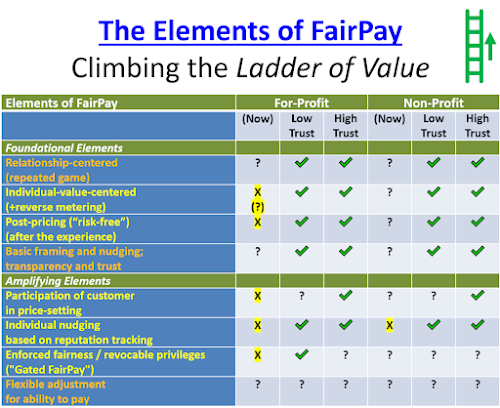
There is of course much more to how this is done, and it will vary greatly from context to context. Background on these variations is in my previous post, The Elements of Next-Gen Relationships and Pricing -- A Unifying Framework. It provides this summary table of the elements, and then comments on each:

 (with minor updates 10/27/19)

The columns to the right show that while most of these elements are applicable to both for-profit and non-profit organizations, the details will vary, and it will further depend on the level of trust and cooperation in the customer segments to be addressed.

As indicated, most non-profits currently use fewer of these elements than for-profit businesses, but greater use could improve their results (including increasing the satisfaction and generosity of their community). This presents a broad opportunity for a platform to make it easy for non-profits of all sizes to gain leverage.

Again, the clearest difference from how FairPay is used by for-profits is that fairness will often be left as voluntary, to be gently nudged with positive "carrots" rather than enforced with negative "sticks" (such as the revocation of privileges). But motivating fairness should be relatively easy for non-profits, since they can readily point to both the individual value and broader social value of their cause. (And non-profits can generally avoid the most complex element of FairPay, the business logic and policy issues of revocation or other negative incentives.)

The foundational elements are already used to some degree in many contexts, to build on the power of ongoing relationships. Now the amplifying elements can be added in and combined, to bring new synergy to revenue operations.

The general implication of the differences across columns is that the more advanced elements of the FairPay framework are most effective when the parties are perceived as holding up their side of the social contract:
  • for service providers who are perceived as offering real value and warranting trust and commitment from customers/patrons for being fair, transparent and responsive to their value creation needs and desires.
  • for customers who are perceived as fair and honest about communicating their needs and desires, and being fair (even generous) in making contributions to sustain that desired value creation. 
Concrete use-case examples

If this still seems abstract or unclear, please see my other posts with more concrete details of how FairPay applies in specific use-case examples:
Simpler "80/20" solutions with the same platform

Organizations using this proposed Revenue as a Service platform need not use its more advanced features, except as they are ready and wish to. The platform can be configured to deliver just the features each organizations wants. Thus it can provide a service that scales gracefully, from very basic, to very advanced.

One very important simplification of FairPay can serve as a high-leverage 80/20 solution in both voluntary and payment-required contexts. That is the "risk-free" subscription model that relies on post-pricing (after the experience). That can be done without using any of the participative pricing elements of more advanced FairPay solutions (and need not even exploit nudging). That is less of a departure from traditional set-price subscription or membership pricing. But unlike the high hurdle of an all you can eat, fixed price membership paywall, it works as a gentle "pay ramp." (This, too, is explained in my Elements post, and the Whitney and Metropolitan Museum use-case examples listed above.)

Similarly, the platform, itself, can be built in stages, beginning with the more basic elements, then gradually adding the more advanced ones.

Crossing the lines between donors and those served

As explained in my 2016 post on non-profits, FairPay provides new and better way to address the complex issues of pricing and sustainability across the spectrum from donors to those served.  Consider how this works for these two often overlapping constituencies:

·         Recipients -- direct customers/patrons of direct services (the mission). Here, pricing takes on two interrelated dimensions -- what is the fair value of the service, and what is the fair contribution from the recipient (to both the cost of the service to them, and to the added overheads needed to sustain the organization -- and optionally to the cost of service for those who can less afford it).
·         Benefactors -- indirect customers/patrons of indirect services (the altruistic value of supporting services to others, and the value of being a benefactor, including perks and recognition).  Here, the key dimensions are the value of direct services to others enabled by the benefactor’s donations, and the value of the indirect benefits to the benefactor.

The details will vary with the type of customer/patron and the nature of the organization and mission, but the essential task is the same -- to generate sustaining revenue by cooperatively setting prices (for service or donation) that make the value proposition "win-win." (That also includes recognition of non-monetary contributions by those who give in kind.)

The platform as a universal leverage point for achieving impact

The problem that limits the uptake of these methods is the implementation effort, and the need for ongoing testing and refinement (including "devops," the work of enhancing and maintaining the operation). Fund a platform for that, and many more organizations will be able to teach men to fish -- or give them fish -- or whatever other good works they do. The platform is a universal leverage point.

A platform solution across many organizations also has other kinds of economies of scale and network effects, beyond simply outsourcing that service. FairPay dialogs about value generate valuable data about exactly what each customer values at a fine-grained transaction level, as well as reputation data about the fairness of each customer (and how that varies with context). While that data is sensitive, if managed with care it could potentially be used in win-win ways to help guide service providers to engage with those customers who most value their service (for a single service provider, or across all the service providers that use the platform, subject to appropriate privacy controls). That can lead to more effective co-creation of value for everyone.

------------------------
Posts that are specific to non-profits and social welfare:
...and focused on journalism:
------------------------

[Update 4/14/20:]  An excellent article on how one platform service, Network for Good, is bringing some of the relationship-building methods I describe here, is How NonProfits are Doubling Down on Relationships with Subscription Giving. The article is by Tien Tzuo president of Zuora, who wrote the excellent book, Subscribed, that I reviewed in 2018.

------------------------
More about FairPay

A concise introduction is in Techonomy"Information Wants to be Free; Consumers May Want to Pay"

For a full introduction see the Overview and the sidebar "How FairPay Works" (just to the right, if reading this at FairPayZone.com). There is also Selected items (including links to videos and decks). 

(FairPay is an open architecture, in the public domain. My work on FairPay is pro-bono. I offer free consultation to those interested in applying FairPay, and welcome questions.)

Tuesday, March 26, 2019

"Risk-Free" Subscriptions to The Celestial Jukebox? (A Working Draft)

They promised us an "Infinite Jukebox" -- but we never expected the price to be infinite

The early days of the Internet promised an "infinite," "celestial jukebox," with instant access to all the content in the world. But instead of heaven, we are now facing "subscription hell." Yes, we can now enjoy nearly infinite access -- but the price also seems to be approaching the infinite. What we have here is not a failure of technology but a failure of business model innovation.

The future of subscriptions is to make them risk-free to the consumer.  For digital services, the provider risks little except the opportunity to take money in exchange for no value. That will be less and less tolerated.

===================================================================
Your thoughts?  This is still in formative stages, and feedback is invited.*  
===================================================================

One issue is that subscriptions are all about relationships, and that is more true than ever in our digital world. Our current relationships are dysfunctional because businesses make consumers take on pricing risk for no good reason. Consumers see the risks they face, realize that makes little sense for digital services, dislike that, and dislike businesses for demanding that. The compounding issue is that the inherent abundance of replicating digital services makes consumers even less willing to accept pricing risk.

Providers seem to think current models are the only way to do business – if they think about it at all. (Some prefer not to think about it, and love the value proposition of "autopay forever," hoping you forget that they are sucking money out of your wallet every month.) Even those with better intent and more desire to innovate are stuck in the scarcity-based economic mind-set of real goods, and have not really understood the value-creation power of the new economics of abundant digital services. We are still mired in your father's subscription models -- models for mailing pre-defined assemblages of print and squeezing pre-defined sets of TV channels into an analog cable:
  • Business know that consumers like simplicity. 
  • They also know that consumers hate surprises. 
  • So subscriptions are made simple: unlimited, flat-rate, all you can eat (AYCE). 
  • But AYCE distorts incentives -- it overcharges light users and undercharges heavy users. It limits risk at the high end, but not at the low end or the middle.
Businesses know there are problems here.
  • They have difficulty acquiring customers, and so offer introductory discounts (jam yesterday)
  • They have difficulty retaining customers, and so offer retention discounts, but only after you try to cancel (jam tomorrow)
  • But there is rarely any discount in normal times (never jam today).
Seeing the problems with AYCE subscriptions, some turn to another unrealized dream of the Internet -- like an old style jukebox, our infinite jukebox should take nickels -- so-called "micropayments."
  • But micropayments just change the pattern of risk: how many nickels will I need? 
  • This reduces risk at the low end, but not at the mid end -- and dramatically raises risk at the high end.
We have limited forms of micropayments for decades, in the form of pay per item (PPI) or pay per view (PPV). But, run up enough micropayments and those digital microbucks add up to real kilobucks. That is a fatal problem, even if we can make taking the micropayments totally frictionless. (Many grasp at new hope from cryptocurrencies and blockchains, but, much as they may reduce friction, they do not solve the problem of risk.)

The problem remains: consumers hate risk! Both classes of current models force significant and unnecessary pricing risk onto the consumer.

As outlined here, we can easily do much better, for most kinds of subscriptions to digital content or services -- not only for the consumer, but for the publishers (and platforms that serve them).

By getting smarter about harnessing the abundance of digital, we can have our cake and eat it too: we can reduce consumer risk AND we can motivate consumers to sustain those who create the content and services that they desire. (See "extensions to sustain creation" below.)

What is a risk-free subscription?

Here is the basic idea of a "risk-free" (or "no-risk") subscription.  Compare it to a conventional unlimited subscription that costs, say, $5/month. (The "update" section below also considers how this compares to services that are currently free and wish to shift to a paid model, or to enhance a simple voluntary payment model.)

Let's design a risk-free subscription that costs $0 to $7 per month depending on how much you use. Let's design a volume discount that varies -- to work much like micropayments for low usage -- and much like an unlimited subscription at high usage -- with graceful blending in the middle.
  • Get "run of the house" access to whatever items you want
  • If your usage for the month is zero, your bill is $0
  • As your usage for the month grows, your bill grows, but with declining cost per item. Your bill will go from $0 to $7, depending on how many items (and how many of them are premium items).
  • To avoid the risk of bill-shock when you used more than you intended, you never have to pay more than $7.
This is a simplistic example, and the price ($7 versus $5) for this added flexibility may actually be reduced over time. If many more people subscribe (because they have lower risk), total revenues will grow and the ARPU (Average Revenue Per User) target can be reduced (to attract still more subs), so the unlimited cap might shift to $5, or even lower.

We can improve on this (as explained further below):
  • add nuance to our usage metrics to move us closer to a value-based metric that understands that some clicks are more valuable than others 
  • layer on options to more fully support the ongoing investment of publishers and creators.
(This risk-free subscription is a generalization of a model I first suggested in 2015 --“Post-Bundling – Packaging Better TV/Video Value Propositions with 20-20 Hindsight” -- and have since discussed with major TV providers. That provides added detail on the use-case for TV/video bundles.)

[Update] Note that while the discussion in the original post was about risk-free models that ramp up based on items accessed or consumed, the same principles can be applied to work based on time, not items.  Some possible advantages of that are outlined in the update section on time-based models at the end.

Of course such a subscription is not absolutely risk-free, but it is much closer -- and yes, there are some levels of risk to the provider -- both of which are discussed below. But first, a closer look at consumer risk.

Consumer risk in an unlimited subscription

Think about the consumer's issues when they decide whether to subscribe, ...as they continue, and ...if they consider cancelling:
  • Will I use enough to justify the monthly price -- now, in the past, and going forward? Am I using the service often enough?
    Am I happy with my interest level in the selections offered?
    Am I satisfied with the quality of the items I consume?
    Do I just skim many items, or quit part way through?
    Do I get the desired value (or enjoyment) from the items?
  • Which premium channels should I buy access to?
    How would I know in advance?
    Did I watch enough items on the premium channels I chose and paid extra for?
    Was I happy with the premium channel items that I did consume?
    Did I regret that I could not watch programs on premium channels I did not subscribe to?
  • Is this subscription one that deserves to be in the "portfolio" of sources I pay for unlimited access to (given all the content sources of this kind that I want)?
    Did I find this month that I wanted other services I did not subscribe to?
    Can I afford to add still more subscriptions?
    Is this a subscription I should drop, so I can afford something else?
  • How can I predict any of this reliably?
    Do I know what will be offered in coming months?
    Do I know what alternatives will draw my attention elsewhere?
    Will I be paying for periods where I am on vacation or too busy?
The problem is that most digital consumer services offer constantly changing collections of experience goods. Especially for content services, we have only limited ability to predict what value will be offered, what items we will actually choose, and what value we will realize. That is highly unpredictable, except in hindsight.

Subscription providers seem to ignore this. They focus on customer acquisition and customer retention (and its converse, churn), but how many of them consider the dynamic value propositions of value/risk to each individual consumer? They optimize for CLV, the Customer Lifetime Value to them, but not for VLV, their Vendor Lifetime Value to the customer. How many businesses really think about how they justify their share of the consumer's wallet?

As more and more content of all kinds goes behind flat-rate subscription paywalls, how many subscription are simply unaffordable to many consumers who might gladly pay a profitable amount for occasional access? How many services offer discounts only for new customers, or those threatening to cancel? (This reflects a natural risk discount -- if the price is set in advance, a consumer's willingness to pay must factor in a discount to adjust for their risk of disappointment.) What about those who would be continuing customers at modest but still profitable levels? A few top publications like the New York Times are making money with subscriptions paywalls -- but only about 3% of their readers subscribe! -- and most news publishers do much worse. What a waste to both consumers and businesses! Surely we can do better!

The game most subscription providers play now, is one that charges at flat rates that work for their best customers, but that leave more moderate customers on the ragged edge of saying no. And the vast majority of those who might pay for moderate amounts of content do not subscribe at all. Some providers are even more cynical and customer-hostile, hoping you will take a trial and forget you are paying $5 a month, and then making you jump through hoops when you realize you no longer want to.

Consumer risk in micropayments (pay per item)

Why do consumers hate micropayments? -- even if they are frictionless? Because consumers hate unpleasant surprises.
  • What if I run up a huge bill?
    What if I get hooked on a binge?
    What if my kid goes overboard?
  • Will I be sorry I paid per item instead of getting an unlimited subscription?
  • What if I select items but find them disappointing?
  • What if I like to skim, and so access many items but get little value from each?
These problems are inherent in micropayment models that do not have significant volume discounts or other value-adjustment provisions. Pay per view movies have a profitable niche, but viewing more than a few gets very costly. News services like Blendle have been even less successful -- they offer single articles, but at 25-49 cents each, the bill rises quickly.

The psychological distress of the ticking meter has been well established. Think of telephone minutes, cellular data megabytes, and the old days of online minutes on AOL. Knowing the billing clock is ticking makes it very hard to enjoy using a service. We are always worried: "what shock will I face when I see the bill?"

20/20 hindsight and post-pricing

My work on FairPay highlights the difficulty of setting prices before the experience, why that is an issue of risk, and how "post-pricing" can avoid that problem. The value of experience goods is best known with 20/20 hindsight. Consumers are much happier paying for the value they get after they know what the value actually is. The classic Our Gang "Pay as You Exit" story illustrates the power of that.

Provider risk and profit

Back to my opening statement, "the provider risks little except the opportunity to take money in exchange for no value." Providers will, of course be quick to argue that they do face risk, but to what extent? Since the unit costs of access to existing content and most other digital services is negligible, the risks are not the marginal costs of service, but the usual subscription issues that drive CLV -- CAC (customer acquisition cost) and retention/churn -- and the risk of just not having enough subscribers.

The deeper provider risk issue relates to the predictability of cash-flow -- whether they can expect to fund their content creation and marketing expenditures going forward.
  • Compared to micropayment/PPI models which are already totally dependent on usage, the risk-free model should not worsen predictability -- and might improve repeat activity enough to make predictability much better.  Many businesses are hit-based, and deal with it, and all but the smallest publishers can spread that risk.
  • Compared to flat-rate subscriptions, the obvious concern is that the steady stream of monthly payments from each customer might become much less steady. However, the law of large numbers (many customers) will tend to smooth that in aggregate. Also, if the risk-free offering is designed well, there is reason to expect that reduced CAC and churn will dramatically increase the number of subscribers, so that overall revenue and net profit will be much higher, even if it is more variable.
Cynical providers be very reluctant to shift from the "get them on autopay and hope they never think about it again" gravy train -- but isn't that really very thin gruel?

Tuning the model

That is the basic idea, and the core of the case for it. It will take good design, testing, and refinement to prove it out and get it to work well. That can start with limited, low-risk tests. There is reason to expect that to validate some promising sectors and customer segments, so it can grow from there.

The rest of this draft explores some ideas on how to build on this strategy, by further reducing consumer risk and adding more value-based metrics of usage -- and by keeping the impact on provider risk manageable. Value-based pricing is increasingly viewed as best-practice in B2B -- we need to be more creative about applying that for B2C.

The discount curve

A key feature of the risk-free subscription is that it depends on usage, but adds a volume discount. Designing the discount curve that gets built into the price schedule will be critical to making it behave in a way that can make consumers comfortable. Consumers want simplicity, so the trick may be not to expect consumers to look closely to understand whatever tiered or continuous schedule of rates is used, but to simply give some examples of what to expect at representative usage levels. As long as customers have a sense that the curve is reasonable, and that they can see their detailed accounting for any month if they want to, that may be enough -- as long as the cap on total rate is not too high, and they don't reach it too quickly. (Of course one or more levels of premium pricing might be reflected in this schedule as well.)

Extension: The money-back guaranty, and the skim discount

One thing Blendle, the news micropayment aggregator, did well was to offer an unconditional refund button on each article viewed. That is a good start, but too all-or-nothing. It may be much better to let users specify a percentage refund they want, so that they can ask for a partial "satisfaction discount" when they are disappointed, without shying away because they feel a full refund would be unfair if they did get some value.

(Note that a quality guaranty can increase willingness to pay, thus offsetting the cost of the guaranty. Now consumers unconsciously build in a risk discount that discounts for the risk that they will regret their purchase. The guaranty can eliminate the need for customers to discount for that risk.)

Related, is the skim discount. Instrumentation increasingly makes it practical to determine the time spent consuming items, and what portions are consumed -- why not discount the unit price if the time spent is clearly short, or the item is clearly not finished? This kind of tracking also makes it possible to confirm that subscribers are being honest about claims of dissatisfaction, and limiting refund privileges for those who go overboard.

Extension: value-based usage metrics

Advertising-based revenue models lead to click-bait, and there are valid concerns that usage-based revenue models can create the same kind of harmful incentives. A simplistic usage metric such as number of items accessed, may well create similarly misaligned incentives for quantity without quality. But extensions like the satisfaction discounts and skim discounts above, will shift this from a simple count, toward a more nuanced value-based metric.

Further extensions can add more sophisticated value metrics (and the bonuses of the next section) to make this model more reflective of the true value of the experience to the consumer. Such metrics may factor in time spent with an item (dwell time), how full a portion of it is consumed (aborts and sampling), is it re-accessed, does it lead to further actions (outcomes), is it shared, etc. Of course most users will not want to dig into this complexity, but a simple "relative value/intensity of use" metric for each item could be reduced to an average and included in their statement. That is likely to be accepted as long as it seems reasonable.

Extensions to sustain creation:
A publisher-sustaining bonus, and a creator-sustaining bonus


The real challenge in sustaining digital services, especially content services, is that we are only beginning to realize that we must have a new social contract. We must pay to sustain the supply of future content, which is costly, not to access current content, which costs almost nothing. A risk-free subscription can make this transparent and discretionary:
  • At the end of the period (along with the statement that reports on usage, and what the "risk-free" price came to), invite a voluntary bonus to sustain the publisher. 
  • Remind the subscriber what they accessed and what they apparently got the most value from. 
  • Invite them to add a bonus payment, to reward the publisher, to better enable them to continue to supply more like that. 
  • Also, invite them to make this a recurring bonus (that can be cancelled at any time), so the publisher has more certainty of continuing revenue.
This can work for single publisher subscriptions, and for aggregations. Aggregators can suggest that bonuses be contributed for each publisher the consumer patronizes heavily (as well as a bonus for their own curation services).

A similar bonus can be offered to reward and sustain creators/artists -- the authors, musicians, filmmakers, gamemakers, or podcasters that each customer patronizes most heavily. Report the top candidates each month, and encourage a voluntary sustaining-bonus contribution that goes directly to them -- one-time or continuing. This might substantially increase consumer willingness to pay, and might generate significant benefits down the value chain, to enable digital services to create value far more sustainably.

This would work as a new kind of hybrid model, adding a component much like recurring crowdfunding (as supported by Patreon and similar recurring variations of Kickstarter and Indiegogo) into the mainstream of subscription businesses. Of course these bonuses need not be entirely voluntary -- there could be some required minimum "sustaining fee" -- or some premium-level sweetener could be added that requires a minimum fee.

A low-risk step for publishers in the direction of FairPay

Notice how this risk-free subscription becomes a way to edge toward FairPay while limiting risk to the publisher. The simple no-risk subscription outlined here uses the 20/20 hindsight of post-pricing to largely eliminate the consumer risk in conventional pre-priced subscriptions (and micropayments). It does that in way that keeps the provider in full control of the price schedule. FairPay goes farther to reduce consumer risk, in a more unconventional way, by adding customer participation in setting the price. Powerful as that promises to be, it is understandable that many providers are hesitant to give up that control.

The extension features outlined above gives the customer limited power to effectively adjust the price. They can adjust downward with the guaranty and upward with the bonuses. That moves incrementally toward FairPay, with a basic level of participation in a portion of the pricing.

It may be hard for publishers to make the case that they should be able to "take money in exchange for no value" -- but they do have a legitimate case that if they must invest to provide the value that consumers want in the future. A consumer who values the service has some obligation to sustain that investment.
  • Think of the base risk-free subscription as the way to maximize market reach, and ensure a base level of compensation commensurate with usage. (A component of price that is controlled by the provider.)
  • Think of the sustaining bonus as the way to nudge consumers to sustain the ongoing creation of services they value. (A component of price that is controlled by the customer, within limits set by the provider.)
Think about where to start with this, test it, learn how to manage it, and move toward a solution that serves more consumers and generates more profit for providers.

And, with this kind of win-win model, we can more sensibly sort out a balance between publisher-specific subscriptions and aggregated services (as Apple has given added prominence to) -- to find a harmonious mix that is good for consumers, publishers, and aggregated distribution services across a full spectrum of dynamically varying usage levels.

Why not give it a try?

---
Update: A "pay-ramp" not a "pay-wall!"

Think of the risk-free subscription as a "pay-ramp" -- a gentle incline that presents an almost imperceptible barrier to new and light users that permits ongoing sampling at modest cost as long as desired. As users gain the usage habit, the cost ramps up slowly, and even bingeing is at low risk.

Compare this to the sudden, hard barrier of a "pay wall" -- Even so-called "soft" or "metered" paywalls are really hard, shutting the door once you exceed the quota of free items. Instead of a hard barrier, the risk-free pay-ramp is more like a gentle speed-bump -- it does not stop users, just slows them momentarily.

Compare this also to an introductory subscription discount that has a somewhat lower (but still sharp) barrier, and then a further sharp hurdle (even if largely hidden, but overhanging) when the discount period ends.

Update: Time-based risk-free subscriptions -- with rollovers

Some services offer time-limited access, "pay as you go" models that are a form of micropayment that is not item-based but time-based. These can include "day passes" or variants for some number of minutes, hours, days, or weeks.

I have not been keen on the "ticking meter" aspect of these (the same problem as other micropayment models), but in speaking with a SaaS provider of such services I learned that some services are getting much better results with these than with item-based models. That led to discussion of a time-based risk-free model.

  • Current time-based models require the user to choose in advance whether they want an hour, a day, a week, or more. Interestingly, users often favor the shorter options because of fear that they will not use the longer options (even if it offers a hefty discount) -- lose-lose on both sides. 
  • So of course I proposed applying a post-pricing variation. Why not provide automatic rollover? Let the user start with the 15-minute or 1-hour option, but if they want longer access, don't go back to zero, roll into the longer, more discounted, option and credit the short-term fee against the longer-term fee so there is no risk.
  • This eliminates all but very small price-risk hurdles, and provides full optionality. 
  • Just provide a simple notice to the user when the current period has expired, stating that continuing will trigger the rollover.
  • Being time-based also has the advantage that it can seamlessly roll right into a full, auto-renewing subscription. On each monthly roll-over, just give the user the option to make it auto-renew.
  • The UX need not even explain all of this up front, it can do it in incremental bites as rollover points are reached.

Update: From free to paid (whether compulsory or voluntary)

The discussion above was largely framed as an alternative to paid subscriptions (or pay per item), this risk-free model is attractive in comparison to other conventional models as well.

It is very relevant to services that are now free, but that want sustaining revenue.
  • As an alternative to adding a conventional paywall, the no-risk value proposition softens the blow. Users can more easily be converted to paying customers if they know they do not risk paying for value they may not get. The hurdle becomes vanishingly low. Try it and keep usage low, until you see how it prices out. Instead of $5/month every month, it may be $0 or $1 or $2. If the discount curve is not right, usage will be driven down, but not to zero. That buys time to tune the discount curve so that most free users can be converted to paying customers. Make it easy to see the current total (and to get item refunds), so reluctant customers need not fear any billing surprise.
  • For mission-oriented providers who want all payments to be voluntary, the sustaining bonus component does the job. Keep the subscription price at zero, but suggest sustaining bonuses to the service provider, and to selected creators of items that are accessed. For example, a public service news offering could know its customers and gently nudge them based on their usage patterns, and any other value data it can apply. Patrons can be encouraged to set up recurring bonus contributions, knowing they can be stopped or adjusted any time they like. They can be nudged to boost their bonus contributions whenever their observed value consumption increases.
  • For member perks, this brings a risk-free way to charge for premium membership tiers. Many services (whether for-profit or non-profit) find it challenging to add paid premium tiers because the value propositions are especially lumpy, making fixed contributions especially high-risk to potential patrons. Risk-free charging solves that problem.
Update: How this can enhance and complement advertising revenue

It should be noted that this enhances and complements ad-based revenue models in two ways:
  • Paywalls conflict with ad revenue because they dramatically reduce views. Risk-free subscriptions reduce that effect because they reduce the subscription hurdle. They are more like an pay-ramp or pay-bump than a pay-wall. Paywalls reduce reach, and thus page views. So even if direct ARPU decreases, when ads are factored in, ARPU can be expected to increase.
  • The win-win nature of risk-free subscriptions can be complemented by a similarly win-win model for advertising. That is to apply a "reverse meter" that gives users credit for the attention and data they contribute when viewing ads. My post, Reverse the Biz Model!, explains how this can re-align incentives to make advertising more valuable for users, advertisers, and publishers/platforms.
Together, these strategies can have a compounding effect in raising revenue.

Update: Risk-free aggregation as the savior of long-tail providers

"Subscription hell" and "subscription fatigue" are especially limiting for long-tail providers. It is hard enough for dominant providers to attract subscribers, but even harder for smaller providers of more niche content. They are more value-challenged in attracting subscribers and more hungry for them. Potential subscribers face a lumpy value proposition (an expectation of fewer items of interest per month than for a dominant supplier such as Disney or HBO or NY Times) that makes flat-rate AYCE a very high-risk. An all you can eat buffet has low appeal at any viable flat-rate price when there is not much you want to eat.

Risk-free models can be especially valuable to them, and an aggregator who supports such models can help them reach beyond the small core of customers who would cross the hurdle of a flat-rate subscription (and not quickly churn away). This builds on my closing paragraph above: "this kind of win-win model...can...find a harmonious mix that is good for consumers, publishers, and aggregated distribution services across a full spectrum of dynamically varying usage levels."

Detailed discussion of how risk-free aggregation can work in the context of TV/video subscriptions (equally applicable to other content types) is in my earlier post, “Post-Bundling – Packaging Better TV/Video Value Propositions with 20-20 Hindsight.”

Update: Paywalls soft and hard versus risk-free payramps

NiemanLab reports that soft paywalls will get weaker with the change in Chrome that will prevent detection of incognito mode. The suggest this "could encourage more publishers to go all in on a hard paywall, in which you can’t read a single article without first registering."

As I commented, "Maybe the solution for publishers is to shift from the zero-sum thinking of warfare against their readers to the win-win thinking of co-creating value with them."

Update 9/30/19: Some corroboration from Zuora

An interchange with Jessica Lessin, triggered by an article in The Information reminded me of some important corroborating data from Zuora, a leader in services to SaaS businesses that analyzes data on over 900 SaaS companies (both B2B and B2C). From their chief data scientist, in "What Goldilocks Can Teach Us...:"

“Giving subscribers too many options is overwhelming. Giving them too few options is unattractive to customers who demand choices and value. But there’s a just right sweet spot based on understanding how your customer values your offering that leads them over time to sign up for more. A case in point lies in how you charge subscribers for usage with a pay-as-you-go component to your billing plan: without usage billing, subscribers may feel that a one-size-fits-all plan is charging them for more product than they use. But if you charge primarily based on usage, subscribers feel like you're looking over their shoulder and charging them for everything they do.”

“Our research shows that churn is lower and companies grow faster when there is a usage component to pricing: these companies experience 6% lower churn and 8% faster annual growth. But faster growth happens when the usage component is less than 50% of the bill: an additional 4% annual growth compared to companies where usage is the main mode of billing.”

(With regard to the last point, that "faster growth happens when the usage component is less than 50% of the bill," it seems unclear to what extent that really applies to B2C markets. But to the extent it does, that would suggest using the risk-free "pay ramp" as I outline it here, but perhaps with a minimum "floor" price per month even when there is no direct "usage." This gets to the issue of more sophisticated value metrics beside usage, and might be framed as covering the value and cost of "continuity" services, such as curation, alerts, newsletters, and even optionality. But such a floor price should not make the perceived risk of overpaying too high.) 


***Hint to entrepreneurs: maybe there is a killer opportunity for a risk-free service that aggregates long tail providers (or serves many of them in a harmonious way as a white-label SaaS service). Being more hungry, they will be more willing to innovate on pricing models than the dominant fat cats.

---
*Your feedback is invited. Comment here or email me (FairPay [at] teleshuttle [dot] com).

This post was first published 3/26/19 on my blog at FairPayZone.com
Minor revisions and enhancements are included in this version (latest: 6/24/19).


------------------------
More about FairPay

A concise introduction is in Techonomy"Information Wants to be Free; Consumers May Want to Pay"

For a full introduction see the Overview and the sidebar "How FairPay Works" (just to the right, if reading this at FairPayZone.com). There is also Selected items (including links to videos and decks). 

The Journal of Revenue and Pricing Management, "A Novel Architecture to Monetize Digital Offerings" provides a scholarly but readable overview. 

Or, read my highly praised book: FairPay: Adaptively Win-Win Customer Relationships.

(FairPay is an open architecture, in the public domain. My work on FairPay is pro-bono. I offer free consultation to those interested in applying FairPay, and welcome questions.)


Wednesday, July 19, 2017

Subscription Marketing: Anne Janzer Reviews FairPay

Anne Janzer's Subscription Marketing: Strategies for Nurturing Customers in a World of Churn is one of the best and most popular guides on this increasingly vital subject. Now Anne has applied her marketing insights and clear writing style to a review of my book, FairPay: Adaptively Win-Win Customer Relationships.

Anne observes that my work on FairPay (and its broader perspective on pricing and relationship strategies) is very aligned with her ideas on value nurturing as a core strategy for "sustaining the customer relationships that build long-term success" in the Subscription Economy. That alignment gives her a deep appreciation of how FairPay adds a new dimension that managers should be thinking about. 

Her review, "Disrupting Subscription Pricing: FairPay," provides a concise overview of FairPay and its motivation. Here is a sampling of her comments on why FairPay matters:
...it’s a natural fit for the evolving Subscription Economy... 
The model brings the business much closer to its customers... Instead of running “voice of the customer” surveys, you can see how people vote with their actual dollars. 
The pricing model itself is based on both trust and value... 
In many ways, the FairPay pricing model is the perfect complement to the practice of value nurturing outlined in Subscription Marketing. 
She concludes with a nod toward the unconventional nature of FairPay:
As soon as you start picturing this in your head, questions will pop up... But before you start thinking of the objections, ask yourself this: 
How would FairPay change the way you do business? 
How would your business operate today if your revenues were directly tied to the customer’s perception of value? What would you do differently in marketing, product development, or support? How would it change the way you think of customers, and of pricing?
I hope you will read her review, and then take a closer look at how FairPay works and why you should be thinking about its implications -- how you can make value nurturing include value discrimination. Even if you are not yet ready to go far with it, thinking about FairPay will change how you view your business. Details are in my book, and my blog (see the Overview, and More Details).

I also highly recommend that you read Anne's book, which provides a practical understanding of the essentials of subscription businesses -- why value nurturing matters and how to make it central to your business.

Thursday, April 13, 2017

Finding Value in The Subscription Economy

At the heart of the Subscription Economy is the idea that customers are happier subscribing to the outcomes they want, when they want them, rather than purchasing a product with the burden of ownership.
...Nicely put by Zuora, the SaaS platform company that drives many of the largest subscription services. They have popularized the term "subscription economy," and recently created a Subscription Economy Stock Index that highlights the striking growth of such businesses. This is not just a Zuora thing -- as the Oracle infographic to the right indicates.

This fundamental shift toward subscriptions is driven by the nature of our digital environment, and the power of Big Data and the Internet of Things. It is becoming easy to manage ongoing subscription relationships and service delivery -- and to get increasingly rich understandings of actual value received. We are only beginning to recognize how deeply this will transform how we exchange value in commercial relationships.

This post explores the key concepts of value as they apply to subscription relationships -- and as they are are embodied in the pricing of subscriptions. This draws on "value-based pricing" strategies that shift from simple (but less optimal) cost-based or competition-based models. (These are increasingly transforming B2B markets, but have so far seemed less readily applied to B2C markets. FairPay, a new approach to value-based consumer relationships, promises to change that game.) This post shows why shifting toward value-based pricing -- even if only in small, incremental steps -- is vitally important to maximizing the value of subscription relationships -- Customer Lifetime Value (CLV).

[UPDATE 4/20/17:] Think of this is "value discrimination." Marketers and economists think about "price discrimination" as the way to be efficient about getting the most revenue from each customer. But in recurring relationships, what we really want is value discrimination -- finding the optimal value proposition for each customer. Value discrimination involves optimizing not only the price, but the value of the product/service package that is provided for that price.

Value is complex, multidimensional, and highly individualized 

Our digital age has not only driven "relationship marketing" to become deeper and more powerful, but has changed the economic realities of value -- shifting focus from "value in exchange" to "value in use." That is what the opening quote from Zuora referred to, "the idea that customers are happier subscribing to the outcomes they want, when they want them..." We generally do not really want products for their own sake, but as services that produce outcomes. Subscriptions are not a product with a set value in exchange, but a structure for a service relationship that produces a dynamically varying value in use.

Current subscription models drive toward this idea of value-in-use, but do not yet fully embrace it. Our concepts of value and value-in-exchange are still rooted in the old logic of products ("goods"). Value-in-use can not be known until after use. Not only does value vary from subscriber to subscriber and from period to period, but there are many factors involved in estimating value.
  • Is the value tied to the period of access and/or the amount of access (permitted or used)? 
  • Is it per unit of product/service? 
  • Is it how well the service met quality or service-level standards (performance)? 
  • Is it what the experience achieved, what benefits it led to, or how well liked it was (outcomes, whether objectively measured or in customer perception)? 
  • Is it a matter of broader values, like cultural merit or support for social/civic/environmental values (including economic "externalities")? 
  • Is it affordable to me (willingness/ability to pay), and does what I pay sustain creation of more content or services that I desire?
An ideal market system would factor all of these aspects of value into pricing. For example, the value of a content service is not just how many songs or videos or stories I have access to, nor how many I do access, nor whether they arrive without halts or delays, nor whether I play all of an item or hate it and stop, nor whether the service pays its creators and employees, and avoids pollution, nor whether it is priced within my means. Ideally it is a reasonable combination of all of these.

The question is: how well can we do at approaching that, in a way that still creates a good customer experience without undue complexity? In this digital era, we are gaining a wide range of Big Data that bear on understanding value -- data that directly or indirectly provide new insight into:
  • the usage of products and services with detail on what we use, when, and how completely or intensely
  • the performance of what we use and the quality of the experience
  • the objective and subjective results of the experience.
Marketers are already using newly available data to target their offers, and to factor better predictions of value into their pricing. But subscription pricing strategies are just beginning to address the gap between average predictions of value and the widely varying actual experiences of individual consumers. 

Climbing the ladder of value -- profiting from more win-win relationships

Consider the range of approaches to price that we commonly see in practice and how they track to value. Keep in mind the fact that value in use, the outcome of a service, is difficult to predict in advance, and varies from customer to customer and time to time -- and so is best assessed after use, when the outcomes are known. There is also the problem that important subjective value perception data arises from within the head of the consumer -- that aspect of value can be hard for the business to know, even after the fact.

Uncertainty in quantifying value realization forces us to address the related question of who takes on pricing risk? This has important implications. How much use will I get from my subscription? Must I lock in a package rate to get a volume discount, and then have to wonder if I will use enough of the package to get the value expected? What if I use it, but am disappointed?
  • Pre-setting prices puts the pricing risk on the consumer (causing many to refuse to take the risk at all, resulting in lost revenue), and often leads to disappointed customers (which hurts customer retention, thus reducing future revenue).
  • As practitioners of value-based pricing recognize, offloading pricing risk from the customer is a service, and one that can increase sales and loyalty. Think of it as pricing-risk-management as a service.
  • For digital services (which typically have near-zero marginal cost for unlimited replications), businesses have little to lose by taking on pricing risk (as long as they manage that risk effectively).
Both parties suffer when services are priced in a way that a) poorly correlates to the value the customer receives, and b) forces consumers to take on unwanted pricing risk. Specific strategies can be understood in terms of how they combine three aspects of pre- (versus post-) pricing risk:
  1. Pre-set packaging of an assortment or bundle of items or services in a subscription. Do you have run-of-the-house access to a full range of items or services to choose from, as you decide you want them, or must you choose a specific assortment or bundle in advance? This comes up when you subscribe to TV channels in bundles, or to NY Times news plus crosswords, or support a museum or a musician on Patreon, and choose from multiple packages with different perks at different prices. Do you know in advance what combination you will want and how you will value it?
  2. Pre-set usage levels. If you subscribe to a service, does the price depend on how much you use it, building in volume discounts? Other things being equal, a customer who uses many articles, songs, programs, or whatever, per period will presumably get more value than one who uses only a few. Does the price reflect that? Unlimited usage plans do not -- so heavy users get a bargain, and light users subsidize them (and may not find it worthwhile to subscribe at all). Beyond that, usage-related pricing generally tracks better to value when it applies volume discounts, as with mobile data plans, and TV channel bundles. (Such prices can vary a unit at a time, or be fixed within set usage bands.) Volume discounts can factor in both diminishing returns to the customer and economies of scale to the supplier. 
  3. Pre-set price schedules. Even when pricing depends on usage, and offers volume discounts, that usage is most commonly priced using a pre-determined price schedule, which presumes some average quality of outcomes. More advanced value-based pricing approaches can allow the price schedule, itself, to depend on actual outcomes. For example, the price of an article or song or video may depend on the value I actually get (/perceive) from it. One simple example is when a sales commission depends on the price obtained for the sale. Outcomes pricing is generally not done in current consumer subscription plans (but is a feature of the new FairPay strategy).
Whatever the particular form of pre-pricing, the business must try to predict pricing levels (/tiers/packages) that work on average, but will inevitably work poorly for the many consumers who diverge from the average in one way or another. To the extent that such pricing decisions can be deferred, greater price discrimination can be achieved in a fair and transparent way. That leads to better economic efficiency, higher profit, and happier customers.

More detail on "Understanding the rungs on the ladder of value" is provided in the sidebar below, but to cut to the chase...

Maximizing CLV and Value Experience

The established wisdom of subscription economy businesses is that it all about Customer Lifetime Value (CLV). The problem is that this is generally viewed from a one-sided perspective -- value to the vendor. But value to the vendor is maximized when the relationship is win-win. It is a matter of fair balance -- maximizing CLV requires equal attention to how the customer values the relationship: Vendor Lifetime Value (VLV).

  • It is costly to acquire customers, and therefore it costly to lose them and have to replace them -- recurring revenue models work best when the revenue recurs. 
  • Customers are retained when they feel they are getting good value for their money -- for what they really want. That is especially likely when they feel the business is listening to them, understanding what they value, and seeking to deliver that at a fair price. 
  • To the extent that we can migrate toward pricing methods that offer better mappings to value-in-use, customers will be happier and more loyal, and move toward maximum CLV (and VLV).

It is easy to get lost in the mechanics of pricing and subscription models (which are complicated and full of compromise) and lose sight of the underlying goal -- to find a right price, for each customer -- a price that each customer will view as fair compensation for the value they seek. We are so used to the compromises and nasty zero-sum games that are the dark side of the past century of mass marketing, that we often descend into a cycle of exploitation on both sides. Businesses treat the consumer's perception of the total value proposition as something to manipulate and exploit, and, as a result, consumers distrust businesses and try to "hack" them. But as businesses become "customer-first" and oriented to "customer experience" (CX), we see that what really matters is cooperating in a joint, effort to co-create value, to maximize "value experience" (VX).

A few decades is a long time in our personal lifetimes, and that makes it is easy to forget that we are still in the infancy of the digital era, with many deep changes yet to come. But we do see that a few decades into the digital era we are still in a time of continuing disruption and turbulence. As Peter Drucker said, "The greatest danger in times of turbulence is not the turbulence, it is to act with yesterday's logic." Moving toward value-based post-pricing will move us toward tomorrow's logic -- to reduce the cost and risk in how poorly prices track to value. It is that new logic that will fully realize the value in the subscription economy.


-------------------------------------------------------
Sidebar:  Understanding the rungs on the ladder of value

A more detailed view of how this plays out in subscription pricing plans is outlined in the following list (drawing on an earlier post, Beyond the Deadweight Loss of "All You Can Eat" Subscriptions). Looking at this progression, ordered roughly in accord with the degree of value-based post-pricing, it becomes apparent that we are only at "the beginning of the beginning" of our evolution toward a commerce for the digital era.
  • Unit sales of items (pre-priced). This is the pre-subscription base case. Examples are song/album, video, e-book, and article ownership downloads (with or without cloud repositories). This is simple and easy, but tracks to value only on average -- and as predicted, not as realized. It is a bargain for heavy users of specific items, but costly or prohibitive (and a management problem) for light use of many items.
  • All You Can Eat (AYCE), unlimited subscriptions (pre-priced). The common model of all the items you want, time-limited to periods of subscription. This too is simple and easy, but has similar kind of unfairness and inefficiency -- still tracking to value only on average (overpricing light users and underpricing heavy users), and considering value only as to the predicted average experience, not the value-as-realized. Many potential subscribers who are unsure of the value or how much they will use (or expect it will not be much) are disinclined to subscribe. Often referred to as paywalls (with all the exclusionary connotations of a "wall,") these also include tiered variants with levels of premium access, including freemium versions that begin with a free tier (but still place a paywall at some pre-set premium level). 
  • Membership models (pre-priced). These are a form of subscription with a more cooperative, participative orientation, such as for publications, artists/creators, or museums -- sometimes using crowdfunding platforms like Patreon or Indiegogo. These may seem more voluntary than hard paywalls, and often include tiers or bundles that include different levels of perks, but still have pre-set prices for given levels of service (see pre-bundling, below, and note that these perks, such as T-shirts and tote-bags, are often gimmicks of questionable value).
  • Partially usage-related subscriptions (pre-priced for the most part). These improve on unlimited models by adding usage-related tiers, such as for varying levels of mobile data service, how many TV channels are viewable in a bundle, or how many DVDs or e-books you can have out at one time. In most cases not only are the price schedules pre-set by the seller, but the customer must pre-select which specific tier or bundle they want. These can track better to value, in terms of usage, but only based on pre-defined units of usage -- without considering the experiential value of that usage.
  • Fully usage-based subscriptions (pre-priced schedule applied to actual, metered usage). Currently, these are most widely accepted in B2B, such as jet engine "power-by-the-hour" and fleet "tires-by-the-mile." These have also been used for B2C, such as the old "per-minute" charges for mobile phone and dial-up Internet services. Consumers often dislike these plans because of the unpredictability of both usage and value, and the relentlessness of the "ticking meter." However, in some B2C uses the tracking of usage units to value can be quite satisfactory. Tire miles and engine hours are manageable and serve as a good estimator of the broader business outcomes.
  • Pre-bundled subscriptions (pre-priced menu). These can be forms of any of the above in which the customer is given a set menu of options (pre-set, tiered packages) to select from at pre-specified prices. The use of tiers and packages with appropriate volume discounts leads to a better fit to value (for the tier or package), but in a very static way -- it forces the customer to select a tier or package before knowing if they really want it and will find value in it, and sets the value based on predicted averages, not actual value in use.
  • Post-bundled subscriptions [new] (post-priced in part based on actual usage -- but still based on pre-set volume discount schedules). This is an enhancement of conventional subscriptions that I have proposed, such as for TV services, that offers discount prices at levels comparable to current TV bundles, but with the composition of the bundle set after the fact, so that customers can watch whatever channels they want, while still benefiting from a bundled-rate discount. This can track significantly better to value as it varies from customer to customer and month to month. It does not directly address outcomes (did you like that program?), but refund options can be provided (for each program view) to add a degree of outcomes tracking (duds are free).
  • Performance/Outcomes-based pricing (post-priced based in part on actual usage, with a price schedule that is based on performance or outcomes). This goes beyond usage alone, to factor in the quality or result of that usage. Performance-based pricing is common in digital advertising (clicks, leads, transactions) and other B2B markets. Outcomes-based pricing takes that farther up the value ladder, and is increasingly applied in healthcare (where the price schedules are typically set in advance, based on prior results in test populations). Of course it would be more desirable to base the schedule (at least in part) on actual individual customer outcomes, where that is feasible (pay if cured). 
  • Soft values as pricing factors (pre-priced or post-priced). This adds consideration of broader values in the overall experience, like cultural merit or support for social/civic/environmental values. Conventionally, this is rarely an explicit factor in pricing, but some aspects are increasingly implicit in prices, in the form of a tacit understanding that consumers are OK with paying a premium for goods and services that support broader human values and/or are produced and delivered in socially responsible ways.
  • FairPay subscriptions (/memberships) (post-priced, with price schedules set after usage). This is the new value-based strategy that shifts to an adaptively cooperative process for "dialogs about value" that get finalized after usage to create the best practical approximation of price to value in use. (FairPay also applies elements of participatory pricing to optimally factor in the customer's perception of value-as-experienced.) FairPay is designed to co-exist, at whatever level desired, with the other methods above, and to be able to subsume them in a flexible architecture for collaborating on value and price (co-pricing). More about FairPay and how it can adaptively seek the best of all of these approaches is addressed elsewhere in this blog. It is not yet clear how widely applicable FairPay will be, but it points to many aspects of deeply value-based strategy that will almost certainly be important in one form or another.


----

(Other posts in this blog have explored many aspects of the subscription economy, and how FairPay offers a path to a next generation of more profitable subscription relationships. Recent posts explained how and why the FairPay strategy adapts the "value-based pricing" approach that is increasingly transforming B2B markets, but has so far seemed less readily applicable to B2C markets --and how FairPay's new approach to consumer relationships can change that game.)

For a full introduction to FairPay see the Overview and the sidebar on How FairPay Works (just to the right, if reading this at FairPayZone.com). There is also a guide to More Details (including links to a video).

Even better, read my highly praised new book: FairPay: Adaptively Win-Win Customer Relationships.