Monday, October 26, 2015

New Video on FairPay -- Reisman Presentation to ISSIP 10/14/15

Video is now online at ISSIP from my 10/14/15 presentation on FairPay. ISSIP is the International Society of Service Innovation Professionals, "a professional association co-founded by IBM, Cisco, HP and several Universities with a mission to promote Service Innovation for our interconnected world."
==============
Video Details:  This is about 24 minutes of presentation, plus some Q&A, with a very interesting and interested audience. A full slide set (including some supplementary slides not on the video) is also online. (Should there be any difficulty with those links, there are alternative locations for video and slides, and future updates of presentation slides will also be online.)
==============
I was introduced to ISSIP when I met Jim Spohrer of IBM, one of its founding board members, at the Naples Forum on Service in June. Jim immediately saw the appeal of FairPay, and how it embodies many of the principles ISSIP is helping to illuminate. He has been very supportive in introducing me to the ISSIP community. That led to this presentation, which was facilitated by Haluk Demirkan of the University of Washington.

As my still-formative and inexpert encapsulation of how FairPay fits with service science and Service-Dominant Logic (S-D-L), these teachings suggest that much of our conventional thinking relates to "Goods-Dominant Logic" that developed over the past centuries -- "yesterday's logic." But now we are in a service economy, and are beginning to recognize that goods matter only in enabling a service -- for example, a nail has little value in itself -- its value is in how it provides the service of fastening, in a particular use and context. The value of a service is understood to be "co-created" by the provider and the consumer in its particular use-context.

From this perspective, FairPay is a form of co-pricing, in which buyer and seller agree on a process to seek a win-win value exchange over the life of their relationship. That opens a whole new dimension in customer relationships that can deeply alter how we do business. (Details of how are in the video, and other pages here.)

One perspective on this might be thought of as Value-Dominant Logic (V-D-L) as opposed to our current Price-Dominant Logic (P-D-L). FairPay offers a process for seeking fair value, in which price becomes emergent from buyer and seller's interactions over time. Thus price remains the metric of net value-in-exchange, but now price tracks directly to value-in-context instead of being pre-set in ways that track poorly to value. The processes of FairPay -- as embodied in cycles of customer journeys -- dynamically set prices to approximate value. This not only can transform business, but makes a better economics, because prices that track to value make the economy more efficient and productive. (Some insight into this stems from my thought experiments relating to an all-knowing economic demon.)

The idea is very simple: P=V. Price = Value (in context). Price should at least seek to approximate value over time. Doing that would make our economy work better for all of us. FairPay suggests a way to adaptively seek P=V. (I plan to expand a bit on this in a separate post.)

----
On the video, after the talk, is a few minutes of Q&A, with some very interesting questions.

(To add one clarification, I should have given a fuller answer on the first question in the Q&A. The question was about crowdfunding and crowdsourcing. I neglected the second part, and would add this: Crowdsourcing fits very nicely into the FairPay logic, since it is just another form of value, which flows in reverse, from consumer to provider, and just one more dimension of value to be mutually considered and netted out in the "dialogs about value," Just as value from the provider can be measured and then valued, so can value from the consumer.)

Saturday, October 17, 2015

Win-Win Customer Journeys -- With Dialogs about Value

Competing on Customer Journeys is a very interesting article in the 11/15 HBR that presents an emerging marketing paradigm, one that provides just the context for a further step of proactivley ensuring the journeys are maximally win-win. The subtitle is "You have to create new value at every step" -- my work on FairPay suggests a way to enrich the customer journey to do that much more explicitly and effectively.

Edelman and Singer explain that:
The explosion of digital technologies over the past decade has created “empowered” consumers so expert in their use of tools and information that they can call the shots, hunting down what they want when they want it and getting it delivered to their doorsteps at a rock-bottom price...  
Rather than merely reacting to the journeys that consumers themselves devise, companies are shaping their paths, leading rather than following. Marketers are increasingly managing journeys as they would any product. Journeys are thus becoming central to the customer’s experience of a brand—and as important as the products themselves in providing competitive advantage.
They suggest how this can enable "a 'loyalty loop,' ... a monogamous and open-ended engagement with the firm:"


I suggest that this is a big step forward in developing long-term profitable customer relationships, and that it meshes well with the similar kind of continuing feedback loop that drives FairPay. The idea that FairPay adds is to insert "dialogs about value" into each cycle of the journey after the "enjoy" step -- when the consumer knows the value of the experience -- and to adapt the pricing based on that. The enables participative personalization of the value proposition, as a simplified form of value-based pricing:
  • Buy
  • Enjoy
  • Value (added -- dialogs about value, to personalize the value proposition)
  • Advocate
  • Bond
Without this added step, the loyalty loop does not fully realize a central driver of engagement and loyalty -- a proactively personalized value proposition that is win-win for both the consumer and the firm. Without this we just perpetuate the idea that the firm decides on value propositions and tries to coax consumers into accept them. Adding explicit value assessment into the loop engages the customer more deeply and enables the firm to serve the customer far more effectively. This participative element builds consumer loyalty by demonstrating the firm's commitment to learning exactly what each customer values in varying contexts, and seeking to deliver it by customizing the value proposition to match.

Edelman and Singer go to the threshhold of this, and we just need to add this one more step (emphasis added):
We’re now seeing a significant shift in strategy, from primarily reactive to aggressively proactive. Across retail, banking, travel, home services, and other industries, companies are designing and refining journeys to attract shoppers and keep them, creating customized experiences so finely tuned that once consumers get on the path, they are irresistibly and permanently engaged. Unlike the coercive strategies companies used a decade ago to lock in customers (think cellular service contracts), cutting-edge journeys succeed because they create new value for customers: Customers stay because they benefit from the journey itself.
As emphasized on this blog, the driving goal of FairPay is to make price=value, over time. When it comes to value propositions, firms remain coercive, effectively saying: "We give you this value package for this price. If you don't like that, how about this other value package for this other price? If none of our options suit you, we are not listening -- you will have to settle or go elsewhere." FairPay dialogs about value open a new dimension of adaptivity and dialog to personalize value propositions based on individual context, needs, and value perceptions. These dialogs about value become central to the journey, and a key driver of the loyalty cycle. How that is done is shown in the sidebar, and expanded on in the Overview and More Details pages.

Adding this focus on value does not just increase loyalty, but promises to dramatically increase profitability as well. The article presents an example about Sungevity, a provider of residential solar panels:
Sungevity is ... using what it knows about its customers to extend the journey... With granular data on each household’s energy use and habits, Sungevity can advise people one-on-one about managing their energy consumption, and it can recommend a tailored package of products and services to help them reduce their dependence on the grid and reap savings. ... Ultimately, the firm plans to integrate its services with home-management networks that can automate energy conservation (adjusting lights and heating, for example) according to decision rules that Sungevity develops with each customer. Another project is to create conservation-oriented customer communities. 
The value step I propose would bring value pricing into this journey -- in a uniquely simple and lightweight form -- to enable Sungevity to evaluate the savings their services actually deliver to the customer, and to engage in dialog with the customer to share a portion of that value with them. Rather than expecting the customer take a risk that they will get a predicted value, and discounting the price they are willing to pay to allow for that risk, Sungevity can design the journey to share the risk, measure the realized value, and share in that value. Examples of how effective such value pricing can be are in this other HBR article.

FairPay is a very natural extension to the customer journey perspective. Edelman and Singer explain that "The move from selling products to managing a permanent customer journey has required mastering the four capabilities that all companies will need to compete: automation ...; personalization ....; contextual interaction ...; and journey innovation .." The same four capabilities support FairPay as well. 

As the new "logic" of customer journeys becomes accepted in marketing, the related new "logic" of FairPay" and its adaptively win-win value propositions should become increasingly accepted as well. Different levels of FairPay empowerment may be applicable to different consumers and different business contexts, but a more explicit focus on value can benefit almost any customer journey.


Tipping, Fair Pay, and FairPay

Tipping in restaurants made the news this week, raising many questions about "fair pay" the social movement toward fair wages -- but also bearing on the very different issues of "FaiPay" the new strategy for value-based consumer pricing described on this blog (and outlined on the Harvard Business Review Blog).

The news is that the prominent NYC-based Union Square restaurant group is phasing out tipping entirely in most of its restaurants (Union Square Cafe, Gramercy Tavern, The Modern, ...). This is a very complex issue, as noted in the NY Times article on 10/15/15, including issues of customer service, fair wages for labor (the "fair pay" issue), economic policy (do minimum wages apply to tipped workers) and even tax policies.

As described in other posts and the sidebar, FairPay is a strategy for setting prices with user participation, having elements of pay what you want (PWYW) that are much like tipping.

  • What FairPay adds to PWYW is that it is applied in the context of a relationship that continues only as long as the payments are considered fair by the business. Thus the consumer can pay any price they want for a given transaction, but the business can decide to stop offering FairPay transactions to a consumer who they consider to be free-riding. That gives the consumer strong reason to pay fairly, to maintain that privileged relationship.
  • This works very much like restaurant tipping -- especially in the case of diners who might be regulars at a given restaurant, and thus concerned about their reputation for tipping fairly, and how that affects their ongoing relationship with their servers (who may provide less service to those they feel were unfair, and superior service to those who are generous). So the behavioral economics of tipping, and of PWYW, are very relevant to FairPay.

My focus here is not on the complex issues of wage equity in restaurants, but on the behavioral economics of the FairPay model -- as applied to other kinds of value exchange -- how tipping sheds light on broader issues of customer value propositions. Still more broadly, these are questions of the overall effectiveness of how businesses relate to their customers, and the processes for determining how value is shared among consumers, businesses, and workers.

Price=Value

The essence of FairPay is the idea that price should correspond to value -- as actually experienced by the customer in the full context of that experience, as it evolves over the course of the relationship. It is based on open dialog and transparency about the value exchange, the costs, and the economic value surplus that is "co-created." If the parties behave fairly, this lead to economically optimal pricing that produces the greatest overall value for all. The details all have to do with getting that fair behavior.

The Times article on tipping makes some interesting points. One is very supportive of this core benefit, an agreed to value exchange that is win-win for both sides:
Many customers remain deeply attached to the right to reward attentive service, or to withhold that reward. And servers often say that the bonanzas they take home after busy nights far outweigh the risk of getting nothing once in a while.
It is widely recognized that when restaurant service is built into prices, with no discretionary reward for service quality, quality is often poor and customers dissatisfied. There are of course some customers who tip unfairly (or not at all), and depending on the demographics of the clientele, this may or may not be a serious problem. But presumably the problem decreases among regular customers, and it is in just such long term relationship contexts that FairPay seems most likely to do well (and I suggest that its use be limited to such contexts). Just to reinforce the key points, I repeat that quote, with added emphasis:
Many customers remain deeply attached to the right to reward attentive service, or to withhold that reward. And servers often say that the bonanzas they take home after busy nights far outweigh the risk of getting nothing once in a while.
Better for both parties!

Clarity and transparency

As always, the devil is in the details, and there is much complexity here. Some of that relates to clarity and transparency as to who is being compensated for what. Another quote:
By increasing prices and ending tips, Mr. Meyer said he hoped to be able to raise pay for junior dining room managers and for cooks, dishwashers and other kitchen workers. Compensation would remain roughly the same for servers, who currently get most of their income from tips. Under federal labor laws, pooled tips can be distributed only to customer service workers who typically receive gratuities, and cannot be shared with the kitchen staff or managers.
Much of that was news to me, in spite of having tipped in NYC restaurants many hundreds of times over many decades. My impression was that it was the servers who got the tips, not the kitchen staff (but I was not sure if that was always true), but I still have no clarity on whether my tip goes to my waiter alone, to all waiters, or to other service staff (which I presume varies with the restaurant). Makes it hard to know what is fair doesn't it? Without knowing who my tip goes to, it is hard to be fair. But if I know what goes to my server, I have a pretty good sense of the fairness of that (as long as I am cognizant of the common "reference price" that 20% is fair for a normal level of good service).

Another aspect of transparency is that the "dialog" about value in a restaurant is very limited. There is the service and the tip, and maybe some polite chatter or body language, but that is about all. It is rare that either party communicates specifics as to why a given tip might be fair or not.  FairPay suggests that convergence on a mutually desirable exchange will be most effective with clear dialog on what is or is not working with all aspects of the value proposition. That may well be awkward with a restaurant server, but it can be very direct with a business that uses modern computer-mediated dialog services such as feedback forms, and that invites and responds to such dialog.

So the NYC restaurant issue involves many factors not directly relevant to FairPay as it applies to other industries -- such as service versus kitchen staff and wage and tax laws -- but the essence seems to reinforce evidence from studies of PWYW in other contexts that people do pay fairly when given clear information on what they are paying for and why. It seems the problem with tipping is not that it doesn't work well for servers, but that other workers are not doing as well. The article goes on:
“The gap between what the kitchen and dining room workers make has grown by leaps and bounds,” Mr. Meyer said. During his 30 years in the business, he said, “kitchen income has gone up no more than 25 percent. Meanwhile, dining room pay has gone up 200 percent.”
This begs the question of why take tipping away from those it works for? Tipped workers were clearly much better served than non-tipped workers. (As a reference point, the CPI increased 221% in the past 30 years.) Again, my issue is not whether tipping is good labor practice, but what this tells us about pricing models more broadly. It may well be that tipping is less effective in less high-quality, service-oriented restaurants (or where waitstaff may be at risk for abuse by customers or management). But it is those contexts where quality and service are key elements of the value proposition that I suggest are the prime opportunities for FairPay.

Computing value

Another thing that tipping teaches about FairPay is how easy it is for people to compute value intuitively. On hearing about FairPay in other contexts, such as for digital content subscriptions, people often ask "isn't it a difficult cognitive burden for customers to have to think about the value?"

But tipping provides a clear answer -- this computation is not difficult -- it is highly intuitive. We easily do a complex multivariate, multi-dimensional analysis in our head, during and after a meal and know immediately whether we think the service was average, or better or worse, and by roughly what degree. We can then easily figure whether we adjust our average tipping level up or down, and whether to adjust for being a regular or any other special factors, to conclude that we should tip X%. Any computational difficulty is just doing the arithmetic of how much X% of the bill is (with or without tax, rounding, etc.). Other complications relate to whether our tipping is visible to others in our party that we might want to impress -- which is something that may or may not be relevant in FairPay contexts, and may not be much of a problem even when it is a factor.

So all in all, it seems the behavioral economics of tipping is very supportive of the idea that FairPay will prove very effective in selected business contexts. Whether tipping can and should survive in restaurants -- given all of the unique social, labor, and legal issues involved -- is a different question.

Thursday, October 8, 2015

Ad-blocking -- Kicking and Screaming to Win-Win Value Propositions

Media companies are in a panic over ad-blocking, as an existential threat, now that Apple has enabled it for mobile -- but this may just force the end of an era of consumer abuse deservedly left behind, and the beginning of a new era of win-win value propositions. Advertising strategies have become increasingly consumer-hostile, and that has caused consumers to say "I'm as mad as hell and I'm not going to take this anymore." While this may seem the end-of-days for publishers, we may just be turning a corner toward a much more effective blend of advertising and subscription models. What we need is a new and more collaborative, win-win mind-set.

Things have long been in a downward spiral, as publishers are squeezed at both ends -- lack of subscriber revenue and decreased ad effectiveness.  Even though we have entered an age of personalization and targeting, desperate publishers overload users with a poorly targeted barrage of ads, and fed-up users choose to block them. That it is nicely illustrated in this diagram:
Apple's enabling of ad-blocking in Safari may be the coup de grace for current models. The recent PageFair/Adobe Ad Blocking Report shows how this has been growing over 40% per year for several years, to a loss of tens of billions of dollars, even before the new Apple support gives ad-blocking increased legitimacy.

As my friend Bill Rosenblatt observed on Forbes, to publishers, ad-blocking looms much like piracy. Publishers have relied on ads to pay the freight, so consumers could buy their content at low rates. Some sites even have terms of service that make the contract explicit -- you agree to view our ads in exchange for access to our content. As with piracy, legal counters to prohibit ad-blocking are being sought by some. Bill referred to Digital Content Next (DCN, formerly the Online Publishers Association) as taking a more nuanced and consumer-friendly view, and a few days later, the CEO of DCN co-authored an interestingly balanced opinion piece on re/code (which contained the diagram above).

The underlying problem is that the advertising value proposition has been a bad one, shoved down the throats of consumers. Publishers decide what the ad burden should be, with little regard to the consumer's view of the value proposition. They set the prices and the ad loads, and seem to care little about how oppressive and obnoxious the ads are. (In an extreme case, a page on Boston.com reportedly took 8 seconds to load editorial, and 30 seconds for ads! -- who wouldn't want to block that?) They tell the consumers to take it or leave it. Contempt for the customer seems to have reached the breaking point:
  • Given no reasonable say in a value proposition they loathe, consumers react with subversion -- blocking ads, just as they react with piracy when they think content prices are rapaciously high. Consumers demand fairness from their suppliers, and if they feel it is not granted, they will seek to take what they feel they deserve by whatever means necessary -- a Robin Hood strategy.
  • And why not? Do they get relevant ads? Do they get to choose how to balance subscription fees and ad load? Publisher have declined to give them any choice, but now the ad-blockers do. The whitelist features of ad-blockers provide new power to consumers to pick and choose their value propositions, whether publishers like it or not. A site with a reasonable ad load may get whitelisted, while one with a heavy hand gets blocked.  
Publishers, why haven't you given your users some say in how to set the balance? Instead you forced them to do it for themselves, with their ad-blockers -- how is that working for you? Now ad-blockers may be just the thing that will force publishers to add some form of "reverse meter" that lets users get credit for their ad viewing, and to decide what mix of ads and fees they prefer. The DCN is advocating moves in this direction, and PageFair is providing tools to publishers to facilitate that. As noted in another DCN piece:
...ad blocking is endemic only because online advertising has become so invasive that hundreds of millions of people are willing to take matters into their own hands. To sustainably solve ad blocking, we must treat these users with respect, not force feed them the popovers, interstitials and video ads that they are trying to get rid of.
Sites which sign up for PageFair are given an analytics system precisely aimed at determining how many visitors are blocking ads, as well as a supplemental advertising system that displays adverts to adblockers only. The idea is that websites use those supplemental ads to ask visitors to turn off ad blocking software, appealing to their better nature and laying out the economic difficulty with operating in an environment where ad blocking is commonplace.
The trend seems to clearly require that publishers reconsider their value propositions, and make them more transparent, personalized, and win-win.

Any move in that direction will bring publishers closer to still more advanced models like FairPay, which apply adaptive processes to find personalized, win-win value propositions. Instead of arbitrary fixed prices for all you can eat (regardless of whether you eat a lot or a little in any given period), FairPay seeks prices that dynamically adapt to individual, time-varying usage patterns -- and the widely varying value-in-context that is received by each consumer at each point in time. Such prices are based on a new kind of value metering that acts as a flexible guide, not an oppressive sledgehammer. And it is a value meter that runs in both directions -- charges for value received, and credits for value given (such as in the form of ad viewing, personal data that can be sold, viral promotion, user-generated content, etc.). All of this is based on a win-win balance of powers. The Internet has leveled the playing field, and the sooner suppliers recognize that, the better for all of us. More about how this can work is in my recent post Patron-izing Journalism -- Beyond Paywalls, Meters, and Membership.

To the extent that publishers make ads more targeted, relevant, and useful, they will make money on ads.To the extent they fail, subscriber fees will be their only option. Either way, adaptive models like FairPay that offer truly win-win value propositions tailored to each user promise to be the most efficient model for doing both. Why shouldn't the consumers have a say in how many ads they view? -- as long as they pay a fair price, whether that be in money or in attention.


[Update:]  See this more recent related post:  Reverse the Biz Model! -- Undo the Faustian Bargain for Ads and Data.

Monday, August 31, 2015

Patron-izing Journalism -- Beyond Paywalls, Meters, and Membership


[Update 8/16/17: A newer post, The Missing Piece of the Membership Puzzle -- Agreeing on Value for Each Member, updates some aspects of this, but this post remains highly relevant.]

Who will pay for journalism? The turbulent first decades of our new digital era suggest no one -- or at least too few. Commodity news is free and advertising values are collapsing. Those who seek to preserve serious journalism, who believe we need more than clickbait and the uncritical crowdsourcing of news, have been scrambling -- and they are actually finding many ways to get revenue (as summarized below). Nevertheless, it is hard to have conviction that even the best of them can be sufficient.
These are very turbulent times for journalism. But as Peter Drucker said, "The greatest danger in times of turbulence is not the turbulence, it is to act with yesterday's logic." What we need is a new logic. What I suggest is a new logic that draws synergy from all relevant revenue streams, in a way that leverages digital, to radically transform the relationship of journalists with their audiences.

Customer or patron? 

Why be a customer? Why pay? The only way for journalism to survive in this new century is to refocus on a new logic for patronship -- getting readers to patronize content providers in the fullest sense: "to give money or support to." To find sustainable business models for journalism in a digital world, me must figure out how to find patrons (in this broad sense), and how to work with them so they are happy to contribute at sustainable levels.

Newspapers, magazines, and news video services are struggling to find a logic that works. Paywalls, "soft" "metered" paywalls (a form of freemium), have been adopted by many publishers as a primary model (but avoided by many others). They seem to be just marginally working, even in the best of cases. But we have been looking at the trees, not seeing that there can be a new kind of forest.
  • Paywalls (soft or not) treat customers as faceless, undifferentiated cattle to be herded and milked. There is no invitation to be a patron, no personalization of the value proposition, even though individuals vary immensely in how they value and consume journalism. How can a single price possibly be right for all subscribers? 
  • Premium level subscriptions (such as Times Premier) have emerged as a supplementary strategy to try to get the most loyal patrons to pay more, based on the realization that some of them can be enticed to pay more. But here too, value propositions are not customized
  • Patronship at the high-end has always been a key support for journalism, from the rich owners of times past, to Bezos, Henry, and Omidyar today.  That is a nice contribution but it seems a shaky foundation for something so important to the public -- something that should be answerable only to its public. 
  • Crowdfunding seeks to move patronship to a wider base, but that seems fragmented and very limited as well.
  • Membership has become the latest hot topic (subject of a CUNY / Tow-Knight conference led by Jeff Jarvis on August 26 that I attended). This gets much closer to the core ideas of patronship. These efforts are a big step toward recognizing the need for more flexible targeting of value propositions, and addressing the many different kinds of value can be exchanged. This can include a very wide spectrum of offers to the audience(s) -- from added features, access to journalists, events, and bling, to pure contribution (drawing on the model of public radio and TV memberships). It also begins to recognize that value also flows from consumers to providers of journalism, the "reverse meter" suggested by Jeff Jarvis in 2011. It was evident at the conference that membership is a rich and promising area, already generating some success, but how to manage this almost too-rich variety of value propositions is a challenge.
    • This is not to forget that advertising remains an important source of revenue, even if increasingly limited. Many of the audience would pay to reduce that burden -- and some might accept more (to get more value, another reverse meter) -- but, again, there is little customization of such value propositions.
    The bigger picture

    We have a growing variety of revenue sources, but none a silver bullet. Where is the overarching synergy? What is tomorrow's logic?  

    I suggest the answer is to link this rich constellation of value propositions into a coherent, adaptive process -- one that seeks to find the right combination of value propositions for each individual, match them to their willingness to pay, and serve them in a customized bundle -- in a cooperative way that makes every regular customer into a true patron. If journalism has value, shouldn't those who are served by it recognize that value, and pay to sustain it? (As has been observed, "if you are not the customer, you are the product.")

    That can be done in many ways, and many are being tried and improved on, but I suggest the most effective way to apply the best methods in concert will be by drawing them into the FairPay architecture. This is touched on on the HBR Blog, and in more detail in this blog's Overview page. This architecture shapes a platform for applying all of the best methods in unison, to cooperatively find the right value proposition (and the right price) for each patron.

    Since I am co-organizer of an event on The Future of Journalism: “Why Should I Pay for Quality Content?” for MIT Enterprise Forum of NYC (October 27), this seems a good time to revisit my perspective on these issues, and to summarize how FairPay points the way to win-win solutions.

    Re-engineering the value proposition of journalism for the digital era

    The big picture idea is that FairPay refocuses journalism businesses on their relationship with their individual audience members -- with all the tools of the digital era -- to center on personalized, win-win value propositions. It builds this relationship on a cooperative understanding of individualized value that integrates all of the relevant elements on both sides of the value exchange. It seeks to enable a holistic view of value (and revenue) related to all aspects of the service that journalism provides -- basic subscriptions, premiums, membership options, perks, and any other kinds of offers, over all aspects of the value exchange.

    From the provider to the consumer, FairPay focuses on the total value of all kinds, as actually delivered to each particular consumer -- the value-in-use for exactly what is consumed and how (what items, how many, how intensely), including content, membership perks, etc. -- the value of that experience and potentially even the outcomes that result (enjoyment, appreciation, and even the results enabled -- did our advice improve your health or you stock market returns?). This can also include "soft" values, such as
    • service and support
    • participation, listening, and responsiveness (comments, access to the journalists) 
    • events and merchandise
    • the social value of investigative journalism, community services, and good corporate citizenship.
    From the consumer to the provider, FairPay considers not just monetary payments (subscription or membership fees, or pay-per-use), but other currencies. Thus it factors in credits (the "reverse meter") for
    • attention to advertising (including the possibility of customized levels of ad loads) and 
    • personal data that can be used or sold (again with possible customization)
    • the value of user-generated content
    • the value of viral promotion and leads
    • up-sell/cross-sell revenue potential
    • volunteer-provided services to the provider
    An ideal economic exchange would fully consider all of these aspects of value, and determine how to balance the exchange in a way that shared fairly the "economic surplus" (of value over cost) between the provider and the consumer -- as described in Harnessing the Demons of The Digital Economy. That post explains how this is not only an economic ideal, but how FairPay provides a practical process for getting consumers and providers to cooperate in approximating that ideal -- an adaptive engine for jointly evaluating the value actually received, and sharing fairly in the surplus.

    FairPay re-engineers how the providers of journalism interact with their audience members to deal with value, compensation, and sustainability, and creates a new balance of power. It recognizes that journalism co-creates value with its audience(s), and applies an adaptive method of co-pricing that (1) gives audience members the power to pay commensurate the value they perceive and can afford, while (2) retaining the power for providers to demand that be done fairly and sustainably.

    This approach draws support from
    • The latest thinking in marketing theory, in which journalism is recognized as being not a product but a service -- and in which services involve not a unidirectional transfer of value from a producer to a consumer, but a joint co-creation of value. 
    • Recent behavioral economics findings on how people will pay voluntarily for services, if asked in the right way.
    • The success of "value-based" pricing (or "performance-based" or "outcomes-based" models) for pricing industrial equipment used by companies like GE -- where a cooperative team of both producer and customer negotiate not a specific price, but a method for analyzing value as actually achieved by the customer in use, and then basing the price on that after the data is known. Just as the Internet of Things is making that more widely applicable, FairPay points to how a lightweight, heuristic variation on that theme can work for computer-mediated mass consumer markets.
    Making it work -- How to serve patrons and how to price for that

    This may seem very abstract and impractical, but the Overview page and the How FairPay Works box in the sidebar (at FairPayZone.com) explain more of how this can actually work, building on a simple balance of powers. Other posts on this blog explain the mechanics in detail, and how it can apply to journalism and similar content businesses.

    -----------------------------------------------------------------------
    A guide to  further details is at the end.
    -----------------------------------------------------------------------

    Why take the risk?

    Journalism is in a downward spiral, with a shrinking market of people willing to pay for it (at least on current terms). FairPay brings a robust and coherent strategy that applies across the spectrum of patronship:
    • For the long tail of pricing, FairPay promises to make it more affordable for the huge population of people who might pay something, but do not pay at all now because they will not pay as much as paywalls demand. FairPay's customized pricing can adapt to the lower, but still profitable, payments of the large population who consume lightly.
    • For the fat head of pricing, FairPay also promises to capture a larger "share of wallet" of those who are already paying. Unlike the complex and confusing value propositions of membership and other set-price premium subscriptions, FairPay can tailor rich value propositions to the desires of each patron, especially those willing to pay to get what they really want, not just some arbitrary, standard bundle.
    The result is a holistic view of value propositions, and how monetary payments fit in with other aspects of value, that enables the engine to individually manage a win-win relationship over time.  It motivates a very wide range of consumers of journalism to act as patrons, who provide an individualized mixture of money and other currencies of value that are a fair and sustainable exchange for what the consumer uses and values. It works as an adaptive, emergent process that identifies desired value propositions, delivers on them, tracks the results, and sets prices that patrons accept as fair and are happy to pay, Subscriptions, premiums, membership, and patronship fit together into an integrated engine of value creation and exchange, one that patrons can understand and fully buy into. This goes beyond the old invisible hand -- which is no longer operative for digital services -- to the more collaborative balance of an invisible handshake.

    While FairPay is very much aligned with the latest thinking in marketing and e-commerce, applying something so unconventional is not without risk. Established businesses will want to test FairPay first at the margins, in limited, controlled trials. This can be done in many areas, including premium tiers, acquisition offers, and retention offers (see the slide on “'Toe-in-the-water' examples for News Subscriptions" -- currently slide 18). Even if it does not work quite as expected, FairPay points us in the right direction -- that of constantly learning about realized value propositions and adapting to what each individual patron wants and values at any given time

    Trying it will lead to learning how to do it right -- how much power to give to your patrons, in what way. Really listening to our customers is now something that technology not only greatly facilitates, but requires us to do very well. It is not optional, something that can be neglected -- it is now central to the co-creation of journalism --and the business of journalism.

    ----------------------

    [Addendum 9/3/15 -- Aggregation and FairPay]  Until I do a fuller post on this soon [Update: see the "Additional posts" just below, especially "Risk -Free..." and "The Case Against..."], here are some quick notes about news aggregation and how FairPay enhances that:

    Aggregation is valuable to make it easy for consumers to access journalism from varied sources. Blendle has gotten much recent attention, and the proposal for The Internet Trust Exchange seems very promising. These approaches generally rely on micropayments to address varying levels of usage. Micropayments have had a troubled history (as Clay Shirky summarized long ago), but they do partially address the challenge of linking price to value when usage varies widely.

    FairPay is very applicable to use by aggregators, and it addresses the problems of micropayments directly, so that consumers need not fear the ticking meter, as explained my posts on "post-bundling" (focused on TV but also applies to journalism) and on “all you can eat” subscriptions. Post-bundling builds in volume discounts after the fact. With full FairPay, these volume discounts are soft and forgiving suggestions that are not binding, so consumers need have little anxiety about usage.

    Even without the more radical aspects of FairPay, if we do nothing more than apply pre-set discount rates from a provider-specified discount schedule, there is still a significant benefit. Why should my incremental cost for one more article be very low (actually zero) if I am an average subscriber on an unlimited usage subscription plan, but high if I have the same activity level using a micropayment system? The incremental charge for an added article should be very small (once beyond some minimal level of volume). The reason consumers hate micropayments is this constantly ticking meter – if we cannot make the meter go away, we must at least make it tick very softly.

    (Blendle does take one smart step in the direction of the participative nature of FairPay, by making it easy to demand an instant refund if not satisfied with an article.)

    -----------------------

    Additional posts relevant to journalism include:
    ...and much more on the More Details page.

    ---
    For a full introduction to FairPay see the Overview and the sidebar on How FairPay Works (just to the right, if reading this at FairPayZone.com). There is also a guide to More Details (including links to a video).

    Even better, read my highly praised new book: FairPay: Adaptively Win-Win Customer Relationships.

    Guide to More about the FairPay Strategy -- For Journalism

    This is a supplement to the post just above, Patron-izing Journalism -- Beyond Paywalls, Meters, and Membership (and others, to be updated as needed).

    The Overview page (and the How FairPay works box in the sidebar) explain more of how FairPay works, building on a simple balance of powers. Other posts on this blog explain the mechanics in detail, and how it can apply to journalism and similar content businesses. Here is a guide to the posts most relevant to journalism (but for fuller background, see the More Details page).

    On FairPay as it applies to journalism:
    On comparisons between FairPay and conventional paywalls and freemium more generally:
    On volume discounting for aggregators and micropayments (writing about TV, but applicable to journalism):


    On why this idea is is just crazy enough to work:

    Also see the current slide deck, and the MIT Enterprise Forum presentation video.

    Friday, August 7, 2015

    Post-Bundling -- Packaging Better TV/Video Value Propositions with 20-20 Hindsight


    [SEE UPDATES AT END 
    WSJ report on cost, viewership,
    Disney's ESPN moving in this direction?

    "Risk-Free" Subscriptions to The Celestial Jukebox?]

    The increasing shift from bundles of TV channels to Over the Top (OTT) and "a la carte" -- or at least "skinny bundles" or re-configurable bundles -- has raised cheers and fears -- and now a broad stock market decline -- but I suggest we should be thinking about a different kind of "post-bundling" future.

    The answer is for bundles to become dynamic, and on-demand -- not post-bundling as in after bundles go away, but post-bundling as in defining bundles after the viewing. Alfalfa, one of "Our Gang" comedies' "Little Rascals" had the answer in 1936: "Pay As You Exit."

    This may seem strange, but think about it. What sense does it make for me to choose ahead of time what channels I want to be able to watch in a given month? Does Spotify ask me to choose what record labels I will want to listen to? How would I know?

    This also bears on the broader migration from pay TV networks on cable and satellite, to OTT services like Netflix, as given new immediacy by this week's market sell-off of traditional TV companies. Still more broadly, this idea of post-pricing and post-bundling can be beneficial for almost any kind of content aggregation, as expanded on below.

    What I propose is that TV/video distributors let viewers select a special post-bundled plan that offers "run of house" access to all available programming, and then applies bundled package rate discounts to that month's viewing -- after the viewer household has made its choices, program by program. Note that this differs from simple "a la carte" which charges a non-discounted rate for a given channel or program. (It has been suggested that a la carte will actually raise costs to consumers, but that does not reflect the idea that a sensible a la carte plan should include package discounts.*) It also differs from skinny or changeable bundles, which still must be pre-set in advance, even if easily changed from month to month. The idea is to apply quantity discounts, much like in current bundling, but do it in a way that lets viewers choose what to watch with a minimum of constraints.

    Such a scheme can give viewers full choice, match that with appropriate levels of billing, and open up a whole world of programming that has been walled off. It may hurt some programmers who have gotten a monopoly benefit by locking in a channel slot, but will help programmers who are able to find a public, without being arbitrarily gated by the distribution system.

    This can be done with conventional pricing methods, but can be far more effective with the more flexible, value-based FairPay model described in this blog, as explained further below.

    Busting the dam of bundling

    Channel bundling is a historical accident, based on the fact the cable and satellite TV distribution systems could only carry a limited number of channels, and had no on-demand capability. The distributor had to allocate those channels well in advance to match demand. Furthermore, it was impractical to charge consumers based on programs watched, so prices were for unlimited viewing of a bundle of channels.  Since different households had different viewing habits and budgets, a range of bundles were offered at different price levels, and with some flexibility as to which channels were in the bundle.

    None of that makes sense in our new world of Internet-based TV, where any program can be provided on demand. It remains a knotty problem for the economics of distributors and TV programming networks, but that too shall pass. They have resisted fiercely, but the dam seems to be breaking as a growing list of incumbent players test the waters or consider it.

    Similar issues apply in a somewhat different form to OTT SVOD "channels" like Netflix and Hulu -- see my post "Beyond the Deadweight Loss of 'All You Can Eat' Subscriptions." Hints at the turbulence resulting from the busting of the dam, even for these OTT services, is provided in a VideoNuze article, "Why SVOD Services Are At Risk Of Being Downgraded by Consumers to Transactional VOD," showing how our current business models just do not make sense, and concluding:
    All of this underscores how uncertain things are for everyone in the TV and video ecosystem. In our Uber-crazed world, consumers are being trained to expect services on-demand and pay only for what is valued and used. Continuously fine-tuning their video services for those actually being watched will become the norm, a huge departure from the traditionally inert world of pay-TV subscriptions. [emphasis added]
    Simple Post-bundling

    The idea is simple. Let viewers pay for what they use, and do it in a sensible way that corresponds to the value they get. Current bundles (regular or skinny) do not do that, a la carte does not do that (not without discounts), and flat-rate SVOD does not do that. Viewing is irregular and unpredictable -- the only way to determine its value is after it is logged.

    Instead of selecting a bundle from a menu beforehand, we need to be able to consume dim sum-syle, and then see what we used, and then price that with an aggressive discount schedule (unlike simple dim sum). A simplistic un-discounted dim sum at a la carte prices would be overpriced, and consumers will fear running up unexpectedly high charges. But it is easy to do better, with discount tiers for various levels of viewing, and for various mixes of premium content.
    • Pricing should factor in not only which channels were viewed, but how many shows (and maybe even which ones). 
    • Tiered plans could give prices similar to current bundles, but with the flexibility to dynamically alter the bundle. 
    • Usage factors could reasonably be set so a bundle of many lightly viewed channels might cost no more than a bundle of a few heavily viewed channels. 
    • A degree of usage related pricing would better track to value.  That could limit the cord-cutting of light viewers, and obtain fair increases in revenue from heavy viewers (with price caps to maintain affordability). 
    • Consumers could be alerted when they approach various budget thresholds, so they need not fear nasty surprises. 
    FairPay post-bundling

    Even greater tracking to value -- and consumer friendliness -- can be obtained with the FairPay cooperative pricing process (see overview). This provides greater flexibility in matching the value proposition to the consumer, and in protecting the consumer from pricing shocks to their budget.
    • With FairPay, the distributor can propose prices for the past month based on a post-bundling discount schedule, but the consumer has leeway to soften the effect of spikes due to high usage (in terms of number or type of programs viewed). 
    • The distributor balances this consumer power by determining whether the consumer is being fair over the life of the relationship, and the ability to revoke the FairPay privilege of those who are consistently not fair enough, sending them back to conventional set-pricing plans for their future viewing. 
    • Since there is little actual cost to short periods of unfairly low pricing, this serves to grow a larger and more loyal customer base, while weeding out those found not to pay fairly for the value they receive.
    Why subscribe to channels?

    As the VideoNuze article points out, subscribing to channels makes no sense in an on-demand world. This actually applies to both cable channels and OTT services, since either way, a la carte pricing threatens their survival.
    • Traditionally, channels got viewer revenue by being packaged in cable/satellite systems. Post-bundling can readily apply there, administered by the distributor. Some long tail channels that enjoyed subsidies in excess of their value will have to retarget their production models, but those that had no channel slots could find new life in a more open post-bundling world.
    • For OTT, free-standing long tail services will find it hard to justify $5-10 per month from more than a small cadre of dedicated viewers. But aggregators like Netflix and Hulu can make them accessible to an entire world of viewers. 
    • Even high-end channels will find the going tough. Is CBS really worth $5.99/month? To some maybe, but to most people, probably not -- not once every other channel tries to get a fixed slice of our wallet.
    • And even Netflix should move on from its one-size-fits-all model. Holding its fees to a set $8.99/month means it cannot offer much premium content (nor can it appeal to those on very low budgets) -- sooner or later that inflexibility will become a real problem -- and the spotty availability of prime movies already is a problem. With flexible post-bundling, Netflix could afford to offer all of CBS, HBO, ESPN, etc., and a full catalog of movies. Netflix should be the Spotify of video!  

    The very idea of a long tail channel becomes questionable -- their curation model must shift from a channel (24 hours of content) to a brand (a continuing supply of desirable content, maybe less continuous, but well curated).

    Content wants to be free  ...as in free speech, not free beer

    This is the whole new value proposition of the Internet age -- its an "inter-network," remember! Content providers keep trying to wall-off their content (in "walled gardens"), but the manifest destiny of the Internet keeps breaking those walls down. Post-bundling is the pricing model for the Internet age, the age of the Celestial Jukebox. Why can't we access anything we think we will value, and then pay a fair price for whatever that turned out to be? This obviously applies to music (Spotify) and why not news, magazines, books, etc. An earlier post explained how a similar form of post-bundling could expand the market for travel guides, such as when taking a multi-country cruise to one city (=program) in each of several countries that were each covered in different guidebooks (=channels).

    The Celestial TV Jukebox

    It is time for TV/video providers to embrace the new consumer-driven on-demand world. I don't care if I watch my programs from CBS or HBO or Showtime or Netflix -- I care about watching specific programs. Channels are no longer "channels." They are simply content brands that I may come to have some interest and trust in. Why should I buy a "channel" and pay for programs I don't watch?

    It is time to think about the answer Alfalfa found: "Pay As You Exit" -- bundle in arrears -- post-bundle. Finding the right way to do that will take some experimentation, and be disruptive to the incumbent networks and distributors, but the sooner we get started, the sooner we will find our way out of the wilderness to reach the land of milk and honey. It seems clear that some of the incumbents have begun to take this sea change seriously, and this week's wake-up call in the stock market adds evidence that we are approaching an inflection point.

    [More on post-pricing and value-based strategies in this newer post: Finding Value in The Subscription Economy]

    ====================================
    *The analysis of a la carte pricing in the Barro NYTimes article, Irwin's follow-up, and in Wikipedia, seems flawed not only by ignoring the role of volume discounting, but also by assuming that the technology of pay TV distribution will continue unchanged. Barro says that channelized distribution argues for bundles:
    Think of it this way: If I put my bag in an overhead luggage bin, you can’t put your bag in the same spot, so it makes sense to charge me personally for my use. But if I watch Bravo, that doesn’t stop anyone else from watching the same show. When a good is “nonrivalrous” like a cable signal, giving it to me doesn’t stop anyone else from using it or add production costs at the margin. In those cases, it can make sense to throw lots of stuff into one package, whether or not I’ll actually use it.
    But that is obsolete technology. It may take time to change over, but cable operators already send a mix of TV channels along with a separate Internet stream down the same pipe to our cable modems -- that can carry any channels desired, as it now does for OTT services like Netflix. (Even the "cable TV" channels now use Internet Protocol in their dedicated channel slots.) As I pointed out in a 2006 post, cable operators can shift capacity between these pipes, and they continue to gradually increase the capacity of the Internet pipe. With some simple equipment changes their plant can shift to all IPTV, with no fixed channels. (Doing that system-wide will take some time and money, but not that much.) So the technical reason that made bundling economical is now disappearing.

    The skeptics also point to the psychic cost of being nickel-and-dimed, but there are ways to counter that as well. I suggest that post bundling goes a long way toward softening that, and the even softer post-bundling of FairPay makes that even more comfortable.

    As to the more fundamental economics, a recent WSJ article puts it plainly: "Selling packets of channels to subscribers once made sense, but not so much anymore." It makes even less sense once you think about post-bundled packaging discounts.

    ====================================

    [UPDATE 4/2/19:  See this generalization and expansion, 
    "Risk-Free" Subscriptions to The Celestial Jukebox?

    [UPDATE 8/30/18: The Information reports on "AT&T's Plans for Changing TV"]

    The Information published a very interesting interview with AT&T Communications CEO John Donovan that shows movement toward the more value-based pricing that I am suggesting. I commented there:
    Looks like it takes a telcom guy to realize the TV industry biz model has no clothes!
    "The existing television business is hugely lucrative because channel owners get paid regardless of who watches." The telcom industry has long known that flat-rate subscriptions are economically inefficient for everyone, and consumers can be happier with usage based models when done with "the customer value proposition" in mind.
    I don't agree that mid-range bundles need to be ad-subsidized if they are smartly usage based (all levels could be, if desired to reduce costs -- or not). What Donovan calls "engagement pricing" I would view as volume-discounted usage pricing, and would design pricing to map to the value of whatever usage level that is. To do that, apply what I call "post-bundling" -- let the user watch whatever they want, and price it based on what they actually watched -- with a discounted price that corresponds to that specific mass-customized bundle -- after the distributor and the customer both know just what it is for that month. Details are in my post, “Post-Bundling – Packaging Better TV/Video Value Propositions with 20-20 Hindsight” [this post]
    ---
    [UPDATE 3/22/17:  WSJ report on cost, viewership]

    This perverse economics of TV channel-based models for costing and pricing continues to grow as a problem for both legacy cable businesses and upstart OTT providers -- and the content providers who supply them. Today's WSJ article title and subtitle drive this home: "Small Cable Channels You Pay for—but Don’t Watch—Are Dying. But don’t expect your bill to decrease as networks go away."

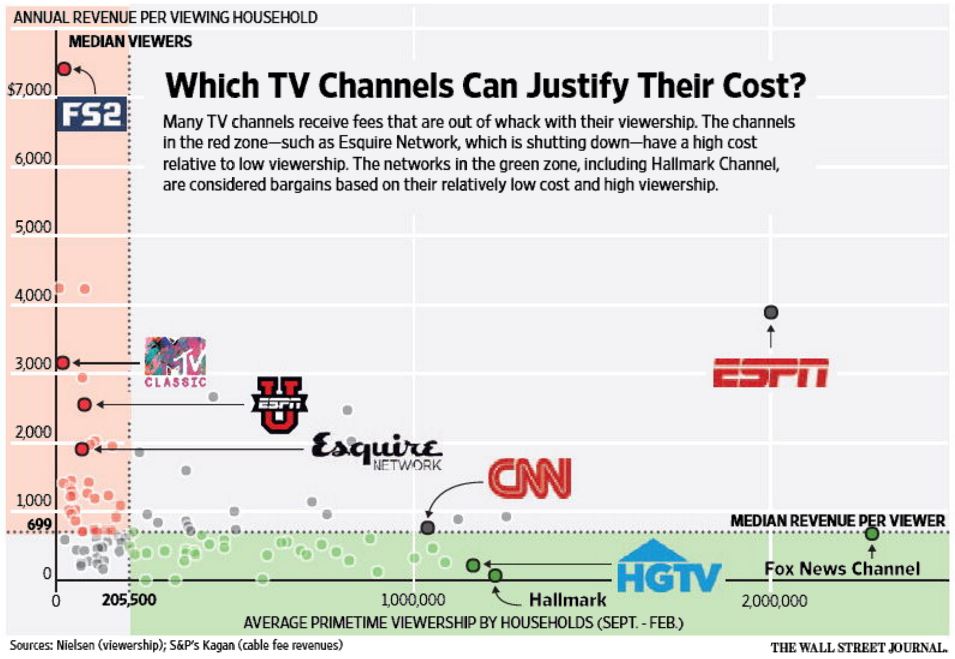
    This report points out how dramatically the cost per viewer varies. with rarely-watched channels like Fox Sports 2 and MTV Classic costing many thousands of dollars per year per viewing household, compared to a median of $699 (and of course the more highly viewed cost outlier, ESPN at $3,885, for its barely over 2 million viewers). Some of the channels are nothing but reruns! What a waste! Some channels have made a killing on this, but it is time the industry got its house in order, and moved on to provide real value at a fair price.

    There is a constant drumbeat of news reports on the decline of pay-TV bundles, and of the difficulties faced by the growing number of skinny bundles.

    When will the industry move beyond all of these silly bundles? We don't need no stinking bundles! What we need is value-based pricing for what customers actually watch.

    [More Updates:

    Friday, July 24, 2015

    The Naples Forum on Service -- Co-Creation of Value, and FairPay as Co-Pricing


    The presentation deck is online:
    Co-Pricing: Co-Creating Customer Value Through Dynamic Value Propositions


    I presented the concepts of FairPay -- in collaboration with two prominent professors of marketing -- to international leaders in an emerging branch of marketing theory at the Naples Forum on Service on June 11th. It was very encouraging to see how the work I have done from a pragmatic, non-academic perspective resonates with those at the leading edge of theory.

    This 5th Naples Forum on Service is dedicated to the areas of Service Science, Service-Dominant Logic (in contrast to traditional Goods-Dominant Logic), and Network Theory, which all relate to emerging recognition that business is really about the "co-creation of value" by consumers, service providers, and other "actors," and that the production and sale of goods (which provide "value-in-use") is just one aspect of this larger concept of service. This has become a focus not only in academia, but in forward-thinking companies like IBM.

    FairPay and Co-Pricing

    My collaboration with Adrian Payne and Pennie Frow began when I contacted Adrian about his pioneering book on Relationship Marketing, with the idea that FairPay was very aligned with his thinking.  That led to discussions of his more recent work on business as co-creation (see Strategic Customer Management by Adrian and Pennie), and how that involves many co-creation activities, including co-pricing.  The theoretical ideas of the co-pricing aspect have not yet been well developed, partly because examples of co-pricing (like value or outcomes-based pricing, and pay what you want) have been limited in applicability relative to other, more studied, aspects of co-creation. 

    We think FairPay has immediate potential to radically change business practices in a way that puts a powerful new form of co-pricing at the forefront of digital content businesses (as described throughout this blog).  Likely initial applications are for digital offerings to consumers in markets such as journalism, e-books, music, video and other content, as well as games and other apps -- both directly between service providers and consumers, and via aggregator/distributor platforms. 

    The slides from our presentation are now available on online, and the abstract is now published in the book of abstracts (page 51).

    Research Directions

    My experience at The Forum reinforced my personal view that FairPay (or a variation on its theme) will not only change a wide swath of business, but will also change the theory of marketing and economics more broadly. My work on FairPay highlights how current practices in pricing fail to correlate well to value-in-use -- and it is value-in-use that is at the core of our markets (whether we recognize it or not). Whether in practice, or just as a thought experiment, thinking more about practical ways to make prices better correlate to value-in-use (and to view that over relationships, not just transactions) will enable us to change how our economy works, and very much for the better for all.

    Collaborators?

    Adrian, Pennie, and I have started on a more formal paper -- and we seek other collaborators who can help us do field trials of FairPay.  This could be an unusual opportunity to do research that not only advances theory, but potentially gains wide recognition from managers and the general public -- by solving urgent problems in finding good business models for the rapidly evolving digital space. (If you have interest in assisting, or suggestions of those who might, please contact me: fairpay [at] teleshuttle [dot] com.)

    Tuesday, May 19, 2015

    An Invisible Handshake for The Digital Wealth of Nations

    It is time to replace the venerable "invisible hand" of Adam Smith with something new and more suited to the strange and challenging nature of digital products. Think instead of an "invisible handshake," that draws producers and consumers into a more cooperative, balanced, and productive relationship. It takes a handshake, because digital is a post-scarcity economics. What matters here is not a balance of demand and finite supply over a population of producers and consumers in a single market -- but a compatible understanding of value between individual pairs of producers and consumers who can act without that producer constraint.

    Let's indulge in some armchair economics to explore some big-picture ideas derived from previous posts.  This draws especially on the prior post -- about my thought experiment of an all-knowing economic demon, that leads to the idea of an invisible handshake, as replacing the invisible hand.

    (This sequel is best understood after reading that.)

    I suggest a kinder, gentler kind of scarcity. Some scarcity is unavoidable, so our solution is not the extreme peer-to-peer "economics of abundance" that some now advocate -- with its limited ability to motivate and sustain serious production of value.  The solution is to re-imagine the socio-economic contract between consumers and the producers that create value for them, to ensure a business model for producers. To maximize the value produced, and the entrepreneurial creativity, we need to motivate organizations that are selfishly driven by a desire for profit. I suggest a new kind of market that rewards the production of intangible stuff, based on a this new socio-economic contract -- neither the limited motivational power of pure altruism, nor the deadweight loss of artificial scarcity. And I suggest that this new economy can evolve from where we are, starting now, with the FairPay architecture outlined in this blog.

    Allocating scarce resources with the invisible hand

    The beauty of the Smith's invisible hand is that it set prices in a way that worked not only at a micro level, but also as a basis for an allocation of resources for society at large. The whole edifice of market economics has been based upon this.

    But now the digital world creates strange new rules, at least in that special portion of our markets.  So then, for the digital domain, what now?
    • We now have freemium and other new models, but do they have any real economic rationale? Do they tell us how to allocate resources in a way that is good and efficient for individual producers and consumers, and across society? 
    • Many producers rely on some form of artificial scarcity as a way to sustain revenues, but put the accent on artificial -- this has no fundamental basis, and creates no balance or fairness in resource allocation,  "The inefficiency associated with artificial scarcity is formally known as a deadweight loss" (Wikipedia article on artificial scarcity),  This may help keep producers solvent, but is fundamentally very hit or miss.
    • We also have the sharing economy, that recognizes digital abundance with its emphasis on collaboration and open-source, but with questions of efficiency, effectiveness, and sustainability at scale. 
    Can we do better?
    The core challenge of the economics of real goods and services is the allocation of limited resources: physical resources, labor, and capital. As Adam Smith said in 1776 in The Wealth of Nations, "...price...is regulated by the proportion between the quantity...brought to market, and the demand of those...willing to pay...." Smith went on to describe how "...he intends only his own gain, and he is in this, as in many other cases, led by an invisible hand to promote an end which was no part of his intention. ...By pursuing his own interest he frequently promotes that of the society more effectually than when he really intends to promote it."  So in the face of scarcity across a market, prices are set by the invisible hand to allocate the supply where it is most wanted. Hayek expanded on Smith to argue that an economy needs prices as the only effective way to signal how resources should be allocated. Debate on how well this works for society continues, but it is widely recognized that it works to build wealth. Is there something to replace that in the digital world?

    An invisible handshake -- allocating share of wallet in a post-scarcity digital economy

    I propose doing allocation in digital markets with an invisible handshake, because the game changes without scarcity of supply. What matters is no longer a dance of a market as a whole at a given point in timebut a dance of each consumer with each producer over time. So what should determine price?
    • Each producer can provide as much as is desired by each consumer. There is no inherent supply constraint -- all that matters is whether the compensation from that consumer satisfies that producer. 
    • Prices for different consumers need not bear any relationship. What does it matter if some pay more and some pay less? Maybe that depends on how much they want to use, what value they get, and how able they are to pay. We are conditioned to think price discrimination is unfair (and sometimes illegal), but that is true only when unilaterally enforced by excess producer power, not if done for reasons acceptable to consumers. 
    The new allocation is not one of supply, but of share of wallet. If each consumer deals with a market full of suppliers for all of their digital products and services, the relevant scarcity is of their wallet -- how much can I spend on all of my digital desires, and how do I split that among my providers?
    • If I negotiate over time, in "dialogs about value," to share the economic surplus of my digital purchases, I am forced to allocate my spending within some digital budget, across all of my suppliers. I can do that any way I wish (to the extent that each supplier agrees to permit).
    • If all consumers do that, then all suppliers get their fair share of all of the wallets for all of their consumers.  They sell as much as their aggregate market population desires, at a sum of prices that is the maximum each market particpant is comfortable allocating.  
    • Given a scarcity of nothing but wallet, what works for each individual pair in the market leads to a result for all pairs that approximates a market-wide optimum.* 
    So, like the invisible hand, the invisible handshakes between each of the individual pairs leads indirectly to a socially beneficial allocation. Like the invisible hand, it refers to an emergent process that by seeking local solutions, leads to globally optimal solutions.
    • The invisible hand applies external market-wide forces (supply vs. demand) to producers and consumers at a given point in time (actually a short interval), It pushes them together to a market price. That pricing process indirectly leads to an approximately optimal distribution of scarce supply resources.
    • The invisible handshake is driven by an agreement between individual consumers and producers to seek a mutually beneficial relationship. That binds them in an emergent process that generates prices over the course of the relationship, and indirectly allocates the wallet share of each participating consumer to demand as much digital wealth as each is willing to pay for -- at prices that work for each of them individually -- to compensate producers for producing as much as each one -- and thus the total population -- values. 
    Thus the handshake is essentially a moral contract between the individual parties. That may sound utopian, but as outlined in the prior post and elsewhere in this blog, it is a moral contract with teeth. There are strong practical incentives to adhere -- and data that can be applied to help verify adherence. (This is the process I call FairPay, as described throughout this blog -- see sidebar.)
    • Digital products and services can be instrumented to generate detailed usage data that correlates to the actual value received.
    • Both parties participate in ongoing dialogs about value, which add subjective insight, but still can be partially validated by the usage data.
    • Based on these dialogs, the producer extends pricing "credit" to the consumer. If the consumer abuses this credit, they get less credit, and lose some or all of the ongoing privileges of the handshake.
    • This process generates consumer reputation ratings for fairness with each producer.  Since a good reputation rating has benefits (much like a credit rating), consumers will seek to maintain it.
    It is this balance of forces -- the subject of the handshake -- that governs the allocation of wallet (in an approximation of the wisdom of the pricing demon).** Different producers can manage their own policies to make their handshakes very strict and demanding, or more loose and forgiving. Different segments of the population may play the game more or less fairly and honestly. But the process will adapt, and find workable relationships for most segments of the market. (And conventional pricing can be applied for those segments that fail the handshake.)

    This provides the basis for a post-scarcity economy, at least for digital -- and perhaps more broadly. The digital goods and services are not scarce, but the willingness of consumers to sustain producers is scarce. The invisible handshake governs an allocation of that willingness to sustain. To/from each consumer according to his willingness and ability to pay. To/from each producer according to their ability to create realized and recognized value.

    As noted in the prior post, this handshake enables a kind of first degree price discrimination. Conventional economics views first degree price discrimination as economically efficient, but not feasible. But what emerges from the handshake is a new kind of first degree price discrimination that is feasible and agreed to by each consumer.

    A kinder, gentler -- and more sustainable -- market

    This enables a broader sense of economic value than is generally addressable in conventional markets.
    • The invisible hand allocates supply and demand for particular items at particular times, thus narrowing consideration, in ways that ignore sustainability and other aspects of social value ("externalities"). Many have sought to broaden the focus of producers with notions of "Creating Shared Value" (CSV) and triple or quadruple bottom lines, that factor in financial, environmental, and social (and other) dimensions.
    • The invisible handshake creates prices that reflect not just financial value, but whatever dimensions of social value the producer-consumer pair want to reflect in the dialogs about value. There is no need for added bottom lines, or separate CSV objectives -- CSV is integral to the handshake
    This handshake is not on a transaction price, but on a continuing relationship. As a result, it fundamentally changes the our economics from working across markets without regard to past or future, to taking a longer term view:
    • It is the lack of past and future that create many of the problems in conventional market economics. We balance supply and demand in the short term, with no direct way to factor in long-term consequences for the individual parties, or society as a whole. Addressing those "externalities" by bolting on special measures (taxes, subsidies, etc.) is artificial and very problematic.
    • With the invisible handshake, the whole focus is on a relationship over time.  Value shares may fluctuate in the short term, but move toward a desirable sharing over the life of the relationship. Sustainability can factor in directly.
    Instead of trying to find a price, we need to find a broader kind of agreement. Instead of agreeing on price. we price out of agreement.  That agreement will naturally vary from person to person and from time to time. The effect of this "invisible handshake" is to draw producers and consumers into a more cooperative, balanced, and productive relationship.

    Now that our digital market has been shattered to bits...

    Moving from here to there will take learning and adjustment by all market participants. But digital has already shattered the market for content to bits -- shouldn't we take advantage of this opportunity?

    Ah, Love! could you and I with Him conspire
    To grasp this sorry Scheme of Things Entire!
    Would not we shatter it to bits--and then
    Re-mold it nearer to the Heart's Desire!

    -- Rubaiyat of Omar Khayyam, Edward FitzGerald translation


    ----

    *There is of course the important case of ad-supported digital services that take no share of wallet. It seems clear that this is not sufficient to support all digital services but it will remain an important contributor. The handshake process can factor in the value of ad viewing as one part of the compensation that offsets any monetary price, and thus takes less share of wallet. In fact, any aspect of value (attention paid to ads, personal information made available for sale, referrals, etc.) can be factored in as credits into these dialogs about value.

    **Of course conventional set prices (or any pricing scheme at all) will also effect some kind of allocation of wallet. But is there any economically sound rationale? -- it is arbitrary, crude, and not personalized (as the pricing demon would suggest), and thus results in significant deadweight losses (notably the value not provided to those who would benefit from and pay fairly for it).